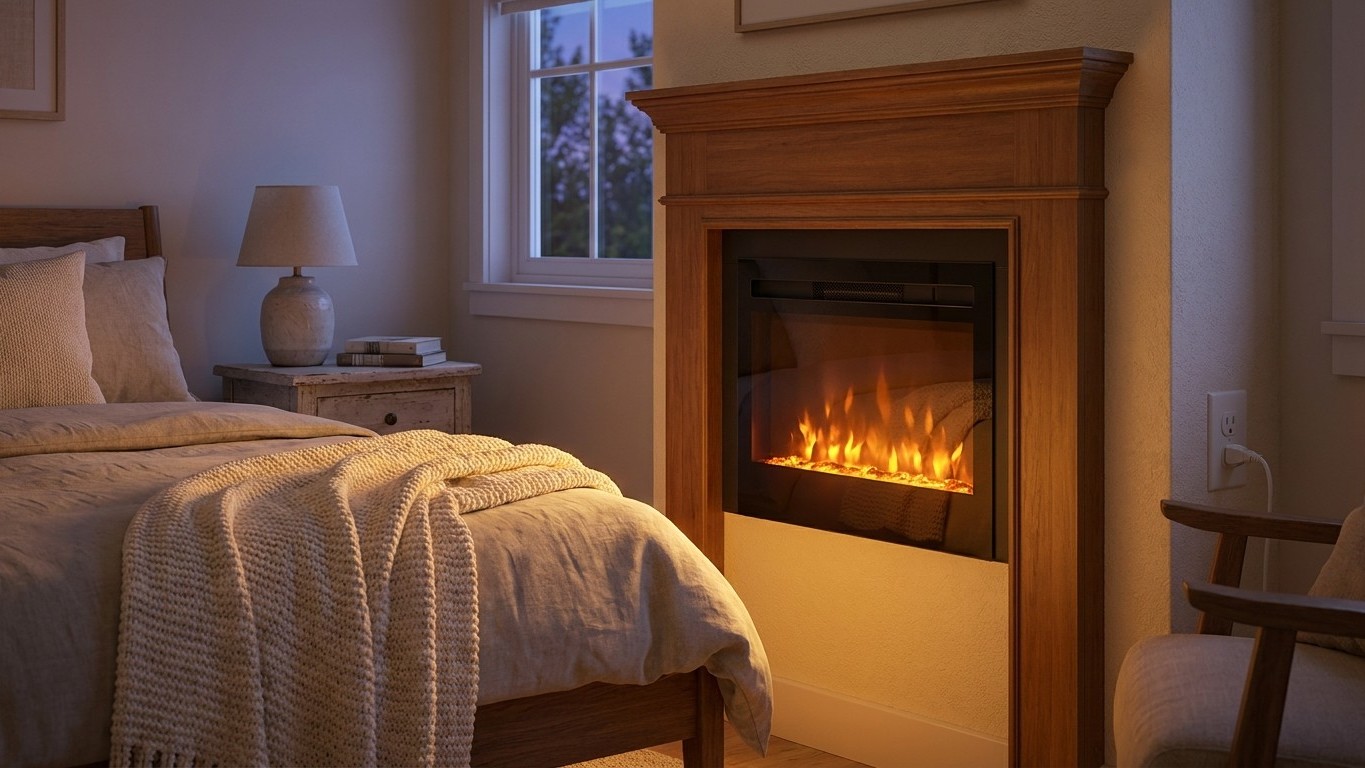

an Electric Fireplace does heat a room, and it heats it the same way any plug-in space heater does: with a resistive element and a fan pushing warm air out. The ceiling is fixed by the outlet it plugs into, not by the size of the unit or the fanciness of the flame display. That ceiling is enough for a bedroom, a den, or a home office. It is not enough for an open-concept living area or a whole house, and knowing that difference before you buy saves a lot of disappointment.
Yes, one room, and here is the ceiling

A plug-in electric fireplace built for a standard North American 120-volt outlet tops out at roughly 1,500 watts. That is not a marketing choice. It is the same ceiling every plug-in space heater on the market bumps against, because it is the practical limit for an appliance drawing power from an ordinary household circuit. Whether the unit costs $150 or $1,500, whether it has a mantel or wall-mounts flush against drywall, the heating element inside almost never exceeds that number.
Converted to heat output, 1,500 watts works out to roughly 5,000 Btu per hour. That number means something concrete: it is close to what a small portable electric heater puts out, and it is a fraction of what a mid-size gas furnace or a wood stove produces. Furnaces and stoves are rated in the tens of thousands of Btu per hour precisely because they are built to heat an entire structure, not a single room.
What 5,000 Btu actually covers
Five thousand Btu per hour is a reasonable amount of supplemental heat for a room in the 200 to 400 square foot range, assuming normal ceiling height and decent insulation. Push that same unit into a great room with vaulted ceilings, or expect it to carry an open floor plan connecting the kitchen, dining, and living areas, and the math falls apart fast. The appliance is not underpowered for its job. The job was just misunderstood.
This is also why manufacturers rarely advertise electric fireplaces as whole-house heating solutions, even when the packaging leans hard on cozy, warm imagery. The honest framing is supplemental: it takes the chill off one space, it lets you turn the thermostat down a degree or two in the room where you’re actually sitting, and it does that job well. Asking it to do more is asking it to break a limit built into the wiring standard behind every outlet in the house, not a limit the manufacturer chose to impose.
The flame is not the heat
Here is the distinction that trips up a lot of first-time buyers: the flame effect and the heat output are two completely separate systems inside the same box. The flickering log bed, the glowing embers, the dancing orange light against the back panel, all of that is produced by LEDs, mirrors, or vapor effects. It is a visual feature, engineered to look convincing, sometimes remarkably so. But it generates no heat on its own.
The warmth comes from a separate resistive heating element paired with a fan that blows air across it and out into the room, the exact same mechanism found in a portable electric heater sitting on a store shelf next to the fireplace display. Turn off the heater function on most units and the flame will keep flickering with zero change in room temperature. That is proof the two systems don’t depend on each other.
Why this matters for expectations
A real wood or gas fire warms you two ways: it heats the surrounding air, and it radiates heat directly at your skin, which is why sitting close to a campfire feels warm even on a cold night with wind blowing past you. An electric fireplace does not radiate heat from its flame display because there is no combustion happening behind that glass. All the warmth you feel comes from convection, air moving across a heating coil and circulating through the room, the same principle as a fan heater with a nicer cabinet around it.
None of this is a knock against the appliance. A convincing flame effect is a completely legitimate reason to buy one, and plenty of owners buy electric fireplaces purely for the ambiance, with heat as a secondary bonus they may not even switch on most nights. The point is simply this: don’t judge the unit’s ability to warm a room by how real the fire looks. Those two things were engineered separately, and they perform separately.
Where it wins
Strip away the heating output comparison for a second, because on other fronts an electric fireplace has real advantages that wood and gas units cannot match. It burns nothing, which means no flue, no chimney, no venting through a wall or roof, and no combustion byproducts to manage. There’s no carbon monoxide risk, because there’s no combustion producing it in the first place. There’s no fuel to store, no propane tank to refill, no cord of wood to stack and season. And because there’s no venting requirement, it can go on essentially any interior wall, including a bedroom, a rental apartment, or a condo where a gas line or chimney installation would be out of the question.
| Feature | Electric fireplace | Wood stove/fireplace | Gas fireplace | Portable heater |
|---|---|---|---|---|
| Heat output | Up to ~5,000 Btu/hr | 10,000-60,000+ Btu/hr | Wide range, often 20,000+ Btu/hr | Comparable to electric fireplace |
| Combustion safety | None needed, no CO risk | Requires flue, CO and ash risk | Requires venting, CO risk if unvented | None needed |
| Installation | Plug in, any wall | Chimney or approved flue required | Gas line or vent kit required | Plug in, portable |
| Running cost | Electricity rate dependent | Wood cost, labor to season/haul | Propane or natural gas rate | Electricity rate dependent |
Running cost is where a lot of buyers get surprised in either direction, and it deserves its own detailed breakdown rather than a quick estimate here. If cost per hour of use is the deciding factor for you, the electric fireplace running cost guide walks through the actual math against your local electricity rate.
Renters get a particular benefit here that owners sometimes overlook. A gas or wood installation is usually a permanent structural change, one a landlord won’t approve and one that doesn’t move with you. An electric fireplace is furniture. It plugs in, it can be mounted with minimal wall damage or simply set on a stand, and it comes with you to the next apartment.
Setting the expectation right
The most common complaint about electric fireplaces traces back to a mismatch, not a defect. Someone buys a wall-mounted unit for the look of a hearth centerpiece, installs it in a large open-plan living room with 10-foot ceilings, and then wonders why the room still feels cool on a January evening. The appliance did exactly what it was built to do. It just wasn’t built for that square footage.
The fix isn’t a better electric fireplace. It’s a clearer question asked before purchase: are you buying this for supplemental warmth in a defined space, or are you buying it for the visual centerpiece, with heat as a nice-to-have? Both are valid reasons to buy one. Confusing them is what leads to disappointment.
A quick gut check before you buy
If the room is small to medium, closed off with a door, and reasonably insulated, expect the heat function to genuinely take the edge off and let you turn down the thermostat in that space. If the room is large, open to adjoining areas, or has high ceilings, plan to enjoy the flame display and treat any warmth as a bonus, not a primary heat source. And if ambiance is the whole point, some buyers deliberately choose units with a stronger flame effect over a stronger heater, simply because they never plan to run the heat function at all.
Safety habits don’t change based on how the fireplace generates its flame, either. The U.S. Fire Administration’s clearance guidance applies here just as it does to a wood stove or a space heater: “Keep anything that can burn at least 3 feet from all heat sources including fireplaces, wood stoves, radiators, space heaters or candles.” An electric unit’s cabinet and vents still get warm during operation, and fabric, paper, or furniture pressed too close can still pose a risk even without an open flame involved.
Common questions
Can an electric fireplace heat an entire house?
No. Its output is capped around 1,500 watts on a standard outlet, roughly 5,000 Btu per hour, which is designed for one room, not a whole structure. A central furnace or heat pump is built for whole-house heating; an electric fireplace is a supplemental appliance.
Does a bigger electric fireplace mean more heat?
Not necessarily. A larger cabinet often means a bigger flame display or a wider mantel surround, not a stronger heating element. Most units, regardless of size, still sit at or below that same 1,500-watt ceiling because of the standard outlet they plug into.
Why does my electric fireplace feel warm but not heat the room?
The area immediately in front of the unit warms quickly because that’s where the fan-driven air is concentrated. A larger or open room dilutes that same amount of heat across more air volume, so the warmth near the unit doesn’t translate into a warmer room overall.
Is it cheaper to run an electric fireplace than central heating?
It depends on your electricity rate and how much of the house you’re trying to heat. Running one unit in a single occupied room while lowering the thermostat elsewhere can save money; running it alongside a fully heated house adds cost without much benefit.