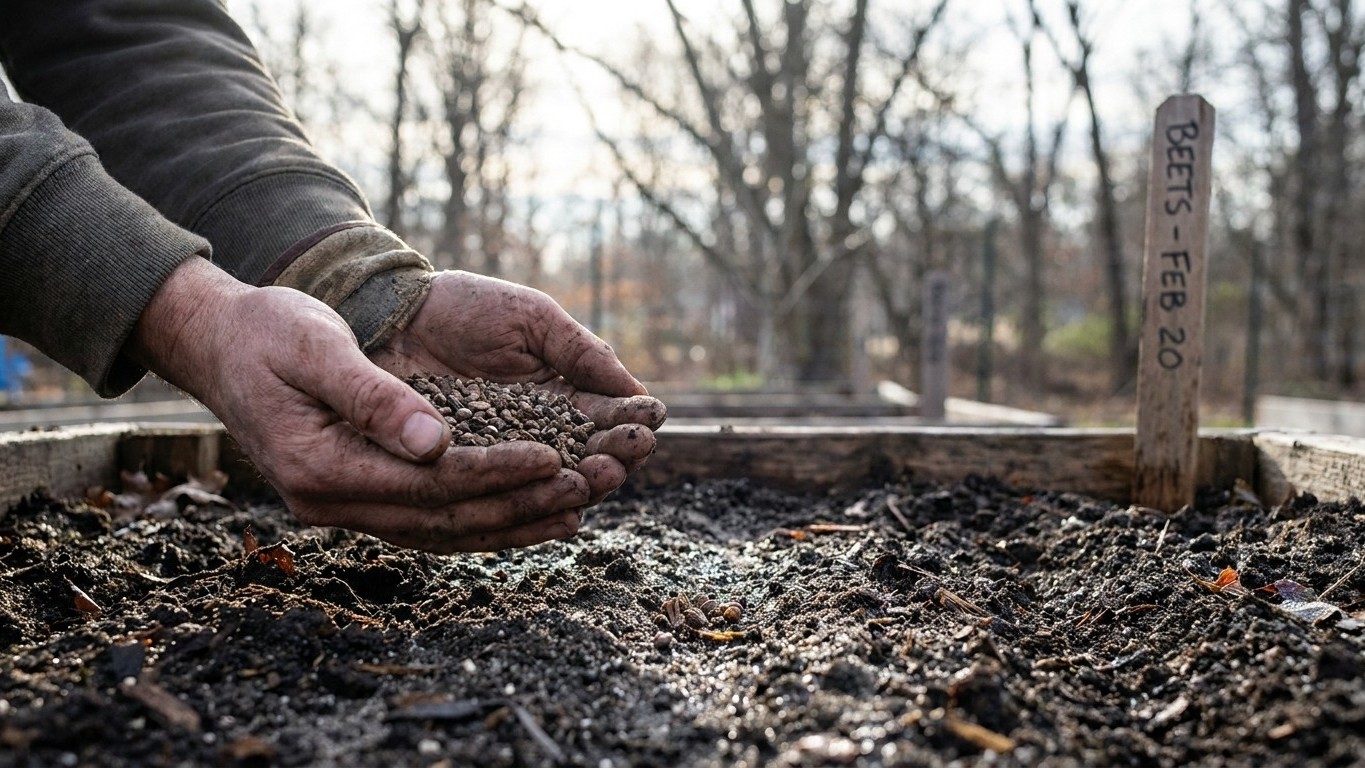

Minnesota gardeners get the best beet roots by sowing seed directly in the ground two to three weeks before the last spring frost, which the Twin Cities area sees between April 17 and April 30. That puts most of the state’s beet seeding into late March through mid-April, with northern counties running two to three weeks tighter on both ends of the season.
The short answer
Minnesota’s official state soil, the Lester series, is an Alfisol formed under forest cover, and USDA records put its surface horizon at 39 percent sand, 24 percent clay, and 37 percent silt, with organic matter around 3.0 percent and a surface pH near 6.6. It’s classified well drained. For a root crop, that’s a mixed bag. Beets do best in soil that’s deep, sandy, and well drained, and the Lester series checks the drainage box and lands close to neutral on pH, which beets tolerate well. But at nearly a quarter clay, it holds more heft than the loose, sandy loam beets prefer, which means a Lester-type bed can crust after rain and resist the kind of easy root push a beet needs to size up smooth.
Organic matter at 3.0 percent is respectable for a mineral soil and gives beets something to work with, though Utah State University Extension recommends amending garden beds with no more than 1 inch of composted organic matter per 100 square feet, since beets don’t need heavy feeding so much as consistent structure and moisture.
Minnesota’s a big state, and the Lester series is a starting point, not a verdict on any one garden. It spans hundreds of soil series, from sandy outwash plains in the center of the state to heavy lake-bed clays in the Red River Valley to the peat and muck of drained wetlands scattered throughout. A backyard bed sitting on fill from a home build, or ground in a river bottom, or a plot on one of those outwash sands, can behave nothing like the representative Lester profile. A soil test remains the only way to know what’s actually under a specific garden.
Heat matters too, though the exact count of 90-degree days for a specific Minnesota city isn’t published in the data behind this page. What’s established is the mechanism: Utah State University Extension notes that once temperatures climb above 85 F and the plant is also short on water, beet roots turn woody and lose the tenderness that makes them worth growing. Minnesota summers bring stretches of that kind of heat, which is one more reason the sowing window matters as much as the soil does. Getting seed in early enough that the plant establishes before the hottest weather arrives gives roots a better shot at staying tender through harvest.
The six weeks that decide it here
Sowing two to three weeks ahead of the last frost date means the first six weeks of a Minnesota beet’s life fall somewhere between late March and early June, depending on where in the state the garden sits and how that particular spring behaves. That window is the one Utah State University Extension flags as the make-or-break period: water stress during those first six weeks is what pushes beets to bolt, sending energy into a flower stalk instead of a root, and once a beet bolts there’s no walking it back.
Minnesota spring doesn’t follow one script from year to year. Some seasons bring a slow, cool, damp thaw where soil stays workable and moisture is steady. Others swing hard, a stretch of raw, wet cold followed abruptly by a run of unseasonably warm, dry days that pull moisture out of a seedbed fast. That swing is exactly the condition that puts young beets at risk, because it’s not steady heat that triggers bolting so much as an interruption in moisture right when the plant is forming its root and deciding whether to flower.
This is a different mechanism from the woodiness problem that shows up later in summer. Early bolting comes from water stress in that first six-week window, while root toughness later comes from heat above 85 F paired with dryness once the plant is established. A gardener who keeps the seedbed evenly moist through April and May has handled the bolting risk; that same gardener still needs to watch soil moisture again once July heat arrives, because it’s a separate threat with a separate fix. Treating both problems as one instruction to “just keep it watered” misses the timing that actually matters here.
Practically, that means the six weeks right after sowing deserve the closest attention of the whole season. A seedbed that dries out and crusts over during a warm early-spring stretch, then gets soaked again days later, delivers exactly the kind of inconsistency that sends beets toward a flower stalk instead of a root.
What goes wrong here
- Crusting after rain in clay-heavy ground. Soils in the Lester range, with roughly a quarter clay content, can seal over after a hard rain and block small beet seedlings from pushing through. Work compost into the top few inches before sowing, and rake the surface into a fine, loose tilth rather than leaving it clumped, so a crust doesn’t form in the first place.
- Bolting from an inconsistent early spring. A wet stretch followed by a dry, mild spell during the first six weeks after sowing is common in Minnesota and is precisely the water-stress pattern that triggers premature flowering. Mulch lightly right after seedlings emerge to buffer soil moisture swings, and water on a set schedule rather than only when the ground looks dry.
- Woody roots from midsummer heat. Once temperatures push past 85 F, any beet that’s also short on water develops a tough, fibrous root instead of a tender one. This shows up weeks after the seedling stage, so it’s easy to miss until harvest. Deep, regular watering through July, plus a layer of mulch to hold soil moisture, keeps roots from toughening up even during a hot stretch.
- Mismatched timing in northern counties. A sowing date built around the Twin Cities’ April 17 to April 30 frost window runs two to three weeks late for much of northern Minnesota. Gardeners north of the Twin Cities metro should shift both the last-frost assumption and the sowing date earlier in the calendar to account for that tighter northern spring.
- Guessing at soil instead of testing it. The Lester series describes a representative Minnesota soil, not any one yard. A bed on sandy outwash drains and dries differently than one on heavy lake-bed clay, and amending as though every garden matches the state soil can mean adding organic matter a sandy bed doesn’t need, or under-amending a heavier one that does. A soil test settles the question instead of assuming it.
Common questions
How many days do beets need from sowing to harvest in Minnesota?
Beets are direct-sown, so the days-to-maturity count starts at seeding, not transplanting. Utah State University Extension puts the range at 60 to 80 days depending on variety, which means a beet sown in mid-April in southern Minnesota is typically ready sometime between mid-June and early July, weather and variety allowing.
Does Minnesota’s state soil mean my garden is automatically well suited to beets?
Not necessarily. The Lester series is well drained and near neutral in pH, both favorable traits, but it’s also heavier in clay than the loose, sandy loam beets prefer, and it represents just one of hundreds of soil series across the state. The only way to know what a specific garden offers is a soil test.
Can I sow beets earlier than the standard two-to-three-week window before last frost?
The two-to-three-week window is built around getting the crop through its critical first six weeks without the water stress that triggers bolting, while still avoiding the worst of the season’s cold. Pushing sowing much earlier than that raises the odds of cold-damaged or slow-germinating seed, particularly in a state where spring soil temperatures can lag well into April.
Is bolting the same problem as woody roots?
No. Bolting happens when water stress during the first six weeks after sowing pushes the plant to flower instead of forming a root, and it’s irreversible once it starts. Woody roots come later, when heat above 85 F combines with dry soil in an already-established plant. They call for the same remedy, consistent moisture, but at two different points in the season.