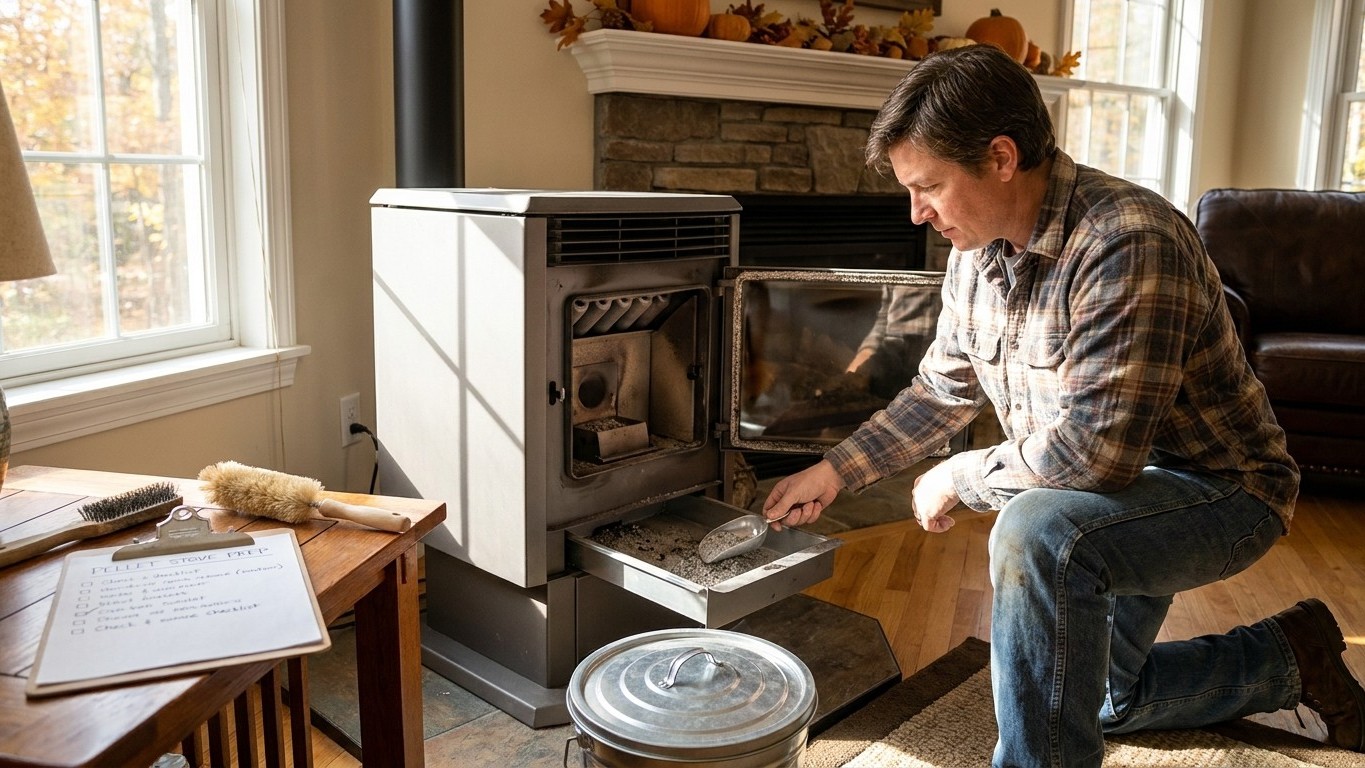

A pellet stove’s first fire of the season goes smoothly when three things line up: the stove is physically clean and clear, the hopper and vent are ready, and you know what normal start-up looks and smells like so you’re not second-guessing every pop and puff. Skip the prep and you’re troubleshooting in the cold. Do the walkthrough first, and the ignition itself takes minutes.
Before you press the button

The gap between a boring first fire and a Saturday morning service call almost always comes down to whatever got left inside the stove back in April. Ash sits, gaskets dry out, and dust settles in places you can’t see from the front glass. None of that fixes itself over a summer of sitting idle.
The six-point walkthrough
- Empty the ash pan completely, even if it looks mostly clean.
- Clean the burn pot and the heat exchanger tubes or fins.
- Look over the door and hopper gaskets for cracking or gaps.
- Check the hopper for last spring’s leftover dust and sawdust residue.
- Confirm the vent terminal outside is clear of nests, leaves, or debris.
- Verify there’s power at the outlet the stove plugs into.
That last point matters more with pellet stoves than with a wood stove or fireplace, because there’s no such thing as a pellet stove that runs on flame alone. As the U.S. EPA puts it, “Pellet stoves need an electrical supply to work because they use motorized components to feed the fire and blow out hot air.” A tripped breaker or an outlet that’s lost power over the summer means the auger won’t feed, the fans won’t run, and the igniter won’t light, no matter how good your pellets are.
Why professionals still get called every fall
Homeowners can handle the ash pan and the visible surfaces, but the internal passages and the vent run are a different job. The U.S. Fire Administration is direct about this: “Maintain heating equipment and chimneys by having them cleaned and inspected each year by a professional.” The EPA says essentially the same thing from the appliance side: “Pellet stoves need to be regularly cleaned to ensure that the stove runs efficiently and safely. Additionally, you should have your stove professionally cleaned at least once a year.” If it’s been a year or more since a technician looked at yours, book that before you load pellets, not after.
While you’re doing the walkthrough, check clearances around the stove too. The U.S. Fire Administration recommends you “keep anything that can burn at least 3 feet from all heat sources including fireplaces, wood stoves, radiators, space heaters or candles.” That includes the laundry basket someone parked next to the stove in June and the stack of firewood that migrated closer over the summer.
What the first hour smells and sounds like
Assuming the walkthrough is done and the hopper is loaded, the first fire of the season is rarely silent or odorless, and that’s expected rather than alarming. Dust that settled on the heat exchanger and inside the firebox over the off-season burns off as the stove reaches temperature, and that produces a noticeably stronger smell for roughly the first hour than you’ll get on day two or day ten.
Fans also tend to run louder during this break-in period. Combustion and convection blowers that have been still for months take a little while to settle into their normal operating rhythm, and a stove that’s still climbing to its set temperature will often cycle the fans harder than it will once it’s holding steady. None of that alone means something’s wrong. If you want a clear line between a normal first-hour smell and one that signals a problem, or between fan noise that’s just breaking in and a bearing that’s failing, the dedicated pellet stove smells and pellet stove noises guides in this series walk through exactly which signs to shrug off and which ones warrant shutting down.
Part of what you’re smelling and hearing traces back to the pellets themselves. The stove works by a simple mechanism: “The pellets are poured into a hopper, which automatically feeds into the stove.” That auger-fed system means the burn quality is only as good as what’s going into the hopper. As the EPA notes, “Pellets can differ significantly in how well they’re made and how well they burn. Lower quality pellets may provide less heat and create a fine dust. Higher quality pellets tend to burn cleaner and produce less ash.” A bag that’s absorbed humidity in a damp garage over the summer will smoke and smell more on that first burn than a bag stored dry, and it’s worth noting which bag you grabbed if the first fire seems smokier than you remember from last season.
Give the stove a full hour before drawing conclusions about how it’s running. Pellet appliances are slower to stabilize than a gas insert, and judging performance five minutes after ignition is judging it before it’s actually settled into its normal cycle.
What to watch on day one
Once that first hour passes, a handful of visual and sensory checks tell you whether the season is off to a normal start or whether something needs attention before you leave the stove running unattended overnight.
A good first fire looks like a steady, consistent flame sitting in the burn pot, not a flame that repeatedly flares and dies back. The glass should be clear, or close to it, after that first hour, rather than coated in a thick black film. And the room itself should smell normal again by then, with no lingering smoke smell drifting from the stove or from anywhere around the venting.
If the flame is erratic instead of steady, the first things to check are pellet quality and the burn pot itself; a partially clogged pot or damp pellets both produce inconsistent flame patterns. If the glass stays heavily sooted well past the first hour, that often points to a damper or air-intake setting that needs adjusting, or to pellets that are burning dirtier than they should. And if you’re still smelling smoke in the room after the break-in period, that’s not a “wait and see” situation. Shut the stove down and don’t restart it until you’ve worked through the specifics on the pellet stove shutdown page, since a persistent smoke smell in the living space usually means the vent path or the door seal isn’t doing its job.
It’s also useful to know what your particular stove is capable of before you decide whether it’s underperforming. The EPA notes that “EPA-certified pellet stoves usually fall into the 70-83% efficiency range, while heating capacities range from 8,000-90,000 Btu per hour.” That’s a wide spread, and where your model falls within it is on the appliance’s own rating label or in the paperwork from your dealer, not something to guess at from the flame alone. With “over 90 different pellet stoves” currently EPA-certified, output and efficiency vary a lot from one unit to the next, so day-one performance should be judged against your stove’s own specs, not against a neighbor’s different model.
Common questions
Is it normal for a pellet stove to smoke on the first fire of the season?
Some smoke and a stronger-than-usual smell during roughly the first hour is expected as dust burns off components that sat idle over the summer. Smoke that continues well past that first hour, or that you can smell inside the room, isn’t normal and warrants a shutdown and inspection.
Why won’t my pellet stove start even though the hopper is full?
Check the power at the outlet first. Because pellet stoves rely on motorized components to feed pellets and move air, a dead outlet or tripped breaker will stop ignition entirely, regardless of how much fuel is loaded.
How long should I run a pellet stove before judging whether it’s working right?
Give it a full hour. Fans and flame both take time to settle after months of sitting unused, and glass clarity and smell are more reliable indicators after that first hour than in the opening minutes.
Do I need a professional cleaning before the first fire even if I clean the stove myself?
A homeowner can handle the ash pan, burn pot, and visible surfaces, but internal passages and the venting system are best handled by a professional at least once a year, as both the EPA and the U.S. Fire Administration recommend for safe, efficient operation.