
Most of What a Pellet Stove does is loud on purpose. The auger clicks, the fans hum, the hopper rattles as it feeds itself: none of that means trouble. What actually matters is when a sound changes character. Grinding instead of humming. Scraping that comes and goes with the feed rate. Those are the ones worth writing down and mentioning to a technician, not the background hum you hear every evening.
The sounds it makes when it is well

A pellet stove running normally sounds like a small, busy machine, because it is one. U.S. EPA notes that “pellet stoves need an electrical supply to work because they use motorized components to feed the fire and blow out hot air.” Every one of those motorized components has its own voice, and together they make up the baseline soundtrack of a healthy stove.
What each sound is actually doing
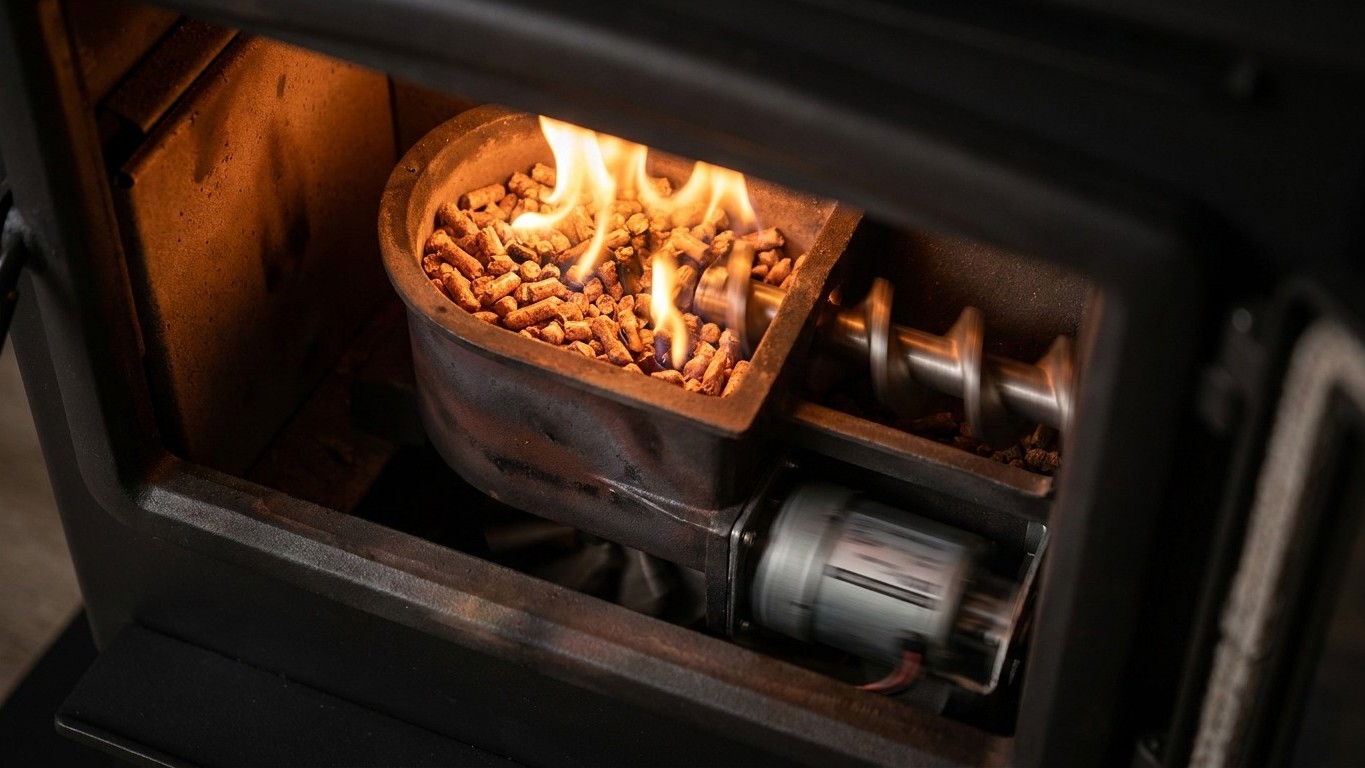
The tick-tick-tick you hear every few minutes is pellets dropping from the hopper into the burn pot. As EPA describes it, “the pellets are poured into a hopper, which automatically feeds into the stove,” and that transfer happens through an auger, a slow screw-like motor that clicks or clacks as it turns. Underneath that, there’s a steady mechanical hum from the combustion blower, the fan that pulls outside air in to feed the fire and pushes exhaust out through the vent. Layered on top is a louder, breezier sound from the convection or room blower, the fan responsible for pushing heated air out into your living space. That one tends to rise and fall in pitch as the stove adjusts its heat output, which is normal and often adjustable from the control panel.
Why it’s louder than a wood stove, and why that’s the deal
People who’ve lived with a wood stove for years are sometimes startled by how much noisier a pellet stove is. That’s not a defect, it’s the mechanism. A wood stove needs nothing but air and gravity. A pellet stove needs motors to load fuel, motors to push air, and often a small circuit board managing both, which is precisely why it can maintain a steady burn without you tending it every hour. EPA-certified pellet stoves “usually fall into the 70-83% efficiency range, while heating capacities range from 8,000-90,000 Btu per hour,” and that consistency, unlike the rise-and-fall of a wood fire, is a direct product of those working parts. EPA also notes it “currently certifies over 90 different pellet stoves,” and sound output varies across that lineup: fan design, Insulation around the blower housing, and cabinet construction all shift how much of that mechanical hum reaches the room. If you’re shopping, quiet is a real spec worth asking a dealer about, not an afterthought.
The sounds that mean something
Some noises are the stove telling you a part is wearing out, not that anything is broken yet. None of these are emergencies by themselves, but they’re worth reporting to whoever services your stove, and worth writing down with a rough sense of when they started.
- A grinding or squealing blower: usually points to a bearing wearing down in either the combustion blower or the convection fan. Bearings are a known wear part on any motor that runs for hundreds of hours a season, and a squeal that gets sharper over weeks is the classic sign one needs replacing.
- A rhythmic scraping in the auger: often means the auger motor or the auger tube itself has debris, a bent component, or early wear at the point where the screw feed meets its housing. It tends to repeat in time with the feed cycle rather than being constant.
- A rattle that changes with feed rate: sometimes traced back to the fuel itself. EPA points out that “pellets can differ significantly in how well they’re made and how well they burn. Lower quality pellets may provide less heat and create a fine dust.” Inconsistent pellet size or excess fines can change how the auger feeds and how it sounds doing it, so a rattle that shows up right after switching pellet brands is worth noting alongside any mechanical explanation.
- A whistle that appears when the door is closed: often a sign of a door gasket losing its seal, letting air whistle through a narrow gap under pressure from the combustion blower. It’s a wear part, not a structural issue, and one of the more routine fixes a technician handles.
None of these are things to diagnose alone with certainty. The value of noticing them early is timing: a bearing caught early is a simple swap, a bearing ignored for a full season can take a motor with it. That’s part of why the U.S. Fire Administration recommends that homeowners “maintain heating equipment and chimneys by having them cleaned and inspected each year by a professional,” a visit that catches wear-part issues like these before they become bigger repairs.
Living with it
Noise on its own isn’t usually a safety problem, but it’s rarely random either, and there’s more you can do about it than you might expect. The single biggest factor is one people underestimate: how clean the stove actually is inside.
A dirty fan is a loud fan
Ash and fine dust build up on fan blades and around the blower housing over a burning season, and that buildup throws blades slightly off balance, turning a quiet hum into a rattle or a whine. EPA is direct about this: “pellet stoves need to be regularly cleaned to ensure that the stove runs efficiently and safely,” adding that owners “should have your stove professionally cleaned at least once a year.” A stove that gets that annual service, plus routine ash removal between visits, tends to run noticeably quieter than one left to accumulate dust all winter. If you haven’t looked at your own cleaning routine lately, it’s worth reading through a dedicated pellet stove cleaning guide before assuming a noise is mechanical.
What else actually changes the sound
Floor and placement matter more than most owners expect. A stove sitting on a solid, level hearth pad transmits far less vibration than one on a springy or uneven floor, where every motor cycle turns into a low resonant buzz through the boards. If your stove seems louder than it used to be and nothing inside has changed, check that it’s still sitting level, since flooring shifts slightly over time in most homes. Fan setting is the other lever fully in your control: most stoves let you run the convection blower on a lower setting, trading a bit of heat throw across the room for a noticeably quieter operation, which is a reasonable trade in a small space or a bedroom nearby. And while it doesn’t affect noise, it’s worth keeping the U.S. Fire Administration’s basic clearance rule in mind whenever you’re near the stove doing maintenance: “keep anything that can burn at least 3 feet from all heat sources including fireplaces, wood stoves, radiators, space heaters or candles.” Between annual professional service, a level solid floor, and a sensible fan setting, most of the noise that bothers people is manageable without replacing anything.
Common questions
Is a pellet stove supposed to be this loud all the time?
Yes, in the sense that the hum from the blowers and the periodic click of the auger run continuously whenever the stove is heating. The volume can usually be lowered with the fan setting, but the sound itself, unlike a sudden grind or squeal, doesn’t come and go.
Can I fix a noisy fan myself?
Cleaning built-up ash off accessible fan blades is something many owners do as routine maintenance. Bearing replacement, motor issues, or anything involving disassembling the blower housing is better left to the professional visit EPA and the U.S. Fire Administration both recommend on an annual basis.
Does pellet quality really affect how the stove sounds?
It can. EPA notes that pellet quality varies in how well pellets are made and how they burn, and inconsistent pellets can change how smoothly the auger feeds, which sometimes shows up as a rattle tied to the feed cycle rather than a constant motor noise.
Should a new noise stop me from using the stove?
A grinding, squealing, or scraping noise is worth noting and mentioning at your next service call rather than ignoring for a full season. It doesn’t necessarily mean you need to shut the stove down immediately, but it does mean the issue is worth tracking rather than tuning out.