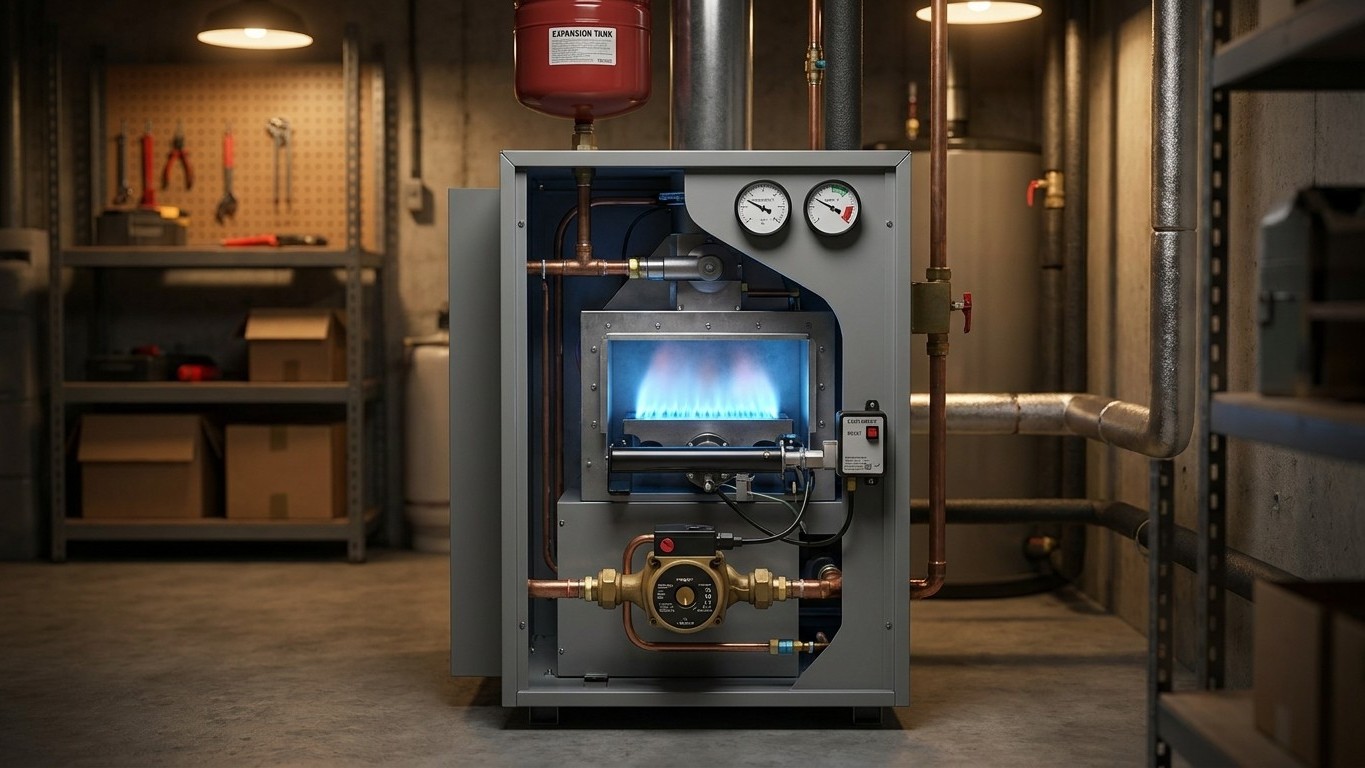

A home boiler isn’t the whole heating system, it’s the box that makes the hot water. Radiators, baseboard, and the pipe loops that carry heat around the house are separate parts already covered elsewhere on this site. This page stays inside the appliance itself: the burner or element, the pump, the pressure vessel, and the safety controls that decide whether that water gets made, moved, and shut off correctly.
The generator, not the radiators
Everything downstream of the boiler, meaning the radiators, the baseboard convectors, the manifolds and zone piping, gets its own coverage on this site because those parts behave differently from the appliance that feeds them. This page and its companions are about the machine sitting in the utility closet or basement corner: the combustion chamber, the circulator pump, the expansion tank, the pressure gauge, and the low-water cutoff or similar safety device.
Four questions come up constantly about that box, and each has its own dedicated page rather than a paragraph here. What type of boiler is even in the house, gas, oil, electric, or a modern condensing unit, and what does that mean for fuel bills and venting? How is a replacement boiler sized, and why does “bigger” almost always mean worse rather than better? What actually fails first, and in what order should a homeowner suspect trouble? And what does a once-a-year service visit actually check, versus what a homeowner can monitor between visits?
The reason to split it this way is mechanical, not editorial. A pressure problem, a stuck valve, and a noisy heat exchanger all live inside the same enclosure but have almost nothing in common in terms of cause or fix. Lumping them into one long page makes the material harder to search and harder to trust. Splitting them lets each fault get the depth it needs: how to recognize it, what makes it worse, and when it’s a five-minute reset versus a call to a licensed technician.
One distinction worth settling here, since it changes which pages apply: an electric boiler burns nothing. It heats water with a resistance element, the way an electric water heater does, and it has no flue, no draft, and no combustion byproducts. Every fossil-fuel boiler, gas or oil, does burn fuel, and that single fact pulls in an entire category of safety information, starting with carbon monoxide, that simply doesn’t apply to the electric version. Knowing which category a given house has is step one before any of the sizing or fault pages make sense.
Choosing and sizing one
Fuel type is the first fork in the road, and it’s a longer conversation than it looks. Gas, oil, propane, and electric boilers differ in upfront cost, running cost, venting requirements, and how they fail, and the page on boiler fuel types walks through the tradeoffs by region and by house type rather than trying to name a single “best” choice.
Condensing or non-condensing is the second fork, and it hinges on AFUE, the Annual Fuel Utilization Efficiency rating. AFUE is the ratio of a boiler’s annual heat output to the total annual fossil fuel energy it consumes; a boiler rated at 90% AFUE turns 90% of the fuel’s energy into heat inside the house, while the remaining 10% leaves up the flue and through other losses. The U.S. Department of Energy’s Federal Energy Management Program notes that an ENERGY STAR-qualified residential gas boiler meets 0.90 AFUE, and FEMP’s own worked example for federal purchasers compares models at 0.84, 0.90, and 0.97 AFUE to illustrate the spread on the market.
| AFUE rating | What it means |
|---|---|
| 0.84 | Typical older or non-condensing unit; more heat lost up the flue |
| 0.90 | Minimum for ENERGY STAR qualification per FEMP guidance |
| 0.97 | High-efficiency condensing boiler, near the top of the current range |
That FEMP comparison is written specifically for federal agencies deciding what to buy in bulk, and its cost-effectiveness math assumes federal procurement pricing and federal facility budgets. It’s a useful reference for understanding the AFUE spread, but its dollar thresholds aren’t advice for a household weighing one replacement unit, and this site doesn’t repeat them as if they were. The dedicated page on condensing versus non-condensing boilers covers what actually changes for a homeowner: venting material, condensate drainage, and how climate affects the payoff.
Sizing is where most installation mistakes happen, and it isn’t about square footage alone. An oversized boiler short-cycles, wearing out its components faster and rarely running long enough to reach steady efficiency, while an undersized one can’t keep up on the coldest night of the year. The proper method involves a heat loss calculation specific to the house, not a rule of thumb based on the old unit’s rating, and that calculation is the subject of the boiler sizing page.
What goes wrong, in order of frequency
Low or fluctuating system pressure is the complaint that shows up most often, usually as a cold radiator or an error light rather than an obvious leak. It’s often the simplest fix and the one homeowners can check themselves once they know where to look, and the full walkthrough lives on the boiler pressure page.
A failed or seizing circulator pump comes next. This is the small motor that pushes hot water through the loops, and when it stops or slows, the boiler may fire perfectly while the house stays cold because the heat never leaves the mechanical room. Diagnosing a bad circulator versus a bad control signal is covered on the circulator pump page.
Zone valves and diverter valves fail often enough to rank third and fourth, and they’re frequently confused with each other. A stuck zone valve heats one part of the house while leaving another cold; a stuck diverter valve, found on combi boilers that split output between space heating and domestic hot water, can leave a house with hot water but no heat, or the reverse. Each fault has distinct symptoms detailed on the zone valve and diverter valve pages.
Kettling, a rumbling or popping noise from the heat exchanger, points to mineral scale or sediment buildup restricting water flow inside the boiler, and it tends to get worse rather than resolve on its own. The mechanism and what a technician does about it is explained on the kettling page.
Leaks round out the list, ranging from a weeping pressure relief valve to a cracked heat exchanger, and the significance ranges from minor to system-ending. The boiler leaks page separates the leaks worth watching from the ones that mean immediate shutdown.
A separate but related issue is control logic rather than hardware. A U.S. Department of Energy study on hydronic heating in multifamily buildings, “Optimizing Hydronic Heating for Comfort and Performance,” found that “control settings are often best guesses and are not typically optimized.” That research covers central hydronic systems in multifamily buildings, where the study measured an average gas savings of 11% and a maximum of 33% from retuning controls; those figures belong to that building type and don’t transfer directly to a single-family home, but the underlying point, that a boiler’s controls are frequently left on factory or installer defaults nobody revisited, holds for houses too.
Keeping it alive
A once-a-year professional visit is the single habit that prevents most of the failures listed above from becoming emergencies. The U.S. Fire Administration puts it directly: “Maintain heating equipment and chimneys by having them cleaned and inspected each year by a professional.” That single sentence covers combustion tuning, flue and venting checks, and a look at the safety devices that most homeowners never touch between visits, including the low-water cutoff, the pressure relief valve, and the flame or ignition sensor.
Between those annual visits, the homeowner’s job is mostly watching, not fixing. Pressure gauge, visible corrosion, unusual sounds, and short-cycling are all things a person can notice on a Tuesday and flag before they become a no-heat call on a Saturday in January. None of that replaces the technician’s inspection; it just shortens the gap between a small problem starting and someone qualified addressing it.
Because gas and oil boilers burn fuel, they belong fully under this site’s carbon monoxide guidance: CO is colorless and odorless, and a functioning CO alarm is required in a home with a fuel-burning appliance, full stop. That risk doesn’t apply to an electric boiler, which has no combustion and no flue, but it applies to every gas and oil unit regardless of age or maintenance history. For exact detector placement, testing intervals, and replacement timing, the dedicated carbon monoxide pages on this site carry that detail rather than this one.
For anything involving pressure settings, temperature setpoints, or the specific code requirements in a given jurisdiction, the appliance’s own data plate and installation manual are the actual authority, backed by the local code office for anything the manual doesn’t settle. No number quoted secondhand should override what’s printed on the unit itself.
Common questions
Is a boiler the same thing as a furnace?
No. A boiler heats water that then moves through radiators, baseboard, or radiant floor loops, while a furnace heats air that’s pushed through ducts. They use different fuels sometimes, different distribution systems always, and they fail in different ways.
How long does a home boiler typically stay in service before replacement becomes the better option?
That depends heavily on fuel type, water quality, maintenance history, and the specific model, and it’s not a figure this page assigns a single number to. A technician who has inspected the unit and knows its condition, corrosion level, and repair history is better positioned to give that estimate than a general guideline.
Can a homeowner safely repressurize a boiler without a technician?
Many systems have a filling loop or valve designed for exactly this, and the process is often described in the owner’s manual. The dedicated pressure page on this site walks through the steps and the warning signs that mean it’s time to stop and call a professional instead.
Does an electric boiler need a carbon monoxide alarm?
Not because of the boiler itself, since it burns nothing and produces no combustion byproducts. If the same home has any other fuel-burning appliance, a gas water heater, a gas range, a fireplace, the CO alarm requirement still applies because of that appliance, not the electric boiler.