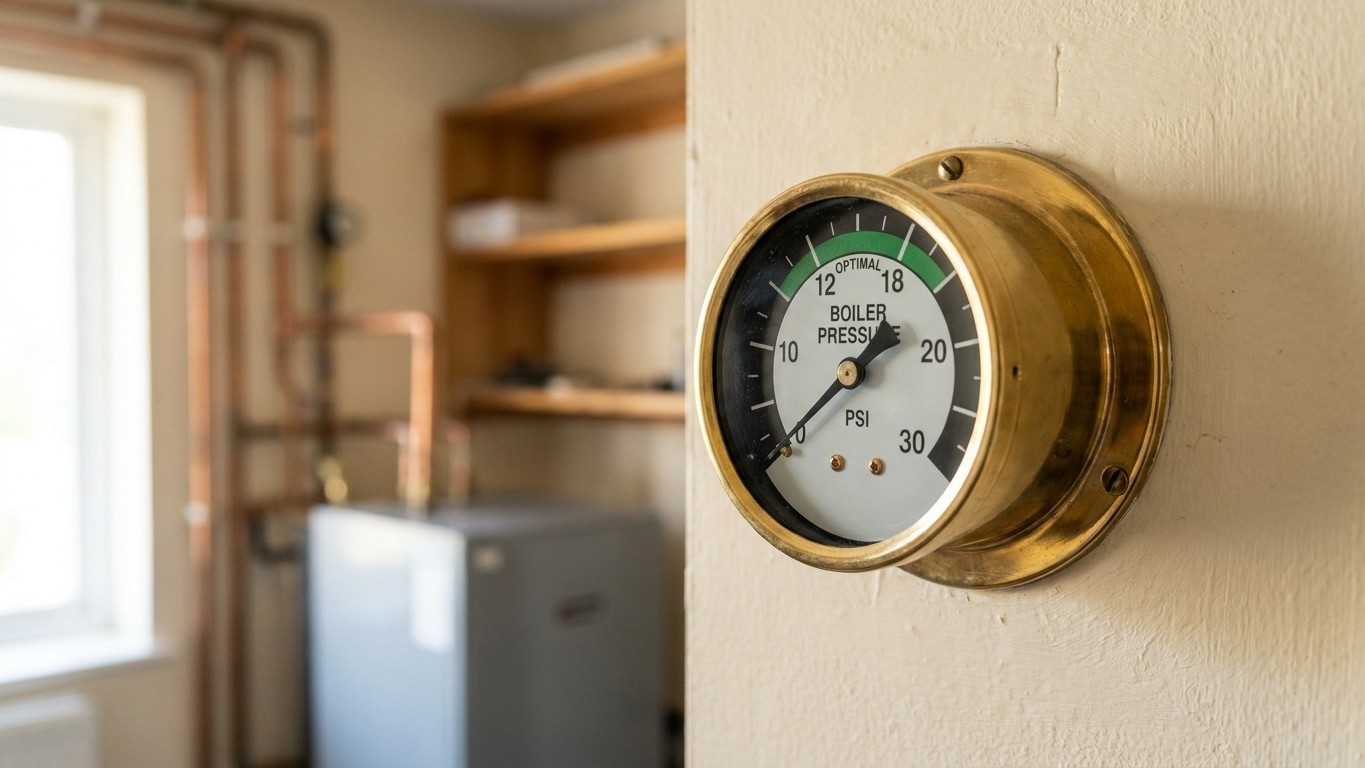

A boiler’s pressure gauge is not a power gauge. It tells you whether the closed loop of water that carries heat around your home is still full, or whether it has lost fluid somewhere along the way. When the needle drops, the system is short of water. When it climbs and stays up, something is stopping the system from handling the water’s natural expansion as it heats. Neither reading tells you the boiler is “working harder” or “working less”, it tells you whether the plumbing itself is sound.
Why a closed loop needs pressure at all
A hydronic heating system is sealed. The same water circulates through the boiler, the pipes, and every radiator or baseboard unit in the house, over and over, without ever draining out or refilling under normal operation. For that water to reach the radiator on the top floor, or the baseboard at the far end of a ranch-style addition, the whole loop has to be held at a pressure above atmospheric. Without that push, water finds the easiest path and air finds its way into the gaps, and a system with air pockets circulates unevenly, gurgles, and heats some rooms while leaving others lukewarm.
That is the whole reason the gauge exists. It is a proxy for fullness. A correctly pressurized system has enough water in it, under enough force, to fill every branch of the pipework including the highest point in the house. Drop below that threshold and the top-floor radiator is often the first thing to go cold, simply because it is the hardest point for water to reach once pressure falls off.
Where the target number actually lives
Every boiler has its own correct operating range, and that range is not universal. It depends on the height of the building, the layout of the piping, and the specific expansion tank and fill valve installed. Manufacturers mark the acceptable range directly on the gauge face, usually as a colored band, or spell it out in the installation manual. That is the number to use, not a figure remembered from a different house or a different system. If the gauge has no marked band and the manual is missing, a licensed heating technician can confirm the correct range in a few minutes during a routine visit.
A related point often gets missed: the gauge reading changes with temperature. Cold, a system typically sits at the low end of its band. As it heats, the water expands and the reading rises somewhat before settling. That rise is normal and expected, it is only a rise that keeps climbing past the top of the marked band, or that never comes back down, that signals a problem.
Pressure that falls
A falling gauge is the fault most homeowners run into, and the underlying story is always the same: the system is losing water. A sealed loop does not lose pressure on its own. Water is going somewhere, whether that is a slow drip nobody has noticed yet or a valve doing exactly what it was designed to do.
The usual suspects, roughly in order of how often they turn up:
- A radiator valve or connection weeping slowly, often leaving a faint tide mark or a patch of corrosion on the floor beneath it.
- A pipe joint or fitting that has loosened or corroded, sometimes hidden behind a wall or under flooring.
- The pressure relief valve discharging, which happens when pressure has gone too high elsewhere in the system and the valve is doing its job by venting the excess.
- A failed expansion tank that can no longer absorb the water’s normal expansion, pushing the system to shed pressure through the relief valve instead.
The temptation, once a boiler starts running low, is to top up the system and move on. That treats the symptom without touching the cause. Every refill introduces fresh water, and fresh water carries dissolved oxygen that reacts with the iron and steel inside the boiler and radiators. A system topped up once a year is a minor inconvenience. A system topped up every few weeks is being fed a steady diet of corrosive fresh water, and that shortens the life of the boiler and the pipework it depends on. A gauge that keeps sliding back down is worth tracking down, not just refilling.
If the loss traces back to water actually appearing somewhere, on a valve, a joint, or pooling near the boiler itself, that is a distinct problem covered in detail on this site’s guide to a leaking boiler. If the loss instead seems tied to a tank that no longer holds air the way it should, the expansion tank guide walks through how that component fails and what a failure looks like from the outside.
Pressure that climbs
Rising pressure gets far less attention than falling pressure, mostly because it feels less alarming. A gauge that creeps up as the heating runs, and then fails to settle back down once the system cools, is actually one of the more telling faults a hydronic system can show, because it usually points to one of two specific components rather than a vague list of possibilities.
The first is the expansion tank. That tank holds a cushion of air, separated from the system water by a diaphragm, and that air cushion is what absorbs the water’s expansion as it heats. When the tank loses its air charge, whether through a slow diaphragm failure or a valve that has let the charge bleed out over years, the system water has nowhere to expand into. Pressure has to go up instead, and it keeps climbing every time the heat runs.
The second candidate is the automatic filling valve, the small device that connects the sealed heating loop to the household water supply. If that valve is not seating properly, it passes a trickle of mains water into the system continuously, and the system slowly overfills. Combined with normal thermal expansion, that trickle pushes pressure past the top of the marked band.
Where a climbing reading ends up
Either fault leads to the same place: the pressure relief valve. That valve exists precisely to protect the boiler and the pipework from overpressure, and it will open and discharge water once the system exceeds its rated limit, regardless of why the pressure got there. A relief valve doing its job occasionally under a genuine spike is normal. A relief valve that starts weeping regularly is a different matter, because once the seat has been forced open and worn even slightly, it rarely reseals cleanly on its own. A valve in that state tends to keep dripping at lower and lower pressures, which is often mistaken for a new fault when it is really the same worn valve continuing to leak. At that point the fix is addressing whatever caused the overpressure in the first place, whether that is a spent expansion tank or a filling valve that needs replacing, and having a technician confirm whether the relief valve itself still seals.
Common questions
Does boiler pressure affect efficiency, or AFUE rating?
Not directly. AFUE measures the ratio of a boiler’s annual heat output to the total fuel energy it consumes; an AFUE of 90% means 90% of the fuel’s energy becomes usable heat in the home while the remainder leaves through the flue and other losses. That rating is a property of the appliance’s combustion and heat-exchanger design, tested under standard conditions, not a reading that moves with system water pressure. The U.S. Department of Energy’s Federal Energy Management Program, which writes purchasing guidance for federal buyers, notes that an ENERGY STAR-qualified residential gas boiler meets 0.90 AFUE, and its worked examples compare models at 0.84, 0.90, and 0.97 AFUE. That guidance is built around federal procurement decisions, not a homeowner’s replacement budget, so its cost thresholds shouldn’t be read as a recommendation for a household purchase.
Why do control settings matter as much as pressure?
Pressure keeps the loop full and functional, but how the system is controlled determines whether that water is used well. A U.S. Department of Energy study on optimizing hydronic heating, covering multifamily buildings with central hydronic systems, found that “control settings are often best guesses and are not typically optimized.” That study measured an average gas savings of 11%, with a maximum of 33%, from correcting those settings, figures specific to multifamily central systems and not something to expect from a single-family house. The broader point still applies at any scale: a correctly pressurized system that is poorly controlled will still underperform.
Does a pressure problem create a carbon monoxide risk?
A fuel-burning boiler always carries the standard combustion risks of any gas or oil appliance, and carbon monoxide is colorless and odorless, which is why a working CO alarm in the home is non-negotiable regardless of what the pressure gauge shows. Pressure faults themselves are a plumbing issue, not a combustion issue, and an electric boiler burns no fuel and produces no combustion byproducts at all. Whether a system’s pressure trouble is linked to any venting or combustion concern is something a licensed technician should check during service, alongside the CO alarm itself.
How often should the system be checked, and does that include pressure?
The U.S. Fire Administration advises homeowners to “maintain heating equipment and chimneys by having them cleaned and inspected each year by a professional.” An annual visit is also the simplest way to catch a slow pressure drift before it becomes a cold radiator in January, since a technician checking the system will typically verify the gauge against its marked range, inspect the expansion tank, and confirm the filling valve and relief valve are both behaving as they should.