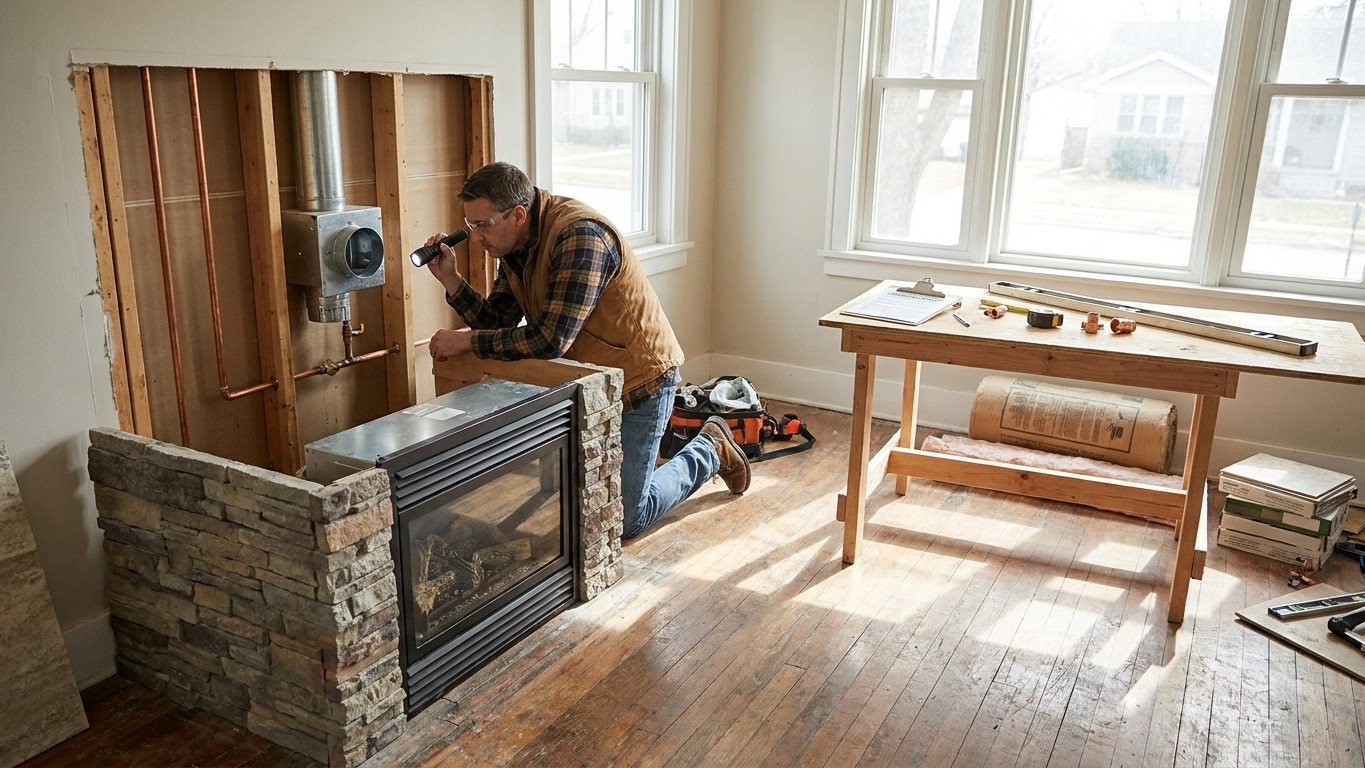

A gas fireplace installation is rarely just “hook up the fireplace.” It’s a small construction project that touches gas supply, venting, framing, and often electrical work, then gets signed off by a local inspector before anyone lights the pilot. Knowing that scope upfront explains why two contractor quotes for the “same” fireplace can land thousands of dollars apart, and why the cheapest bid sometimes leaves out an entire trade.
Four trades in one job

Strip away the marketing and a gas fireplace installation breaks into four distinct scopes of work, and a given house rarely starts with all four already in place. The first is gas supply: running or extending a gas line from the meter or an existing branch to the appliance location, sized and pressure-tested by whoever holds the gas-fitting license in that trade. A house with a gas furnace or gas water heater nearby often has an easier tie-in point than one that’s all-electric, where the line has to be run from scratch.
The second scope is venting, and this is where the appliance type changes everything. A vented unit needs a flue running to the roof or an existing chimney; a direct-vent unit needs a sealed wall terminal or a shorter run through an exterior wall; a vent-free unit needs no venting at all, because it releases combustion products, water vapor included, straight into the room. A house with an existing masonry fireplace may already have a usable flue for a vented insert. A house with no chimney and an exterior wall nearby is a natural candidate for direct-vent. Neither fact decides the choice by itself, but it explains why one contractor quotes a simple hookup and another quotes a wall penetration and exterior terminal.
Framing, finish, and power
Third is framing and finish work: building or modifying the surround, running a mantel, patching drywall, tiling a hearth face, whatever the appliance and the room call for. This is carpentry and finish labor, not gas or electrical, and it’s often the scope that gets quoted separately or skipped entirely by an installer who only does the mechanical hookup. Fourth is electrical, needed whenever the unit has a blower to circulate heat or an electronic ignition system instead of a standing pilot. A house with an existing outlet near the fireplace location skips this step; a house without one needs a new circuit run, which is its own licensed trade.
A homeowner who assumes “installation” means one visit from one person is usually the one who ends up with a change order midway through the job.
Permits and inspection
Gas appliances are permitted and inspected work in most jurisdictions, and this is the step homeowners are most tempted to skip, and most likely to regret later. A gas line, a vent terminal penetrating a wall or roof, and sometimes an added electrical circuit are exactly the kind of work that local building departments track, because each one carries a real safety consequence if done wrong. The local code office is the authority on what’s required in that specific jurisdiction, and requirements differ enough from one town to the next that no single national rule covers every case. Anyone installing a gas fireplace should call that office, or have their contractor pull the permit, before work starts rather than after.
Skipping the permit doesn’t just risk a fine. It surfaces at the worst possible moment: a home sale. Buyers’ inspectors routinely flag gas appliances with no permit record and no visible inspection sticker, and that finding can stall a closing or force a seller to open up finished work to prove it was done correctly. Homeowner’s insurance is the other place unpermitted gas work bites back. A claim tied to a fire or a gas leak on unpermitted work can be denied or delayed while the insurer investigates who did the installation and whether it was ever inspected, turning what should be a straightforward claim into a dispute.
What an inspector is actually checking
An inspection exists because combustion appliances fail in ways that aren’t visible to an untrained eye: an under-sized gas line, a vent terminal placed too close to a window or an air intake, a connection that wasn’t pressure-tested. None of that shows up when the fireplace is simply switched on and appears to work. The inspector’s job is to catch it before the appliance is buried behind drywall and trim, which is also why permitted work happens in a specific order, with certain steps needing to pass inspection before the finish carpentry closes them up.
Carbon monoxide is colorless and odorless, so a working alarm is the only way a household will actually detect it, regardless of whether the appliance passed inspection on day one. That’s a separate layer from the permit process, not a substitute for it, and it matters for any gas fireplace, vented or not, for as long as the appliance is in the house.
What to ask before signing
Two contractors can quote the “same” gas fireplace installation and land far apart, and the gap almost always comes down to what each one is actually planning to install and include. Before signing anything, it’s worth asking which specific appliance and which venting type the quote is based on, since a vented, a direct-vent, and a vent-free unit are not interchangeable and each changes the labor scope described above. That decision, vented versus direct-vent versus vent-free, comes before the quote, not after, and it’s worth working through on its own before comparing prices.
Vent-free units in particular deserve a specific conversation, because they have no outside vent for combustion products and rely entirely on ordinary room ventilation to stay safe; inadequate airflow or a burner that’s out of adjustment is what lets dangerous levels build up indoors. Currently manufactured unvented gas-fired room heaters carry an oxygen depletion sensor under the industry’s voluntary standard, designed to shut off the gas before carbon monoxide reaches a life-threatening level in the room. That’s a voluntary industry standard, not a federal mandate: the U.S. Consumer Product Safety Commission revoked its own mandatory version of that requirement back in 1984, by which point 95 to 100 percent of manufacturers had already built it in anyway. Anyone considering a vent-free appliance should ask directly whether the unit includes that sensor and confirm it in writing.
Line items worth pinning down
Beyond the appliance and venting type, a few specific line items separate a complete quote from one that grows mid-project:
- Whether the price includes the vent liner or the exterior wall terminal, not just the appliance itself
- Whether a blower is included, since that adds an electrical scope that some quotes leave out
- Who is pulling the permit, the contractor or the homeowner, and who is scheduling the inspection
- Whether framing, drywall patching, and surround finish work are included or billed separately
Two U.S. Fire Administration guidelines are worth folding into that same conversation, since they apply after the installer leaves and stay relevant for as long as the fireplace is in use. The agency advises to “keep anything that can burn at least 3 feet from all heat sources including fireplaces, wood stoves, radiators, space heaters or candles,” and to “maintain heating equipment and chimneys by having them cleaned and inspected each year by a professional.” Ask the installer whether that annual maintenance is something they offer, since it’s easier to schedule with the same company that did the original install. And if a gas smell ever shows up at any point, before, during, or after installation, the answer is the same every time: leave the house and call from outside. No question on this list outranks that one.
Common questions
Do I need a permit for a gas fireplace even if I’m not moving the gas line?
That depends on the local jurisdiction, since requirements vary from one code office to another. Even a straightforward appliance swap can trigger a permit requirement if it involves gas connections or venting changes, so the local building department is the one to call before assuming the work is exempt.
Can I install a gas fireplace myself?
Some homeowners do parts of the framing or finish work themselves, but the gas connection and venting are licensed trades in most places, and the permit and inspection process typically expects that work to be done or signed off by a licensed installer. The local code office can clarify what’s allowed for owner-installed work in that specific area.
Why do gas fireplace quotes vary so much between contractors?
Because “installation” can mean anything from a simple hookup to an existing gas line and flue, to running new gas supply, cutting a wall penetration for a vent terminal, adding an electrical circuit for a blower, and building a new surround. A quote that skips one of those scopes will look cheaper without actually covering the same job.
Is a carbon monoxide alarm necessary if the fireplace is vented?
Carbon monoxide is colorless and odorless regardless of appliance type, so an alarm is the only way a household detects it if something goes wrong, whether the fireplace vents outdoors or not. It’s a layer of protection separate from the appliance’s design, not a substitute for proper installation and annual maintenance.