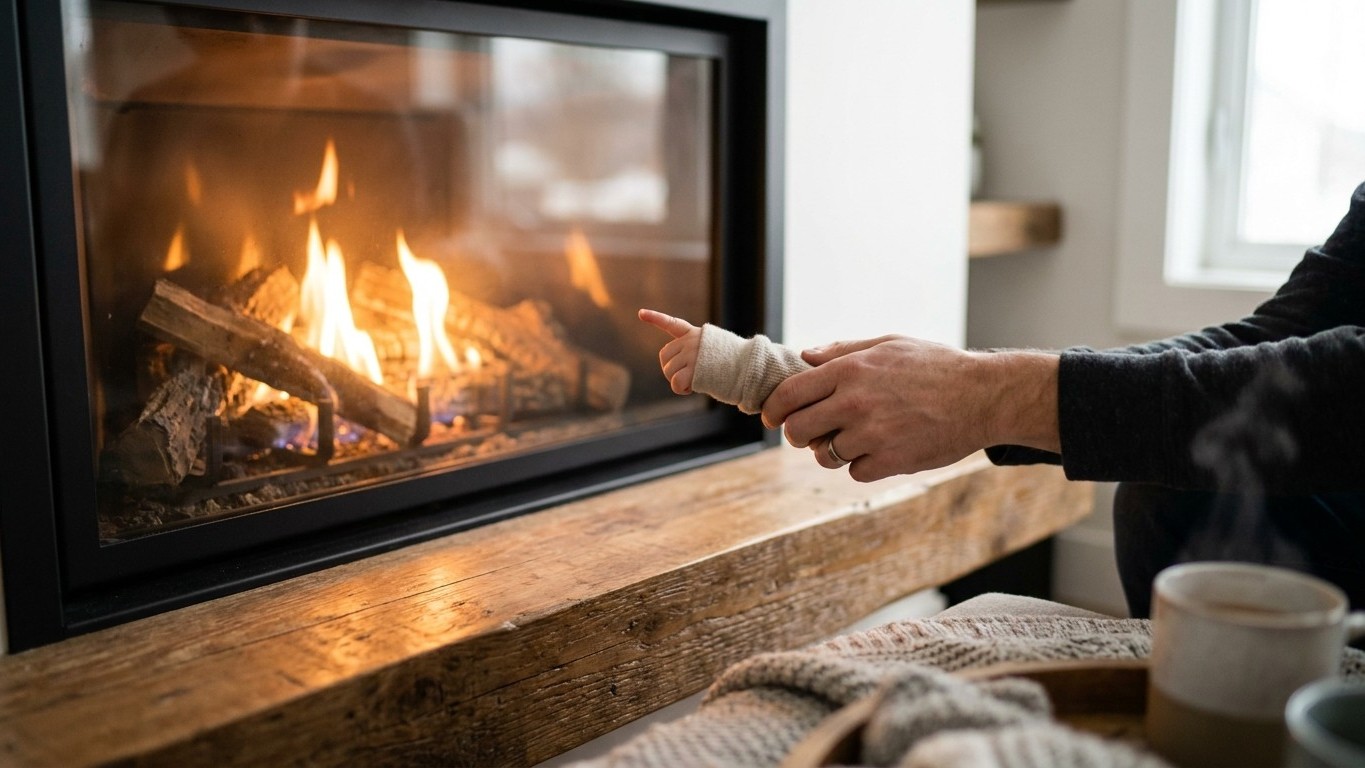

Gas fireplace glass gets hot enough to burn skin on contact within seconds, and it holds that heat long after the flames shut off. Cleaning it safely means waiting until the unit is stone cold, then using a cleaner formulated for fireplace glass, never a household glass cleaner or an abrasive pad. The white haze that shows up on new units is normal curing residue, not a defect, and it usually wipes away with the right product.
It reaches burn temperature, and stays there

The number that trips up most households isn’t the flame, it’s the glass. On a direct-vent gas fireplace, the sealed glass front sits inches from an open flame with almost no airflow to cool it, and it reaches a surface temperature that will burn bare skin within seconds of contact. That’s the fact that catches parents and pet owners off guard: the fire looks contained behind a clean pane of glass, so it reads as “safe to touch” in a way a wood fire’s crackling heat never does.
The second part of that fact matters just as much. The glass doesn’t cool down when the flame does. Direct-vent units hold residual heat in the glass and the surrounding frame for a stretch of time after shutdown, long enough that a child or a curious dog can still get burned well after anyone in the room assumes the fireplace is “off.” There’s no safe interval to memorize here, because it depends on the unit, the run time, and the room’s ventilation. The only reliable rule is to treat the glass as hot until you’ve confirmed otherwise by touch, from a safe distance, with the back of a hand.
This is exactly why current gas fireplace models ship with a physical safety barrier, a screen or grille mounted in front of the glass, separate from the glass itself. That screen exists specifically to keep hands and paws off the hot surface while still letting the fire show through. Removing it is not a cosmetic choice. It’s a decision that puts the full burn hazard back into open reach, and it’s one homeowners sometimes make without realizing the screen was doing anything beyond decoration.
The U.S. Fire Administration’s clearance guidance applies directly here too, and it’s worth repeating word for word: “Keep anything that can burn at least 3 feet from all heat sources including fireplaces, wood stoves, radiators, space heaters or candles.” That distance isn’t just about flame, it’s about a glass front radiating enough heat to matter to anything flammable nearby, curtains, furniture, holiday decorations, well before anything touches it directly.
The white film, and what causes it
New gas fireplace glass almost always develops a whitish, sometimes streaky film during its first several fires. Two things cause it. The first is curing: manufacturers apply protective coatings and finishes to internal components, and the initial burns drive off residual manufacturing oils and compounds that land on the glass as a light haze. The second is ongoing, not just a break-in issue: combustion by-products, fine mineral deposits and moisture-borne residue from the burner, settle on the inside surface of the glass every time the fireplace runs, gradually building a film if it’s never cleaned.
The fix is straightforward, but the sequence matters more than the product. The unit has to be completely cold before anyone touches the glass, both because of the burn risk covered above and because cleaning hot glass with a liquid cleaner can cause thermal shock and cracking. Once it’s cold, a cleaner made specifically for fireplace glass, applied with a soft cloth, is what actually cuts through the baked-on film. These formulas are designed to dissolve combustion residue without attacking the glass’s coating, and they’re a different category from anything sold for windows or shower doors.
What damages the coating
Ordinary household glass cleaners are the first thing to avoid. Many contain ammonia, which can react with the ceramic coating some fireplace glass carries and leave it permanently hazy or streaked rather than clear. Abrasive pads, steel wool, and scouring powders are the second hazard: they can scratch the glass or strip a coating that’s not designed to be scrubbed. Paper towels can leave lint or micro-scratches too, so a soft microfiber or cotton cloth is the safer applicator. If a film doesn’t come off with a proper fireplace glass cleaner and a soft cloth, that’s a sign to stop rather than switch to something stronger, since more aggressive cleaning is more likely to etch the glass than remove the residue.
The gasket is part of the seal
The glass itself is only half the story. On a direct-vent gas fireplace, the glass isn’t just a viewing pane, it’s part of the sealed combustion chamber. That chamber depends on outside air being drawn in and exhaust being pushed out through a sealed wall terminal, and the whole system only works if the seal between the glass, its frame, and the gasket running around the edge is intact. The gasket is a compressible strip, usually a fiberglass or ceramic-fiber material, that closes the tiny gap between the glass and the metal frame so combustion gases can’t leak into the room and outside air can’t leak into the firebox in the wrong place.
That seal is easy to break without realizing it. Glass reinstalled without its gasket, or with the gasket pinched, folded, or seated unevenly, no longer closes that gap the way it’s designed to. The appliance can still light and run, which is part of what makes this risky: there’s no obvious sign that the seal has failed, no warning light for a compromised gasket. What changes is the balance of air and exhaust the direct-vent system was built around, and that’s not something a homeowner can verify by eye.
This is exactly why removing and refitting the glass on a direct-vent unit is a service task, not a homeowner maintenance job. A technician has the training to reseat the glass to the gasket correctly, check the seal is uniform, and confirm the unit is drawing and exhausting the way its listing requires. That lines up with the U.S. Fire Administration’s broader guidance to “maintain heating equipment and chimneys by having them cleaned and inspected each year by a professional,” a service visit that’s the natural point to have the glass and gasket checked at the same time, rather than pulling the glass loose between visits to chase a film that hasn’t come off with a cold-glass cleaning.
One more distinction is worth keeping straight while any of this is being planned: a vented fireplace sends combustion products outdoors through a flue, a direct-vent unit draws air from outside and exhausts through a sealed wall terminal, and a vent-free unit releases everything, including water vapor, into the room. The glass-and-gasket seal described here is specific to direct-vent construction, so anyone unsure which type they have should check the appliance’s own label before assuming this advice applies as written.
Common questions
Can I clean gas fireplace glass with regular glass cleaner?
No. Household glass cleaners often contain ammonia, which can damage the ceramic coating on fireplace glass and leave permanent haze. Use a cleaner made specifically for fireplace glass, and only once the unit has fully cooled.
How often should I clean gas fireplace glass?
There’s no fixed interval in manufacturer or fire-safety guidance. In practice, most households find a light film builds up over repeated use, so checking the glass periodically and cleaning it when the haze becomes visible, always on a cold unit, keeps ahead of buildup without unnecessary handling of the glass.
Is it safe to run a gas fireplace with the glass removed?
On a direct-vent unit, the glass and its gasket seal the combustion chamber. Running the appliance without the glass properly seated removes that seal and should only be considered, if ever, under a technician’s direction, since it changes how the unit draws and exhausts air.
Why does new gas fireplace glass have a haze that won’t come off with a regular wipe?
That film is typically a mix of curing residue from the manufacturing process and combustion by-products from the first fires. A cleaner formulated for fireplace glass, used cold with a soft cloth, is designed to break down that specific residue where a standard wipe or household cleaner won’t.