
Most sounds a heat pump makes are the equipment doing exactly what it’s designed to do: shifting between heating and cooling, clearing frost, moving refrigerant, adjusting fan and compressor speed. A smaller set of sounds signal wear or a failing part. And a good chunk of what gets blamed on the heat pump is actually the mounting, the pad underneath it, or the ductwork carrying air through the house. Sorting those three buckets first saves both a wasted service call and a missed early warning.
The ones that are the machine working

A heat pump runs a longer list of routine sounds than a furnace ever will, because it’s doing more jobs: reversing direction between heating and cooling, defrosting itself outdoors in cold weather, and constantly adjusting compressor and fan speed to match the load. Each of those jobs has its own sound signature, and once you know what triggers each one, most of the noise stops being suspicious.
The reversing valve is usually the biggest surprise for someone used to a gas furnace. When the system switches between heating and cooling mode, that valve shifts refrigerant flow, and it does it with an audible whoosh or a soft thunk that lasts a second or two. It happens at mode changes, not randomly, so if you hear it right when the Thermostat calls for a different mode, that’s the explanation.
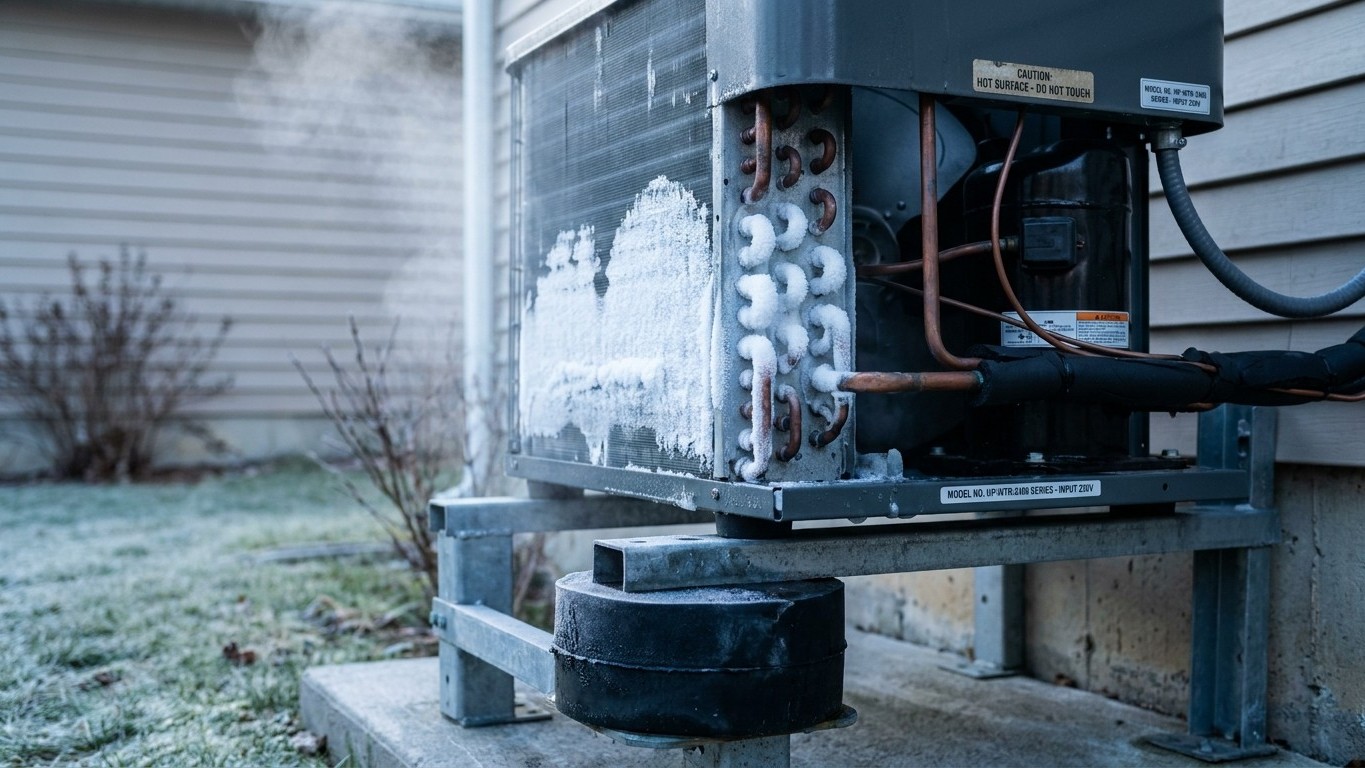
Defrost cycles cause the second most common false alarm. In cold weather, outdoor coils build frost, and the system periodically pauses heating, reverses briefly, and runs hot to melt it off. That sequence often starts with a pause, a click, and then a rush of steam or a hiss as the melted frost turns to vapor near the coil. It’s not a malfunction. It’s the unit maintaining its own airflow.
| Sound | What it is | When to expect it |
|---|---|---|
| Whoosh or thunk at mode change | Reversing valve shifting refrigerant flow | When switching between heating and cooling |
| Pause, click, then a rush of steam | Defrost cycle starting on the outdoor coil | Cold weather, periodically during heating |
| Dripping or water flung against the coil | Condensate or melted frost draining, thrown by the fan | During and right after defrost, or in humid weather |
| Hum that rises and falls in pitch | Variable-speed compressor modulating output | Continuously, as the system matches the load |
| Fan speed changing audibly | Outdoor or indoor fan ramping to match demand | At start-up and as conditions change |
The steady hum that seems to breathe, louder for a while and then softer, is the compressor doing its job well. Older single-speed equipment runs at one output and cycles on and off. A lot of newer heat pumps modulate constantly, which trades the old on/off click for a hum that changes pitch. That’s a feature of how the equipment maintains a steady indoor temperature, not a sign it’s straining.
The ones that do not belong
A smaller group of sounds points to something mechanical going wrong, and the difference from the sounds above usually comes down to texture and timing. Normal operating sounds are smooth and tied to a mode change or a cycle. Trouble sounds are sharp, repetitive, or tied to contact between parts that shouldn’t be touching.
| Sound | What it usually is | Can it wait? |
|---|---|---|
| Metallic scrape, continuous while running | A fan blade contacting its housing or a loose panel rubbing | No, address soon before contact wears a groove or bends the blade |
| Rattle that changes with fan speed | Debris in the outdoor fan cage, or a loose fastener on the fan assembly | Check promptly; often a simple fix if caught early |
| Grinding | A failing motor bearing | No, this points toward a part nearing failure |
| Loud bang at start or stop | A compressor mount issue or a refrigerant flow surge inside the line set | Worth a professional look, especially if it’s new or getting louder |
| Hum with no motion at all, fan not turning | Capacitor family issue, motor trying to start and failing | Stop and call for service |
That last one deserves its own note. A hum with no visible fan movement, especially one that starts and cuts off repeatedly, usually traces back to a run or start capacitor that’s no longer delivering the jolt a motor needs to begin spinning. This is the same failure mode covered on the central air capacitor guide, and the caution there applies here word for word: a run capacitor holds an electrical charge even after power to the unit is cut. That’s a job for someone trained to discharge it safely, not a homeowner repair, and this page isn’t the place for that procedure.
For the rest, timing tells you a lot. A rattle that only shows up at high fan speed and disappears at low speed points at something loose that vibrates more as airflow increases, often a fastener or a bit of debris rather than a structural problem. A bang that happens once, right at start-up, and never during steady running is a different animal from a bang that repeats throughout the cycle. If a sound in this table is new, getting louder, or paired with reduced heating or cooling, treat it as a signal to get eyes on the equipment rather than a curiosity to monitor for another season.
Half of it is not the machine
A heat pump bolted to a wall bracket or set on a pad transmits vibration into whatever it’s attached to, and that structure can turn a quiet hum into a noticeable buzz somewhere else in the house. Before assuming the unit itself is at fault, it’s worth working through what’s around it.
- Check the wall bracket or mounting hardware. A unit hard-mounted to a wall without vibration isolation can transmit compressor hum directly into the framing, and that hum can show up as a rattle in a room on the other side of the wall. Isolation pads or brackets rated for the equipment’s weight reduce that transfer.
- Check whether the outdoor pad has settled or tilted. A pad that’s sunk unevenly into soil lets the cabinet twist slightly, which can turn a smooth hum into a rattle as internal components shift against their housings. Releveling the pad often resolves it without touching the unit itself.
- Check the outdoor grille and access panels. A grille or panel that’s lost a fastener or warped slightly will drum against the frame as air moves past it. Tightening or replacing the fastener usually stops it.
- Check what’s near the unit. A fence, wall, or dense hedge placed close to the outdoor unit reflects sound back toward the house, sometimes right at a bedroom window. Moving the obstruction, or the unit’s aiming point during installation, changes how much sound bounces back rather than dissipating outward.
Anything added to quiet the unit down, a sound barrier, an enclosure, foam padding around the cabinet, has to leave the equipment room to breathe. A heat pump’s outdoor unit pulls air in and pushes it back out, and blocking that path to cut noise can starve the coil of airflow, which shows up later as reduced heating or cooling and a compressor working harder than it should. The manufacturer’s clearance requirements around the unit exist for that airflow, not as a suggestion, and they’re the reference to check before adding any kind of noise barrier rather than guessing at a safe distance.
And the indoor half
The indoor unit and the ductwork it feeds have their own list of sounds that get blamed on the outdoor equipment by mistake. A blower wheel that’s picked up dust unevenly can spin slightly out of balance, producing a rhythmic thump tied to the blower’s rotation speed rather than the compressor outside. A filter pulled tight against its frame by strong airflow can whistle or hum, especially if it’s overdue for a change and partly clogged. Ductwork itself can pop or oil-can, a metallic popping sound as sheet metal flexes when air pressure builds at start-up, which is more a duct sizing and installation issue than anything wrong with the heat pump. A loose register or grille can rattle exactly the same way an outdoor panel does, just indoors where it’s easier to hear and easier to fix.
The duct-related noises, oil-canning, whistling at seams, air escaping around loose fittings, get their own full treatment on the duct noise guide on this site, since a lot of that comes down to duct sizing and sealing rather than the equipment attached to either end.
There’s a one-line test that separates indoor problems from outdoor ones without any tools: walk outside and stand next to the outdoor unit while the system runs. If the noise you’re hearing indoors doesn’t change, gets fainter, or disappears entirely, it’s coming from the indoor unit or the ductwork, not from the compressor or outdoor fan. If it gets louder standing next to the outdoor cabinet, the source is outside. That simple check points you at the right guide, and the right fix, before any service call.
Common questions
Is it normal for a heat pump to sound like it’s running constantly?
Yes, and it’s often by design. Many current systems modulate output rather than cycling fully on and off, which means a steady lower hum for longer stretches replaces the louder on/off cycling of older single-speed equipment. Constant low-level operation isn’t the same as strain.
Why does my heat pump get loud in cold weather specifically?
Cold weather triggers more frequent defrost cycles, and each one brings its own sequence of pause, click, and steam or hiss as frost melts off the outdoor coil. As outdoor air gets colder, the unit has less heat available to extract, and the system has to work through that mechanism more actively, which shows up as more audible cycling. How much this affects any specific installation depends on the model and the house, and the equipment’s own specification sheet is the reference for that, not a general rule.
Can I muffle the outdoor unit with an enclosure or sound barrier?
Only if it doesn’t restrict airflow. The outdoor unit needs clearance to pull air in and push it back out, and the manufacturer’s stated clearance requirements govern how close anything, including a noise barrier, can sit to the cabinet. A barrier placed too close or built too tightly around the unit can choke airflow and reduce heating and cooling performance while doing little to actually cut the sound.
What if the noise only happens indoors and never outside?
Stand next to the outdoor unit while the system runs. If the sound doesn’t follow you outside, it’s coming from the blower, the filter, a register, or the ductwork rather than the compressor or outdoor fan. That points toward an indoor fix, often something as simple as a filter change or a loose grille, rather than anything wrong with the outdoor equipment.