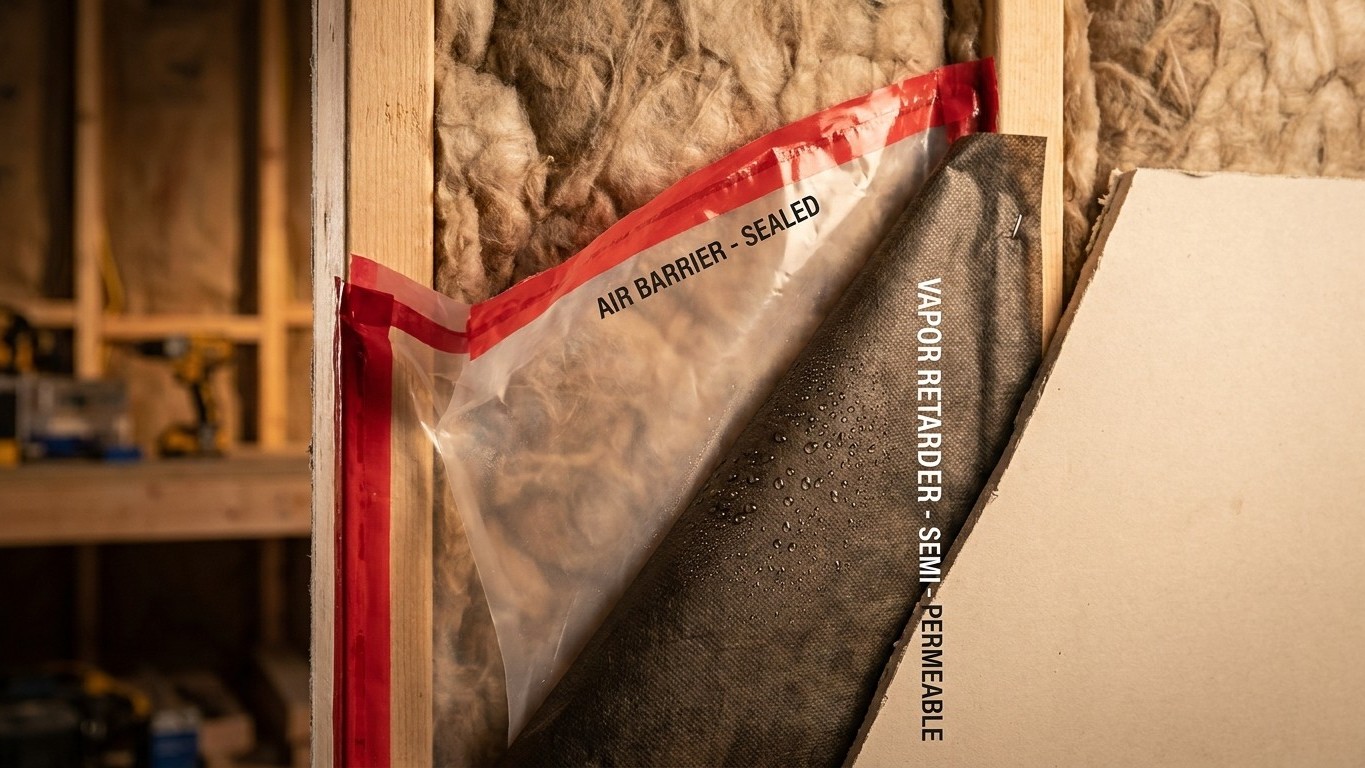

Vapor barrier confusion usually comes down to one word doing two jobs: people say “vapor barrier” when they mean “air barrier,” and the two materials don’t behave the same way inside a wall. The honest answer is that most homes need rigorous air sealing everywhere, but a vapor retarder only belongs in specific spots, on a specific side, decided by climate, not by habit. Get the side wrong and the wall can’t dry.
Air barrier and vapor barrier are not the same
An air barrier stops bulk air movement, warm indoor air leaking out through a wall socket, a top plate, a rim joist. A vapor barrier does something else entirely: it slows the diffusion of water vapor molecules migrating through a solid material over time. One is about drafts you could feel with your hand. The other is about a slow chemical process you’d need a moisture meter to detect.
This distinction matters because the two problems have wildly different scales. Air leakage moves enormous volumes of moisture-laden air very quickly through even small gaps, a quarter-inch crack around a can light can move more water vapor in a day than diffusion moves through several square feet of drywall in a month. That’s why sealing the air barrier is the higher-priority job in almost every home, and why a vapor retarder without air sealing does very little on its own.
Building codes and building scientists increasingly separate these two functions into two products, or into one product doing two things deliberately. A continuous air barrier can be a sealed sheet good, taped rigid foam, or a fluid-applied membrane, and it needs to wrap the whole enclosure without gaps, the way a windbreaker needs a zipper that actually closes. A vapor retarder can be a thin polyethylene sheet, kraft facing on batt insulation, certain interior paints, or specialized “smart” membranes that change their permeability depending on humidity. Some products claim to do both jobs. Many don’t, and treating a vapor-retarding paint as if it seals air leaks is where a lot of confusion starts.
Why the mix-up persists
Part of the problem is language on product packaging. “Vapor barrier” gets used loosely in hardware store aisles and on old technical sheets for anything that looks like a plastic sheet, whether it’s rated for air sealing, vapor control, or both. A roll of polyethylene sold as a “vapor barrier” might block air reasonably well if installed with sealed seams, but that’s a side effect of the installation, not a guarantee printed on the product.
The safer mental model treats these as two separate checklists. Air sealing means finding every penetration, gap, and seam, and closing it with a durable material, caulk, foam, gaskets, taped joints, and checking that the seal continues from the foundation to the roof without interruption. Vapor control is a much narrower decision, applied in specific assemblies, based on which direction moisture is more likely to travel and when. Keeping the two separate in your head is the single most useful habit this page can hand you.
Which side it goes on, and why the answer is not universal
The principle behind vapor retarder placement is straightforward to state and easy to get backwards. A vapor retarder is supposed to sit on the side of the insulation that’s warm during the season when moisture movement is most aggressive, because that’s the side where indoor humidity is pushing hardest to escape toward the cooler side. In a cold climate during winter, that’s usually the interior side of the wall, since warm humid indoor air is trying to move outward through the wall assembly toward the cold exterior.
But “usually” is doing a lot of work in that sentence, and this is exactly where the honest answer has to stop short of a rule. In a hot, humid climate, the dominant moisture drive can run the opposite direction for much of the year, with humid outdoor air pushing inward toward air-conditioned interior spaces. Put a vapor retarder in the wrong spot in that situation and it doesn’t protect the wall, it traps moisture against the same side it was supposed to protect. The same product, installed with the same care, can be correct in one climate and a slow-motion mistake in another.
What actually decides the correct side isn’t a zip code or a state line. It’s the combination of local climate pattern, the specific wall assembly (how many layers, what each layer’s permeability is, whether there’s a ventilated cavity), and how the building is conditioned and used. Two houses a few miles apart, one heated only, one heated and air-conditioned aggressively, can call for different answers. That’s a level of assembly-specific analysis that goes beyond anything a general guide can responsibly hand out.
Why refusing a blanket rule is the right call
It would be easy to publish a simple chart: cold climate, vapor retarder on the interior; hot climate, vapor retarder on the exterior; mixed climate, skip it or use a smart membrane. It would also be irresponsible, because mixed and marine climates in particular don’t behave consistently, and a wall assembly’s specific materials change the calculation in ways a one-line rule can’t capture. A vapor retarder installed on the wrong face doesn’t fail loudly. It fails quietly, over years, inside a cavity nobody opens until there’s a smell, a stain, or rot in the framing.
This is the one spot on the subject where the safest advice is to say plainly: this decision needs a design decision specific to your wall assembly and your climate, not a rule pulled from a general guide. Anyone confidently handing you a one-size answer on this point is handing you a risk, not a fact.
The mistake that traps water
There’s one failure mode that shows up over and over in walls that develop hidden moisture damage: a vapor retarder on both faces of the same wall. Once that happens, the assembly has no path to dry in either direction. Moisture that gets in, from a small roof leak, from construction moisture that never fully left the lumber, from a plumbing drip, from ordinary air leakage carrying water vapor into the cavity, has nowhere to go. It just sits there, and wood framing, sheathing, and insulation don’t tolerate that indefinitely.
The double-vapor-retarder mistake usually isn’t one deliberate decision. It’s two reasonable-sounding choices made at different times, by different people, that stack up without anyone noticing the wall is now sealed on both sides.
| How it happens | What’s already there | What gets added on top |
|---|---|---|
| Retrofit insulation upgrade | Foil-faced batt insulation (foil acts as a vapor retarder) | Polyethylene sheeting stapled up before drywall, “for good measure” |
| Interior finish change | An already-sealed wall assembly with a functioning vapor retarder | Vinyl wallcovering, which is close to vapor-impermeable itself |
| Repainting a sealed wall | A wall built with a vapor retarder on the correct face | A coat of low-permeability paint applied on the opposite face, closing the only remaining drying path |
Notice the pattern: each addition, on its own, sounds harmless. Extra plastic sheeting sounds like extra protection. Vinyl wallcovering sounds like a cosmetic choice. Paint is paint. The problem only shows up when you ask what the wall looked like before, and whether it already had a vapor retarder somewhere in the assembly. Nobody checks, because nobody thinks of paint or wallcovering as part of the vapor-control conversation.
The principle to hold onto, and it’s a simpler one than the permeability tables and climate maps might suggest, is that an assembly has to be able to dry out somewhere. Water gets into walls no matter how careful the construction, through a missed flashing detail, condensation, a future roof repair gone wrong, ordinary humidity. A wall that can dry to at least one side handles that intrusion without damage. A wall sealed on both sides just accumulates it.
What to do when you are not sure
Faced with an existing wall and an urge to “improve” the vapor control, the safest sequence isn’t complicated, and it happens to line up with how U.S. ENERGY STAR frames home performance work generally: understand what’s there before changing anything, seal air first, and treat vapor retarder additions as a decision that needs outside input rather than a weekend project.
- Identify what’s already in the wall before adding anything. Pull a switch plate, check for foil facing, vinyl wallcovering, or a plastic sheet behind the drywall. You can’t make a good decision about adding a vapor retarder if you don’t know whether one already exists somewhere in the assembly.
- Prioritize air sealing, which is almost never the wrong move. ENERGY STAR’s own project guidance puts air sealing before insulation for exactly this reason: insulation laid over unsealed gaps and penetrations hides them from view without stopping the air movement passing through. Sealing gaps, cracks, and penetrations around wiring, plumbing, and framing junctions improves comfort and reduces uncontrolled moisture transport regardless of what climate you’re in or which side anything faces.
- Get advice before adding a vapor retarder to an existing assembly. This is the one step in the whole subject that benefits from a second opinion, because the wrong choice is invisible until it isn’t. A qualified energy auditor or building professional who can assess your specific wall assembly and local moisture pattern is worth more here than any general rule.
One safety note worth folding in here: air sealing a home tightens it, and any fuel-burning appliance, a furnace, water heater, or wood stove, sharing air with spaces you’re sealing needs to be evaluated for adequate combustion air and venting once the work is done. That’s a five-minute check that prevents a much bigger problem.
If you take one thing from this page, let it be this: seal the air, aggressively and everywhere, and leave the vapor layer alone until you actually know what’s already built into the wall. That single habit prevents most of the moisture problems this subject is known for.
Common questions
Do I need a vapor barrier in every wall?
No. Vapor retarders are used in specific assemblies for specific reasons, and adding one where an assembly already has adequate vapor control, or where the climate doesn’t call for it, can cause more harm than leaving the wall as built.
Can I just add plastic sheeting to an older wall to improve it?
Only after checking what’s already inside the wall. Adding polyethylene over existing foil-faced insulation or another vapor-retarding layer is one of the most common ways walls end up sealed on both faces with no path to dry.
Is a vapor barrier the same as an air barrier?
No. An air barrier stops moving air; a vapor barrier slows vapor diffusion through a material. They’re different jobs, sometimes handled by different products, and air sealing matters in far more places in a house than vapor control does.
What should I ask a contractor before they add a vapor retarder?
Ask what’s already in the wall assembly, which side they’re placing the new layer on and why, and how that decision accounts for your specific climate pattern and how the home is conditioned. A contractor who answers with a generic rule rather than assembly-specific reasoning is worth a second opinion.