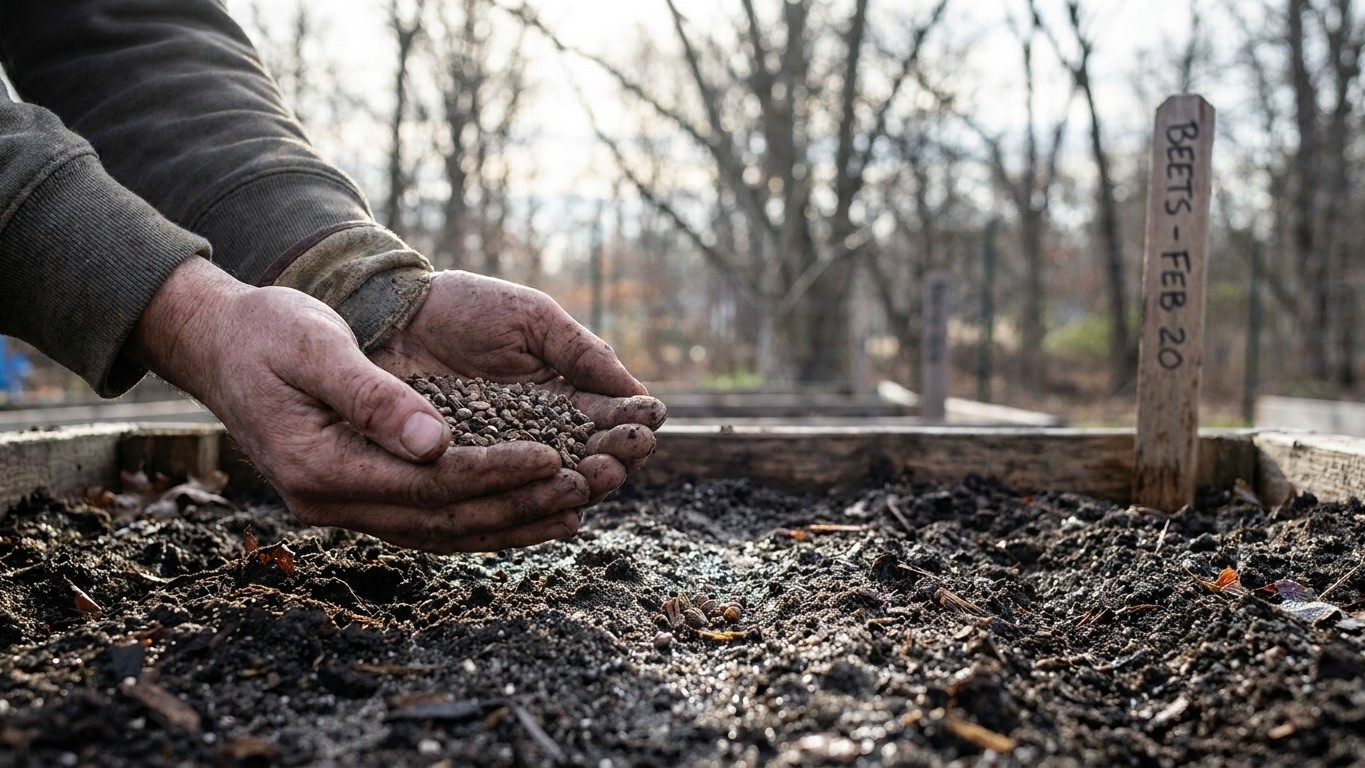

In the Albuquerque area, the direct-seeding window for beets sits roughly two to three weeks before the last spring frost, which NOAA’s 1991-2020 averages put between March 31 and April 12. That lines up outdoor sowing with mid- to late March for most of the middle Rio Grande valley. That’s the short version. What actually decides whether those beets bolt, stall, or turn woody by midsummer is the ground under them and the six weeks of weather right after the seed goes in, not the date circled on a calendar.
The short answer
The soil USDA lists as representative of New Mexico is the Penistaja series, an Aridisol, which is the classification given to dry-climate soils that tend to run alkaline and often carry salts near the surface. The surface horizon of the major Penistaja components runs about 69 percent sand, 15 percent clay and 16 percent silt, with organic matter around 1.4 percent and a surface pH near 7.5. It’s classified as well drained.
Those numbers matter to a beet grower in a specific way. A root vegetable that wants deep, loose ground pulls easily through 69 percent sand. But sand this dominant also sheds water fast, and 1.4 percent organic matter is thin, well below what beets prefer for holding moisture around a developing root. Utah State University Extension recommends amending beet ground with organic matter, capped at roughly 1 inch of composted material per 100 square feet, precisely because native desert soils like this one don’t hold water or nutrients the way a beet root wants.
What the alkalinity adds
A surface pH near 7.5 sits on the alkaline side of neutral. That doesn’t stop beets outright, but combined with the salts an Aridisol often carries near the surface, it can slow early germination and stress young seedlings before they’ve even put down a real taproot, which is exactly the stage when the plant is least able to absorb whatever water is available.
Heat compounds the problem later in the season. Utah State University Extension’s threshold is specific: once temperatures climb above 85 F and the plant is also short on water, the root turns woody. Albuquerque and the surrounding valley run long, dry summer stretches well past that mark, which means the second half of a beet’s growing cycle in this region is routinely working against that woodiness threshold, not just brushing up against it once or twice.
None of this describes every backyard in New Mexico. The state spans hundreds of mapped soil series, and a garden in a river bottom, a mountain valley, or a lot a builder has scraped and filled can differ completely from the Penistaja profile. Treat these figures as a starting point for what the region’s ground tends to do, then confirm your own bed’s texture and pH with an actual soil test before you plant.
The six weeks that decide it here
Sowing two to three weeks ahead of the last frost puts a beet’s first six weeks squarely inside New Mexico’s early spring, and that window has a fairly consistent personality across the state: dry, windy, and prone to sharp swings between a cold morning and a warm afternoon. It’s not a season known for steady, soaking rain.
That combination is the real driver of bolting risk here, more than the frost date itself. Beets that go dry in those first six weeks, whether from a lack of rain, from wind pulling moisture out of loose sandy ground, or from a gardener simply underestimating how fast an Aridisol surface dries out, respond by flowering early instead of building a root. Once a beet bolts, there’s no walking it back; the plant has already decided to go to seed rather than to size up underground.
Why the sandy texture raises the stakes
A soil built on roughly 69 percent sand doesn’t hold a rainfall event, or an irrigation session, the way a loam or clay-heavy soil would. Water moves through quickly, which is good for drainage and bad for consistency. In a spring that’s already leaning dry across much of New Mexico, that fast drainage means the six-week window after sowing needs closer, more frequent attention than a gardener working heavier ground would expect. Skipping a watering by a day or two on this kind of surface can matter more than it would elsewhere.
The last-frost figures themselves, March 31 to April 12, come from the airport weather station behind Albuquerque’s official climate record. Suburban and rural gardens in the surrounding county, and especially anything at higher elevation, typically see their own last frost land later than that, sometimes by a week or two. Sowing two to three weeks ahead of your actual local frost date, not the airport’s, is the number that protects the seedling from a late cold snap while still giving it a full six weeks before the deep heat of summer sets in.
What goes wrong here
- Bolting from early dryness. Sandy, fast-draining ground plus a windy spring pulls moisture away from young roots before they can establish. Water consistently through the first six weeks after sowing rather than waiting for the soil surface to look dry, since sand can look dry at the surface while still holding some moisture just below.
- Woodiness from midsummer heat. Once temperatures pass 85 F and water is short, the root toughens. This is a separate failure from bolting; it happens later in the season, after the root has already started forming, when consistent watering matters as much for texture as for size. Mulching the bed helps hold soil moisture through the hottest stretch.
- Alkaline, salt-prone surface slowing germination. A surface pH near 7.5, paired with the salts an Aridisol often carries, can leave seed sitting in ground that’s harder for young roots to draw from. A soil test before planting tells you whether your specific bed needs correction rather than guessing from the state average.
- Low organic matter limiting root development. At roughly 1.4 percent organic matter, native ground here doesn’t hold nutrients or moisture the way beets prefer. Work in composted organic matter ahead of sowing, keeping it to about 1 inch per 100 square feet as Utah State University Extension recommends, rather than assuming more is automatically better.
- Assuming the state soil is your soil. The Penistaja series describes the ground USDA lists as representative of New Mexico, not the bed in any one yard. A garden near a river, in a valley, or on fill dirt from construction can behave completely differently, so a personal soil test still carries more weight than any state-level figure.
Common questions
How many days do beets need from sowing to harvest in New Mexico?
Because beets are direct-seeded rather than transplanted, the count runs from the day the seed goes into the ground, not from a seedling being set out. Utah State University Extension’s general guidance for beets doesn’t attach a single fixed number to every variety or region, so the safest approach is checking the seed packet for the specific variety and counting from your actual sowing date.
Can I sow beets again in late summer for a fall crop?
A second sowing timed so the crop matures after the worst of the summer heat has passed can avoid the woodiness that comes from heat above 85 F paired with water stress. The exact fall sowing window isn’t part of the frost data covered on this page, so count backward from your local first fall frost using the days-to-maturity listed on your seed packet.
Does the alkaline soil in New Mexico mean I need to add sulfur before planting beets?
The Penistaja series surface pH of about 7.5 describes the state-representative soil, not necessarily your bed. Beets tolerate a range of pH levels, and whether sulfur or another amendment makes sense depends on what a soil test of your own ground actually shows, not on the statewide figure alone.
Why did my beets bolt even though I watered them?
Bolting traces back to water stress in roughly the first six weeks after sowing, and on a sandy, fast-draining soil like the state-representative Penistaja series, the surface can look adequately watered while the root zone below has already dried out. Checking moisture a couple of inches down, not just at the surface, catches this before the plant reacts by flowering early.