
Running a Pellet Stove costs less per unit of heat than most electric resistance heating and often beats oil, but the exact number depends on three moving parts: the price you pay for pellets locally, the price of whatever fuel you’d otherwise burn, and how efficiently your specific stove converts pellets into warm air. There’s no single “average” that applies to every home.
Two bills, not one

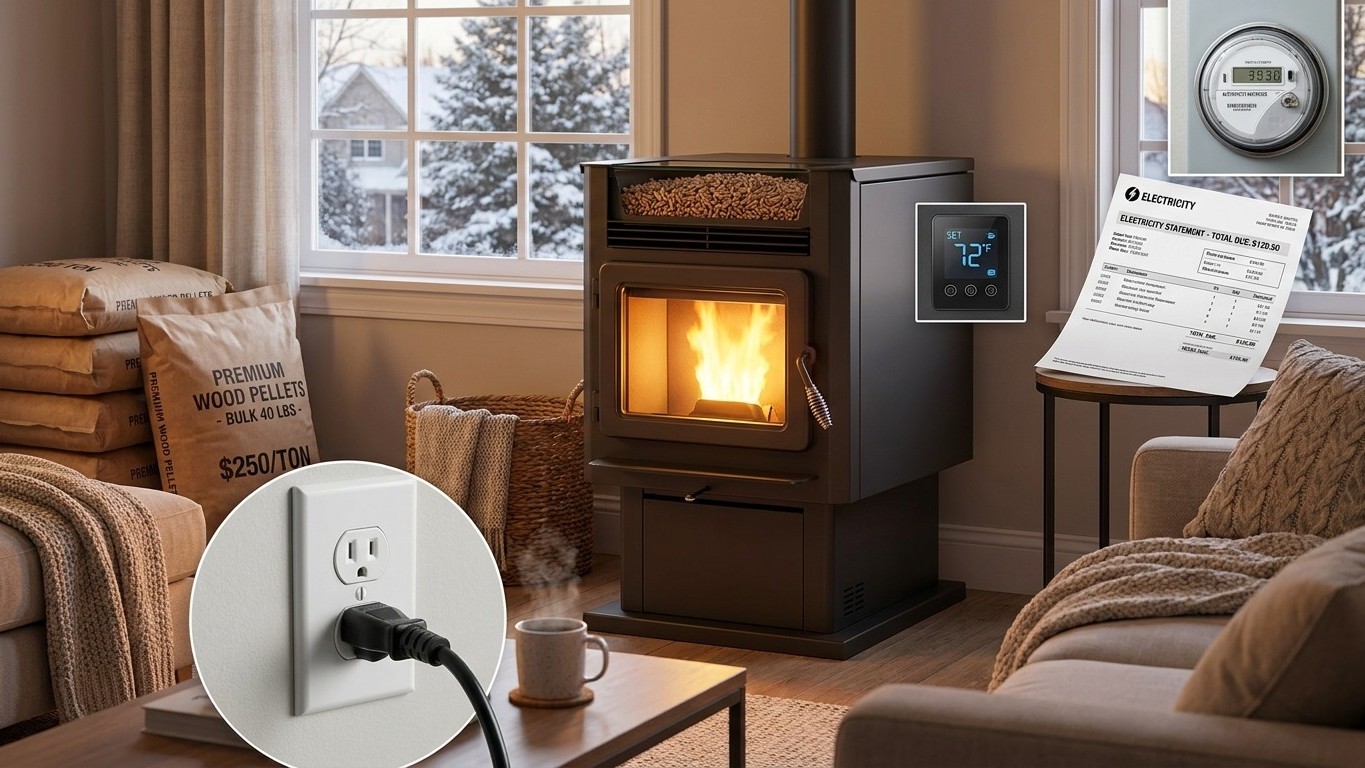
Ask a pellet stove owner what the season cost them, and most people quote one figure: the pellets. That’s only half the accounting. Every pellet stove also draws electricity, and unlike a wood stove or a fireplace, it can’t run without it. The U.S. Environmental Protection Agency puts it plainly: “Pellet stoves need an electrical supply to work because they use motorized components to feed the fire and blow out hot air.”
Those motorized components aren’t optional extras. The auger that moves fuel, the combustion blower, and the room fan all run whenever the stove is producing heat. The EPA describes the basic mechanism this way: “The pellets are poured into a hopper, which automatically feeds into the stove.” That hopper-and-auger system is what makes a pellet stove more hands-off than a wood stove, but it’s also why the appliance is tethered to an outlet. No power, no auger, no heat, regardless of how full the hopper is.
The electricity itself is a modest line item next to the fuel bill. A typical unit draws roughly the same wattage as a box fan or two, run for the hours the stove is actually cycling. Check your own utility rate and the wattage listed on the appliance label or in its manual, then multiply by the hours you expect to run it this season. That’s the only accurate way to price it for your house, since utility rates swing widely by state and even by time of day under some rate plans.
Where this electric dependence actually bites is during an outage. A wood stove keeps working when the grid goes down. A pellet stove doesn’t, unless it’s paired with a battery backup or a generator. For homes in areas with frequent winter outages, that’s worth weighing against the fuel savings, because the cheapest heat in the world does nothing if the auger can’t turn.
Fuel quality also shifts the real cost, even at a fixed price per bag. The EPA notes: “Pellets can differ significantly in how well they’re made and how well they burn. Lower quality pellets may provide less heat and create a fine dust. Higher quality pellets tend to burn cleaner and produce less ash.” Two bags priced the same can deliver noticeably different heat output, which means the sticker price per ton isn’t the whole story either.
Against gas, oil and electric heat
The comparison everyone wants is a straight number: is a pellet stove cheaper than my furnace? The honest answer is that it depends on two prices that change constantly and vary by region, so no article can hand you a universal winner. What’s useful instead is the method professionals actually use to compare fuels fairly: cost per million British thermal units (Btu).
Every fuel has an energy content per unit, whether that unit is a ton of pellets, a gallon of heating oil, a therm of natural gas, or a kilowatt-hour of electricity. To compare them apples to apples, you convert your local price into a cost per million Btu delivered, then adjust for the efficiency of each appliance, since a furnace and a stove don’t turn 100% of their fuel into usable heat.
The rough process looks like this for any two fuels you want to compare:
- Find the current local price per unit for each fuel (your last delivery invoice or utility bill works)
- Find the standard heat content per unit for that fuel (published by the U.S. Energy Information Administration for oil, gas, propane, and electricity)
- Divide price by heat content to get a raw cost per million Btu
- Divide that number by the appliance’s efficiency to get the delivered cost per million Btu
Once you’ve done that math for pellets and for whatever you’re heating with now, you’ll have your actual answer, not a national average that may not reflect your state’s pellet market or your utility’s rate schedule. Pellet prices tend to be more stable year to year than heating oil or propane, which can spike hard in cold snaps, but stability isn’t the same as cheap. In a given winter, in a given region, any of these fuels could come out ahead.
A local pellet dealer or your utility’s customer service line can usually give you current per-unit pricing faster than searching for a national figure that won’t match your area anyway. Run the math with your own numbers before assuming a pellet stove will beat, or lose to, your current heat source.
Where efficiency comes in
Efficiency is the multiplier that turns fuel cost into actual heat cost, and it varies more than most buyers expect. The EPA states: “EPA-certified pellet stoves usually fall into the 70-83% efficiency range, while heating capacities range from 8,000-90,000 Btu per hour.” That’s a wide spread. A stove at the low end of that range wastes noticeably more of each bag than one at the high end, even burning identical pellets.
Certification isn’t a cost rating
It’s worth being clear about what EPA certification actually measures. It’s an emissions test, not a comfort or economy score. The agency notes: “EPA currently certifies over 90 different pellet stoves,” spanning that full efficiency and capacity range. Passing certification tells you the stove meets particulate emission limits. It doesn’t tell you where it lands on the 70-83% scale, and it doesn’t guarantee the unit is sized right for your space. A correctly sized, mid-efficiency stove chosen through our sizing guide will usually cost less to run than an oversized, high-efficiency one that idles constantly because it’s putting out more heat than the room needs.
Maintenance protects the number on the label
Efficiency on paper only holds up if the stove is kept clean. The EPA is direct about this: “Pellet stoves need to be regularly cleaned to ensure that the stove runs efficiently and safely. Additionally, you should have your stove professionally cleaned at least once a year.” The U.S. Fire Administration echoes the annual service point for heating equipment broadly: “Maintain heating equipment and chimneys by having them cleaned and inspected each year by a professional.” A neglected stove drifts toward the bottom of its efficiency range, or below it, burning more pellets for the same warmth.
Placement matters for safety, not just performance. The Fire Administration also advises: “Keep anything that can burn at least 3 feet from all heat sources including fireplaces, wood stoves, radiators, space heaters or candles.” That clearance doesn’t change your fuel bill, but it’s a non-negotiable part of running any solid-fuel appliance safely, pellet stoves included.
Common questions
Does a bigger pellet stove always cost more to run?
Not necessarily. A larger stove sized correctly for a big, open space can run more efficiently than an undersized unit straining to keep up. The problem is an oversized stove in a small or well-insulated room, which cycles on and off or idles at low output, often burning fuel less efficiently than a properly matched unit.
Can I estimate my seasonal pellet cost from last year’s bill?
Yes, if the winter was similar in length and severity, and if you’re burning the same quality pellets in the same appliance. Weather variation, pellet quality changes, and any drop in maintenance can all shift the number from one season to the next.
Does electricity use change with stove settings?
Generally yes. Higher fan speeds and higher feed rates mean the auger and blower motors run more, drawing more power. Check your specific model’s manual or label for wattage at different settings if you want a precise electric estimate.
Is a pellet stove cheaper to run than a wood stove?
A wood stove has no electric draw and, if you source or cut your own wood, can have a lower cash fuel cost. A pellet stove trades that potential savings for automation, more consistent heat output, and the electrical dependence described above. Which one costs less depends heavily on whether your wood is free, purchased, or somewhere in between.