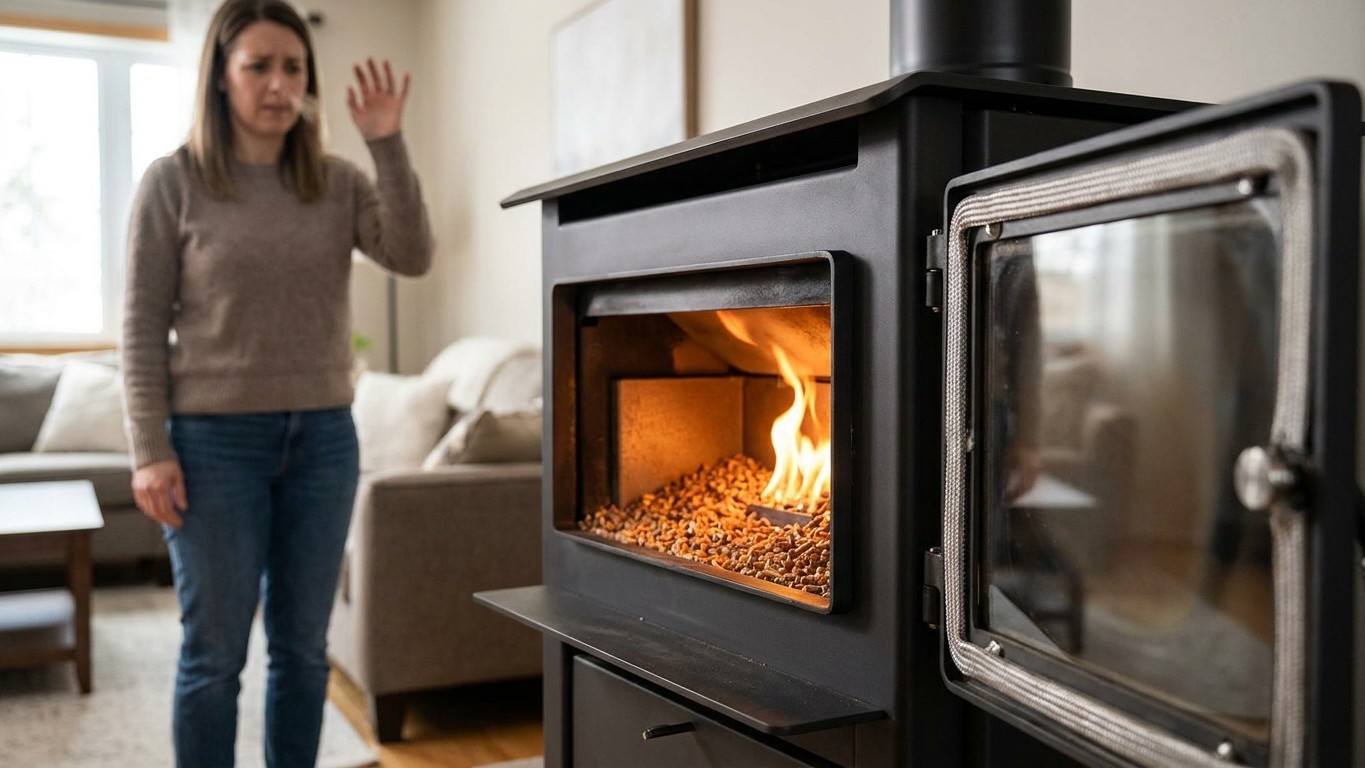

A faint smell during the first few fires of the season is normal and usually fades on its own. A sharp smoke smell that fills the room, though, is not something to wait out. That points to combustion gases escaping where they shouldn’t, and it means shutting the stove down and getting the venting checked before you light it again.
The smell that means stop

Smoke smell inside the house, as opposed to a faint burning odor near the stove itself, tells you combustion byproducts aren’t leaving through the vent pipe the way they’re designed to. That’s a different problem from dust burning off a heat exchanger. It means air that should be pulled outside is finding its way back into your living room, and along with it comes carbon monoxide, fine particulates, and whatever else came out of the fire.
A few mechanical failures cause this. A gasket around the door or ash pan can degrade and start leaking flue gas into the room instead of channeling it up the vent. A vent pipe can get partially blocked by a nest, a dent, or a buildup of ash and creosote-like residue, cutting the draft down to nothing. And because pellet stoves aren’t passive appliances, a failure of the combustion blower itself can stop exhaust from moving at all. The U.S. EPA notes that “pellet stoves need an electrical supply to work because they use motorized components to feed the fire and blow out hot air.” When that motor falters, the whole exhaust system falters with it.
If the smell of smoke is noticeable in the room, don’t try to trace the cause yourself while the fire is burning. Shut the stove down using its normal shutdown sequence, open a window if you can, and get the space ventilated. Then don’t light it again until a qualified technician has inspected the gaskets, the vent run, and the blower. This isn’t a case where you wait and see if it clears up on its own run after run.
Why this isn’t a maintenance detail you can skip
The U.S. Fire Administration is direct about this: “Maintain heating equipment and chimneys by having them cleaned and inspected each year by a professional.” A stove that smokes into the room outside of a first-fire situation is telling you that annual inspection is overdue, or that something has changed since the last one, a cracked gasket, a bird’s nest in the cap, a blower bearing on its way out. If you want to understand what’s actually at risk when combustion gases don’t vent properly, our guide on carbon monoxide and pellet stoves walks through the warning signs and what a detector should be telling you.
One more thing worth remembering here: the U.S. Fire Administration also recommends you “keep anything that can burn at least 3 feet from all heat sources including fireplaces, wood stoves, radiators, space heaters or candles.” That clearance matters doubly when a stove isn’t venting correctly, since a malfunctioning unit can run hotter or less predictably than usual.
The first fire of the season
Not every odor is a red flag. The most common one, by far, is the smell of dust burning off the heat exchanger after months of sitting unused. Dust settles on every internal surface over a summer, and the first time the stove reaches operating temperature again, that dust burns away. It smells faintly acrid, a little like a space heater switched on after storage, and it should ease off as the burn continues, generally clearing within that first fire.
A brand-new stove adds a second layer to this: curing paint. Manufacturers finish stove bodies with a high-temperature paint that isn’t fully cured until it’s been heated through at least once, sometimes a few times. That first burn (or first several) can produce a noticeably stronger smell than a seasoned stove ever will, along with light haze near the appliance. It’s uncomfortable in a closed room, but it’s a known, expected part of breaking in a new unit, not a sign anything is wrong. Cracking a window and running the stove at a moderate setting for the first burn helps it pass faster.
What separates normal from concerning here
The distinguishing factor is location and trajectory. Dust and curing-paint smell stay close to the appliance, fade as the burn continues, and don’t recur once you’ve gone through a few fires. Smoke smell that fills the room, or that gets worse rather than better as the stove runs, or that shows up again on a stove that’s been running fine for weeks, belongs in the first category above, not this one.
This is also the point in the season to think about upkeep generally, not just the smell itself. The EPA is specific about this: “Pellet stoves need to be regularly cleaned to ensure that the stove runs efficiently and safely. Additionally, you should have your stove professionally cleaned at least once a year.” A stove that gets that annual service tends to run predictably from the first fire onward. One that’s overdue is more likely to surprise you, not just with smell but with reduced heat output. For context on what a well-maintained unit should deliver, the EPA notes that “EPA-certified pellet stoves usually fall into the 70-83% efficiency range, while heating capacities range from 8,000-90,000 Btu per hour,” and that “EPA currently certifies over 90 different pellet stoves,” so there’s real variation between makes and models. Your owner’s manual or dealer can tell you where your specific stove falls in that range.
When the fuel is the source
Sometimes the stove is doing exactly what it should, and the smell is coming from what’s in the hopper. Pellets that have absorbed moisture, whether from a torn bag, a damp storage shed, or a stack left too close to a concrete floor, burn differently than dry ones. They smoke more, smolder rather than combust cleanly, and can carry a musty, almost swampy note that’s distinct from either the dust smell of a first fire or the sharp smell of a venting problem. The EPA touches on the underlying reason: “Pellets can differ significantly in how well they’re made and how well they burn. Lower quality pellets may provide less heat and create a fine dust. Higher quality pellets tend to burn cleaner and produce less ash.” Moisture pushes a pellet further toward that lower-quality burn profile no matter how it was made originally.
Additives are a second, less obvious source. Some pellets include binding agents or are made from feedstock blends that burn with a slightly different smell profile than a straightforward wood pellet. That’s not automatically a defect, but it does mean two bags from two different suppliers can smell noticeably different in the same stove, even when both are burning correctly.
Where the fuel enters the picture
It helps to remember the mechanics here: as the EPA describes it, “the pellets are poured into a hopper, which automatically feeds into the stove.” That means whatever is in the bag ends up in the fire on a fixed schedule, with no filtering step in between. A damp or additive-heavy batch doesn’t get caught before combustion, it just burns as-is, and the smell tells you something about the batch rather than the appliance.
If the smell changes between bags, or between a bag stored properly and one left in a damp corner of a garage, the fuel is almost certainly the variable. Our guide on pellet storage covers how to keep bags dry through a full heating season, and the companion piece on pellet quality goes deeper into what separates a clean-burning batch from one that smokes and smolders.
| Type of smell | Likely cause | What to do |
|---|---|---|
| Sharp smoke smell in the room | Leaking gasket, blocked vent, or failed combustion blower | Shut down, ventilate, call a professional before relighting |
| Faint acrid smell, fades quickly | Dust burning off the heat exchanger (first fire of the season) | Let it run, crack a window, expect it to clear within the burn |
| Musty or smoky-sweet smell tied to a specific bag | Damp pellets or additive Differences between suppliers | Check storage, switch bags, dispose of visibly wet fuel |
Common questions
Does a smell outside the house near the vent cap mean something is wrong?
Not necessarily. Vent output naturally carries some odor, especially during a first fire or with a batch of lower-quality pellets. The concern is smoke smell inside the living space, not exhaust smell outside where the vent terminates.
How often should a pellet stove actually be serviced?
At minimum once a year by a professional, per the U.S. Fire Administration’s recommendation to have heating equipment and chimneys “cleaned and inspected each year by a professional.” Stoves used heavily through a long, cold season may benefit from a mid-season check as well.
Can bad pellets cause a safety problem, or just a bad smell?
Poor-quality or damp pellets mostly affect heat output and ash buildup rather than posing a direct hazard on their own. But heavier smoke and incomplete combustion put more demand on the venting system, which is exactly the system that needs to be clear for safe operation.
Should I keep running the stove if I’m not sure which type of smell I’m smelling?
If there’s any doubt and the smell is inside the room rather than fading dust smell, shut the stove down first and figure it out after. Given the clearance guidance around heat sources, and the electrical components involved in feeding and venting the fire, it costs little to pause and confirm before continuing to run it.