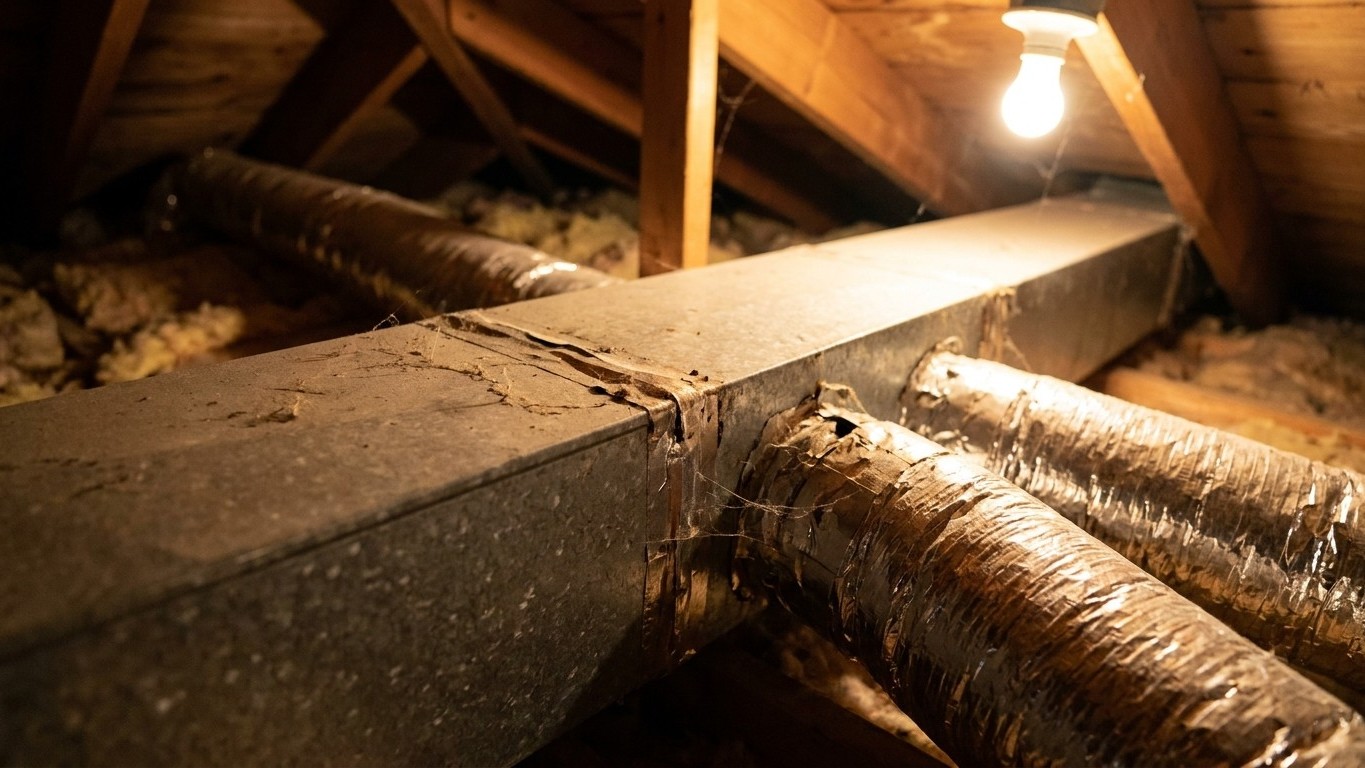

Ducts move heated or cooled air from the equipment to the rooms and back again. When a system heats or cools with air instead of water or refrigerant lines alone, ducts are the delivery network, and every failure downstream, from a cold bedroom to a bill that keeps climbing, traces back to a leak, a blockage, or a duct that was never sized right in the first place. Knowing How to Tell If Your Ducts Leak, and What It Is Costing You is the natural starting point, since many of those leaks can be addressed without a contractor, and Sealing Your Own Ducts is often the first fix worth trying before assuming the whole system needs replacing.
What the ducts actually do

A forced-air system has two halves, and most homeowners only think about one of them. Supply ducts push conditioned air out of the furnace or air handler and into each room through the registers in the floor, wall, or ceiling. Return ducts do the less visible job of pulling room air back to the equipment so it can be reheated or recooled. The return is the half that gets ignored, and it is also the half that “pulls” the whole system along. A house with generous supply registers but one undersized return grille will run louder, work harder, and cool unevenly no matter how good the ductwork elsewhere looks.
Not every house has this problem to solve, because not every house has ducts. According to the U.S. Energy Information Administration’s 2020 Residential Energy Consumption Survey (RECS), 67 percent of U.S. homes have a central air-conditioning unit, the kind that relies on a duct network to distribute cooled air room by room. Another 26 percent run individual units instead: a ductless mini-split, a window unit, a wall unit, or a portable one. Those systems, along with homes heated by hydronic baseboard or old-fashioned radiators, move heat through refrigerant lines or hot water, not air. There is no duct to seal, no return to fix, no airflow to balance. If that describes your house, Heating and Cooling a Room That Has No Ducts is the more relevant topic, and this entire discussion of duct problems does not apply to you.
For the roughly two-thirds of homes that do run air through ducts, the layout matters as much as the equipment. A single trunk line feeding too many branches, a return placed on the wrong floor of a two-story house, flexible ducts that end up Kinked, Crushed and Sagging, or Ducts in an Attic or Crawlspace all create the same downstream symptoms: rooms that never feel right, temperature swings between floors, and a system that seems to run nonstop without ever qui, which is often why homeowners start wondering whether Does Closing Vents in Unused Rooms Save Money? is worth trying before looking deeper at the duct system itself.te catching up. There is also the question of Why the House Is Always Dusty, and What the Ducts Have to Do with It, since leaky or poorly sealed ductwork can pull in dust from attics and crawlspaces and spread it through every room. Sometimes the imbalance is even more localized, with One Room Gets No Air while the rest of the house conditions normally. The rest of this hub sorts those symptoms into what they usually mean and where to read the fix in depth.
What goes wrong, and where to read about it
Most duct complaints fall into a handful of recognizable patterns. The table below is meant as a first stop: match what you are noticing on the left, read what it commonly points to in the middle, and follow the link for the room-by-room or symptom-by-symptom detail. Before assuming a full cleaning is the fix, it’s worth knowing Is Duct Cleaning Worth It? What the EPA Actually Says, since the answer isn’t always yes, and if the sound coming from the vents is the real complaint, Booming, Whistling and Popping Ducts covers what those noises usually meant always what homeowners expect.
| What you notice | What it usually means | Where to read more |
|---|---|---|
| One room barely gets any air, even with the vent fully open | Often a branch duct that is crushed, disconnected, or too long and narrow for the run; sometimes a closed damper further back in the system | Fixing a room with no airflow |
| The house is dusty no matter how often you clean or change the filter | Return-side leaks pulling in attic, crawlspace, or wall-cavity air (and whatever is in it) before it ever reaches the filter | Why a leaky return makes a house dusty |
| Rattling, whistling, or booming noises when the system starts or runs | Loose duct connections, undersized returns creating high air velocity, or metal expanding and contracting | Diagnosing duct noise |
| The system runs almost constantly and struggles to reach the thermostat setting | Airflow restriction somewhere in the loop, often a return that is too small, a clogged filter, or closed dampers stacking up static pressure | Why a system runs constantly and never catches up |
| Utility bills are high and no single fault stands out | Distributed duct leakage: no dramatic hole anywhere, just many small connection gaps adding up across the whole run | Testing for duct leakage |
The pattern worth noticing across all five rows: almost none of these symptoms come from one dramatic failure. A duct system rarely fails the way a burst pipe does. It fails the way a slow leak in a tire does, a little at a time, in more than one place, until the sum of small problems reads as one big one on the utility bill or the thermostat.
The figure worth knowing
Two sentences from ENERGY STAR do more to explain a house’s duct behavior than any single symptom on its own. On leakage, ENERGY STAR states: “In a typical house, however, about 20 to 30 percent of the air that moves through the duct system is lost due to leaks, holes, and poorly connected ducts.” On airflow, the agency states separately: “Airflow problems can reduce your system’s efficiency by up to 15 percent.”
These are two different mechanisms, and the wording is precise about the difference. The leakage figure describes air that never arrives anywhere, conditioned air pushed into an attic or crawlspace instead of a bedroom, lost before it ever does its job. The 20 to 30 percent range is deliberately not one number, because leakage severity depends on how the ducts were built and sealed in the first place; a tight system sits at the low end, a neglected one at the high end, and there’s no way to know which without testing. The airflow figure describes something else: restriction. Even a duct system with no leaks at all can lose up to 15 percent of system efficiency if airflow is choked by a dirty filter, an undersized return, or closed dampers stacking up resistance the blower has to fight through.
What these numbers license you to conclude is that duct problems are common and the losses are large enough to matter on a utility bill, not marginal rounding errors. What they do not license is a diagnosis for your specific house. A house could sit near the low end of the leakage range and still have a serious airflow restriction, or the reverse. Reading these two ENERGY STAR figures side by side is a reason to test rather than guess, not a substitute for testing.
The order to do the work in
Duct problems rarely have one cause, so the fix rarely has one step. Working through them in the wrong order wastes money on repairs that a cheaper step downstream would have made unnecessary. This sequence exists for a reason at each stage:
- Check the filter and any filter bypass first. It costs nothing but a few minutes, and a clogged or poorly seated filter mimics almost every symptom above: reduced airflow, a system that runs constantly, even dust if air is bypassing the filter edges instead of moving through it. There is no reason to touch a duct before ruling this out.
- Address the return side next, because it pulls. The return is what determines how much air the blower can move in the first place. A restricted or leaky return handicaps the entire system before the air ever reaches the supply side, so fixing the pull point first means every downstream repair actually gets to work with adequate airflow instead of fighting the same restriction all over again.
- Move to the supply side, particularly runs through unconditioned space. Attic and crawlspace ducts lose air (and lose or gain heat through the duct walls) faster than anything routed inside conditioned walls, so this is where sealing effort pays off fastest once the return is no longer masking the problem.
- Insulate what’s left exposed. Sealing stops air loss; insulation stops heat transfer through duct walls that are still, correctly, carrying air. Doing this before sealing wastes insulation on ducts that are still leaking; doing it after locks in the gain.
- Only then consider new ductwork or a redesign. Replacing or rerouting ducts is the most expensive and disruptive step on this list, and it should be the last one considered, after cheaper fixes have already been ruled out or exhausted. Most houses never need it.
Where the DIY line sits varies by step. Filter checks and basic mastic sealing on accessible ducts are reasonable weekend projects. Actual leakage testing, duct redesign, or work requiring access to sealed wall or ceiling cavities is where a licensed HVAC contractor earns the call, particularly because guessing at airflow numbers without a manometer or duct blaster test tends to produce confident wrong answers.
Common questions
Does every forced-air house have the same duct problems?
No. Leakage severity depends heavily on how and when the ducts were installed, and ENERGY STAR’s 20 to 30 percent figure is a range for a reason. Older ducts sealed only with fabric tape tend to sit at the high end; newer systems sealed with mastic or metal tape tend to sit lower. Testing is the only way to know where your house falls.
Can duct problems affect heating and cooling differently?
Yes, and often unevenly. Leaks in ducts routed through a hot attic cost more in summer, when the temperature difference between the duct and its surroundings is largest during cooling season; the same leaks in a cold crawlspace or unheated basement cost more in winter. The room-by-room symptoms in the triage table above can shift with the season for this reason.
Is duct cleaning the same thing as duct sealing?
No, and they solve different problems. Sealing addresses leakage and airflow, the two issues covered on this hub. Cleaning addresses accumulated dust and debris inside the ducts themselves; the U.S. Environmental Protection Agency’s 1997 guidance on the topic has never shown that duct cleaning prevents health problems, and it has likewise never shown that it is harmful, so it sits outside the leakage-and-airflow question entirely.
Do I need a professional to know if my ducts are leaking?
For a reliable number, yes. A duct blaster or similar pressure test gives a measured leakage rate; without it, homeowners are mostly reduced to touch-testing accessible joints and reading downstream symptoms like the ones in the triage table. That’s a reasonable starting point, but it will not match a real test for accuracy.
Guides by state
- How to Tell If Your Ducts Leak, and What It Is Costing You
- Sealing Your Own Ducts: What Works and What Falls Off
- Is Duct Cleaning Worth It? What the EPA Actually Says
- One Room Gets No Air: Working Back from the Register
- Ducts in an Attic or Crawlspace: Why They Need Insulating
- Kinked, Crushed and Sagging: What Goes Wrong with Flexible Duct
- Booming, Whistling and Popping Ducts: Reading the Noise
- Why the House Is Always Dusty, and What the Ducts Have to Do with It
- Does Closing Vents in Unused Rooms Save Money?
- Heating and Cooling a Room That Has No Ducts
- How to Tell If Your Ducts Leak, and What It Is Costing You
- Sealing Your Own Ducts: What Works and What Falls Off
- Is Duct Cleaning Worth It? What the EPA Actually Says
- One Room Gets No Air: Working Back from the Register
- Ducts in an Attic or Crawlspace: Why They Need Insulating
- Kinked, Crushed and Sagging: What Goes Wrong with Flexible Duct
- Booming, Whistling and Popping Ducts: Reading the Noise
- Why the House Is Always Dusty, and What the Ducts Have to Do with It
- Does Closing Vents in Unused Rooms Save Money?
- Heating and Cooling a Room That Has No Ducts