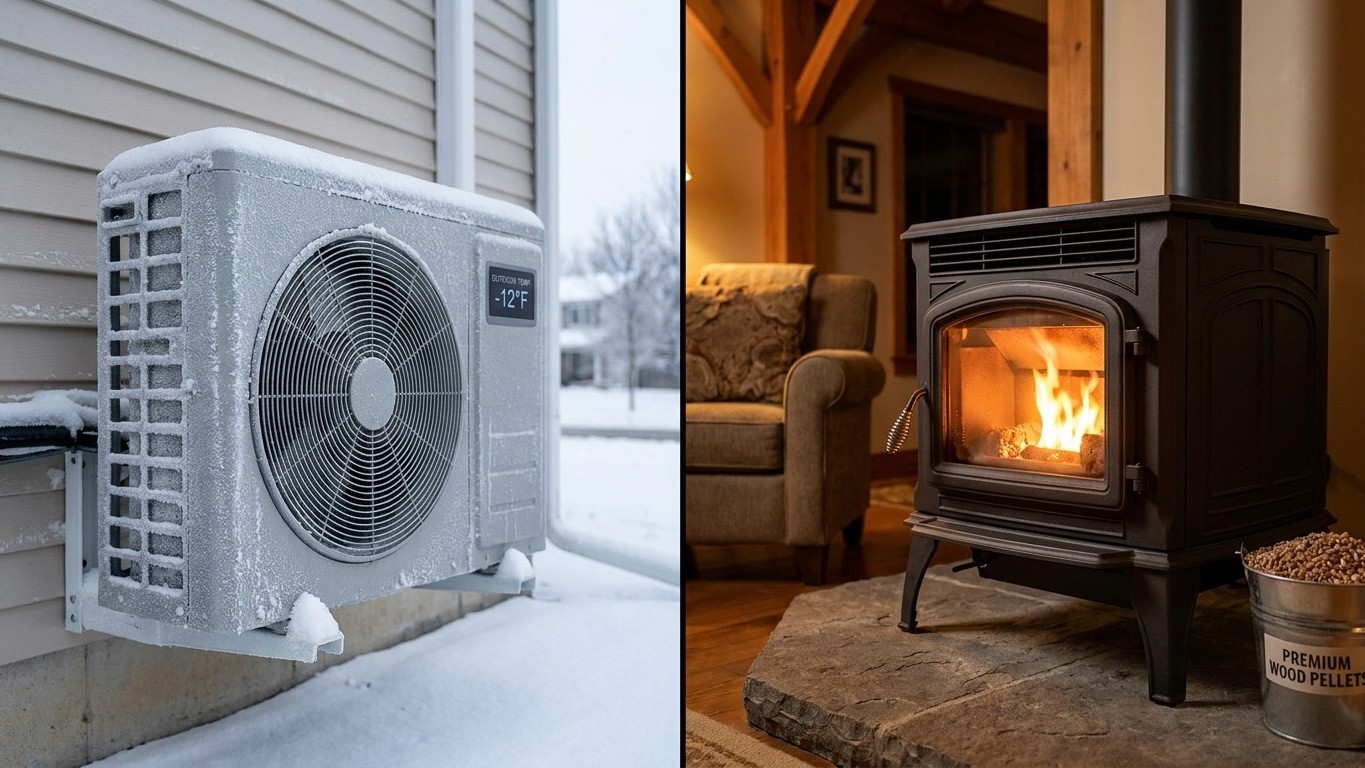

Neither one wins outright, and that’s the honest answer. A heat pump is the more efficient choice for most of the heating season in most U.S. climates, but its output shrinks exactly when you need it most, on the coldest nights. A pellet stove burns at full strength no matter how cold it gets outside, but it can’t heat a whole house evenly and it needs electricity to run, just like the heat pump does. The right answer usually depends on your climate zone, your electric bill, and how often your power actually goes out.
They fail in opposite ways

Here’s the mechanism that catalogs and spec sheets skip over: a heat pump’s capacity is tied directly to the outdoor temperature. As the air gets colder, the unit has to work harder to pull heat out of it, and the amount of heat it can deliver per hour drops. On a mild 45-degree day it might run circles around a furnace. On a single-digit night, the same unit can struggle to keep up, which is why many cold-climate installations pair a heat pump with some form of backup heat for the worst stretches of winter.
A pellet stove doesn’t know or care what the thermometer outside says. It burns the same pellets the same way whether it’s 40 degrees or minus 10. According to the U.S. EPA, “EPA-certified pellet stoves usually fall into the 70-83% efficiency range, while heating capacities range from 8,000-90,000 Btu per hour.” That output is set by the stove’s design and how fast pellets feed into the firebox, not by outdoor conditions. This is the appeal people reach for when they picture a wood or pellet appliance as their cold-weather insurance policy.
But that picture is incomplete, and this is the part that trips people up. A pellet stove is not a fireplace you can feed by hand and walk away from. The EPA is specific about this: “Pellet stoves need an electrical supply to work because they use motorized components to feed the fire and blow out hot air.” The auger that moves pellets from the hopper into the burn pot runs on electricity. So does the blower that pushes heat into the room. Cut the power, and a pellet stove goes cold within minutes, exactly like a heat pump does.
That’s the uncomfortable common ground between two appliances that otherwise seem like opposites. Homeowners often assume a pellet stove is the “off-grid” option and a heat pump is the “grid-dependent” one. In reality, both stop working the moment the lights go out, unless you’ve got a generator or battery backup wired in. If storm outages are a real concern where you live, that detail should shape your decision more than efficiency ratings do. For more on how heat pumps specifically handle sub-freezing temperatures and what backup options pair well with them, it’s worth reading through the dedicated heat-pump cold-climate guides on this site rather than treating that comparison as settled here.
Side by side
Laid out next to each other, the two appliances trade strengths and weaknesses almost point for point. Neither is simply “better,” which is why so many households end up weighing them room by room rather than house by house.
| Factor | Heat pump | Pellet stove |
|---|---|---|
| Behavior in deep cold | Capacity and efficiency drop as outdoor temperature falls; may need backup heat on the coldest nights | Output stays consistent regardless of outdoor temperature, set by hopper feed rate |
| Dependence on electricity | Fully electric to operate; stops without power unless backed up | “Pellet stoves need an electrical supply to work because they use motorized components to feed the fire and blow out hot air” (U.S. EPA) |
| Fuel handling | No fuel storage; draws on ambient outdoor air and electricity | Bagged pellets stored on-site; “the pellets are poured into a hopper, which automatically feeds into the stove” (U.S. EPA); pellet quality varies, and “lower quality pellets may provide less heat and create a fine dust” while “higher quality pellets tend to burn cleaner and produce less ash” (U.S. EPA) |
| Upfront cost | Installed cost varies by capacity, ductwork needs, and climate zone; check quotes from local installers | Installed cost varies by stove size and venting requirements; check pricing from local hearth dealers |
| Maintenance | Filter checks and periodic professional service, similar to central A/C systems | “Pellet stoves need to be regularly cleaned to ensure that the stove runs efficiently and safely. Additionally, you should have your stove professionally cleaned at least once a year” (U.S. EPA) |
| Power cut | Shuts down completely without a generator or battery backup | Shuts down completely without electricity, same as a heat pump, despite burning solid fuel |
A few of those rows deserve a second look before you shop. Neither this article nor the EPA sources it draws on publish a price per ton of pellets, a bags-per-winter estimate, or a Btu-per-square-foot rule of thumb, and any number you see claiming to be an official figure for those things should be treated with suspicion. Your own utility bill, the rating label on the appliance you’re considering, and a conversation with a local dealer who knows your specific house will get you a far more useful answer than any generic chart. On maintenance, the U.S. Fire Administration adds a safety layer that applies to both fuel-burning appliances and space heaters generally: “maintain heating equipment and chimneys by having them cleaned and inspected each year by a professional,” and “keep anything that can burn at least 3 feet from all heat sources including fireplaces, wood stoves, radiators, space heaters or candles.” That clearance rule matters just as much around a pellet stove’s hopper and hearth as it does around any other heat source in the house.
Why many households end up with both
The arrangement that shows up again and again in cold-climate homes isn’t “heat pump or pellet stove.” It’s both, running different jobs. The heat pump carries the load for most of the season, handling the mild fall days, the average January afternoon, and the shoulder months where its efficiency shines. The pellet stove sits in reserve for the handful of nights each winter when temperatures bottom out, and for the outages that inevitably come with an ice storm or a downed line.
What makes that pairing work is dividing the labor honestly instead of trying to make one appliance do everything. A heat pump sized for typical conditions doesn’t need to be oversized (and therefore more expensive and less efficient the rest of the year) just to cover the three or four coldest nights of January. Those nights get handed off to the pellet stove instead. And because the EPA notes that it “currently certifies over 90 different pellet stoves,” there’s a wide enough range of capacities on the market that a household can pick a unit sized specifically for supplemental heat in one or two main rooms, rather than trying to replace whole-house ductwork.
The outage scenario is where the combination earns its keep in a different way. Since both appliances need electricity, a pellet stove alone doesn’t solve the power-cut problem any more than the heat pump does. But pellet stoves generally draw far less electricity to run their auger and blower than a heat pump draws to run a compressor and fans, which means a small portable generator or a modest battery setup can often keep a pellet stove running through an outage even when it can’t support the whole house’s heat pump. That’s the practical reason people who live somewhere with frequent winter outages lean toward keeping a pellet stove installed even after switching their main heating system to a heat pump.
Where the pairing turns redundant is in mild climates with reliable grid power. If winter lows rarely dip into single digits and the power almost never goes out, a second heating appliance sitting idle most of the year is just added maintenance, cleaning, and clearance rules to manage for a backup you may use once every few winters. In that case, a heat pump alone, possibly with electric resistance backup built into the same system, covers the need without the extra hopper to fill.
Common questions
Does a pellet stove work during a power outage?
No, not without a backup power source. The EPA is explicit that pellet stoves need electricity to run the auger that feeds pellets and the blower that distributes heat. A generator or battery backup is required to keep one running when the grid is down.
Which is cheaper to run, a pellet stove or a heat pump?
It depends on local electricity rates and pellet prices in your area, neither of which is published as a fixed national figure. Compare your own utility bill history against a current pellet price quote from a local dealer rather than relying on a generic cost estimate.
Can a pellet stove heat a whole house like a heat pump?
Generally no. Pellet stoves are typically installed as room or zone heaters, with EPA-certified models ranging from 8,000 to 90,000 Btu per hour depending on size, while a heat pump connected to ductwork or multiple indoor units is designed to condition the whole home.
How often does a pellet stove need cleaning?
The EPA recommends regular cleaning by the owner between uses, plus a professional cleaning at least once a year to keep the stove running efficiently and safely. The U.S. Fire Administration also recommends annual professional inspection of chimneys and venting for any solid-fuel heating equipment.