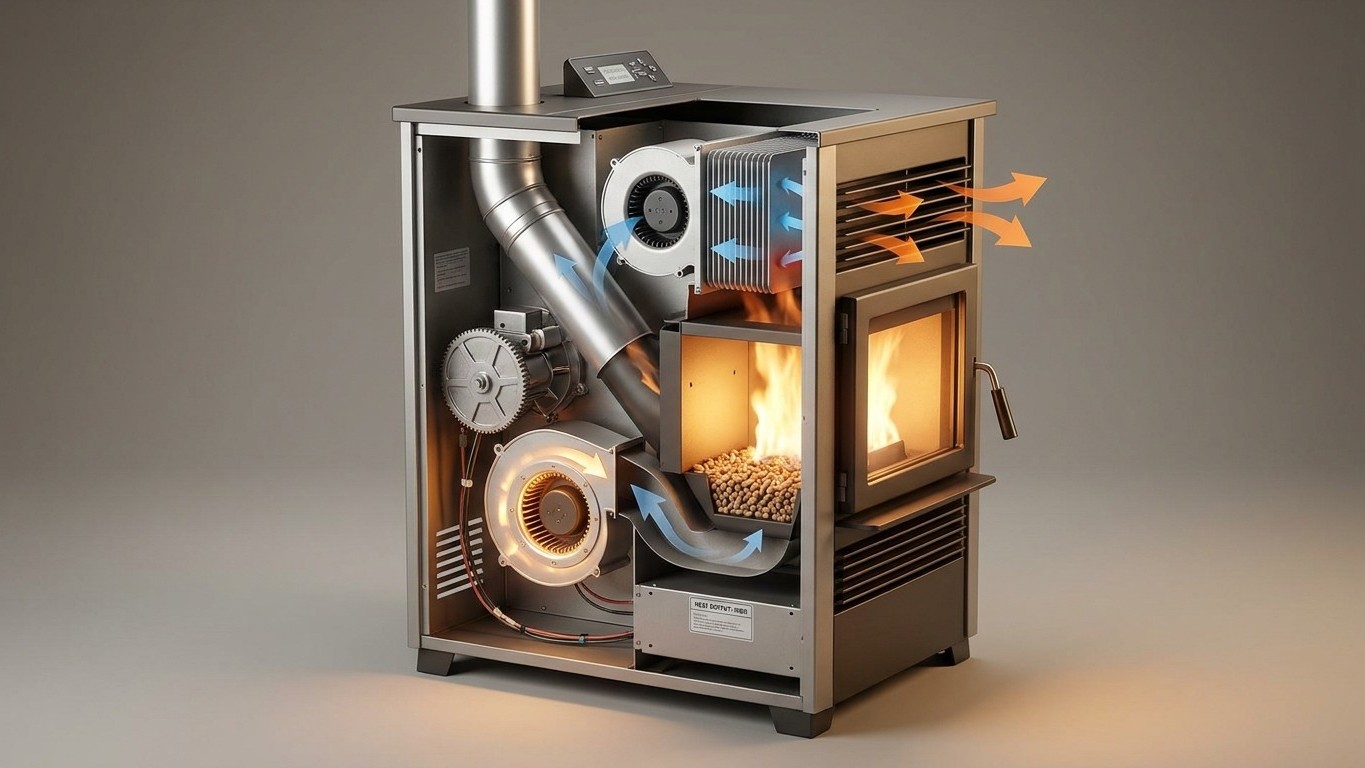

A pellet stove runs on two separate blowers, not one. The combustion blower feeds oxygen to the fire and pushes exhaust out through the vent pipe. The convection blower pulls room air across the hot exchanger and pushes warm air back into the room. They fail independently, they sound different, and mixing them up is the most common reason owners misdiagnose a stove that “isn’t working right.”
Combustion and convection

Picture the two jobs side by side. The combustion blower sits near the firebox and does the work fire itself can’t do without help: it draws in outside or room air, forces it through the burn pot, and drives the exhaust gases out the vent. Without it, a pellet fire smolders instead of burning clean, and exhaust has nowhere reliable to go. That’s why the U.S. EPA notes plainly that “pellet stoves need an electrical supply to work because they use motorized components to feed the fire and blow out hot air.” Cut the power, and this blower stops, and the fire stops behaving safely within minutes.
The convection blower has an entirely different assignment. It never touches the fire or the exhaust stream. It sits behind or around the heat exchanger, the metal surface the fire heats from the inside, and it moves ordinary room air across that hot metal, then pushes the warmed air out through the front or top vents. Turn this blower off and the fire keeps burning exactly the same. The room just stops getting warm air, because nothing is carrying the heat off the exchanger anymore.
That separation explains why the two failures feel so different to someone standing in the room. A combustion blower problem is a burn problem: it affects flame quality, exhaust, and safety systems. A convection blower problem is a distribution problem: the stove keeps making heat, it just can’t get that heat off the exchanger and into the air you’re breathing. One blower failing can trigger a safety shutdown. The other can run for days as a nuisance before anyone traces it back to a fan.
The pellets themselves don’t care which blower is running. As the EPA describes it, “the pellets are poured into a hopper, which automatically feeds into the stove,” and that feed system operates independently of both blowers. So a full hopper and a working auger tell you nothing about blower health. You have to listen to the fans and watch the heat, not the fuel level.
Telling which one failed
Sound and smell are the fastest clues, but the pattern of symptoms narrows it down further. Here’s how the two failures typically show up, and what tends to follow.
| Symptom | Likely blower | What happens next |
|---|---|---|
| Sooted or blackened glass, weak or lazy flame | Combustion blower | Poor air supply starves the fire; ash and soot build up faster than normal |
| Smoke smell or exhaust odor inside the room | Combustion blower | Exhaust isn’t being pushed out efficiently; ventilation and the vent pipe need checking |
| Stove shuts down on its own, error code or safety lockout | Combustion blower | Many units are wired so a failed or weak combustion blower trips a safety shutdown rather than letting the fire burn unsupervised |
| Stove body is hot to the touch, but the room stays cold | Convection blower | Heat is trapped on the exchanger with nothing moving it into the room |
| Fan noise is quieter than usual or absent, no shutdown occurs | Convection blower | Fire keeps burning normally since exhaust and air supply aren’t affected |
A sooted glass problem and a safety shutdown are both signs pointing at the combustion side, and they deserve a closer look before you run the stove again, since that blower is tied directly to how exhaust leaves the house. A cold room with a hot stove body, by contrast, is almost always the convection blower slowing down or seizing, and it’s a comfort issue rather than a safety one, though a stalled convection fan can also mean dust has built up inside the housing rather than the motor actually dying.
One more distinction matters: some units run both blowers off separate switches or separate wiring feeds. If your stove has a “fan” setting that only controls heat distribution, cycling it won’t tell you anything about the combustion blower underneath. If you’re unsure which control does what, the owner’s manual or the local dealer who sold the unit can confirm the wiring for your specific model, since layouts vary between manufacturers.
What keeps them alive
Dust is the enemy of both blowers, and it’s a slower, quieter enemy than most owners expect. Pellet combustion produces fine ash, and even well-made fuel leaves residue that drifts into motor housings over a heating season. The EPA is direct about the fuel side of this: “pellets can differ significantly in how well they’re made and how well they burn. Lower quality pellets may provide less heat and create a fine dust. Higher quality pellets tend to burn cleaner and produce less ash.” Dustier pellets mean more material working its way into blower bearings and motor windings, which shortens the life of exactly the parts that keep the stove running and venting safely.
Regular cleaning is the defense, and the EPA states the standard without qualification: “pellet stoves need to be regularly cleaned to ensure that the stove runs efficiently and safely. Additionally, you should have your stove professionally cleaned at least once a year.” That annual service is when a technician typically opens the blower housings, clears accumulated dust and ash from the motor and fan blades, and checks bearing wear before it becomes a failure. Bearings are a wear part, not something an owner replaces at home; when they get noisy or start binding, that’s a job for the technician doing the annual cleaning, not a DIY fix with household oil.
The U.S. Fire Administration’s broader safety guidance applies here too, even though it isn’t blower-specific. It recommends that owners “maintain heating equipment and chimneys by having them cleaned and inspected each year by a professional,” and separately advises to “keep anything that can burn at least 3 feet from all heat sources including fireplaces, wood stoves, radiators, space heaters or candles.” Neither rule targets the blowers directly, but both matter to how a stove with a struggling blower behaves: a combustion blower running weak can mean incomplete venting, and clearance rules matter more, not less, when a stove isn’t performing the way it should.
Scale matters too. The EPA notes it “currently certifies over 90 different pellet stoves,” and blower design, placement, and access panels vary across that range. A model with a compact convection housing may take longer to service than one with an easy access panel. That’s a reasonable question to ask a dealer before buying, if annual maintenance access matters to you.
Common questions
Can a pellet stove run with only one blower working?
A stove with a failed convection blower can often keep burning, since the fire itself isn’t affected, though the room won’t heat properly. A stove with a failed combustion blower typically can’t run safely at all, and many units are designed to shut down automatically rather than continue burning without proper air supply and exhaust flow.
Why does my stove smell like smoke inside the house?
An indoor smoke smell usually points to the combustion blower or the exhaust path rather than the convection side, since that blower is responsible for pushing exhaust gases out through the vent. It’s worth having a technician inspect both the blower and the vent pipe together.
Is the convection blower fan speed adjustable?
Many stoves let owners adjust convection fan speed to control how quickly heat moves into the room, separate from the combustion blower, which usually runs at a rate tied to the fire’s air needs rather than owner preference. Check your specific model’s control panel or manual for what’s adjustable.
How do I know if a blower needs replacing versus just cleaning?
Dust buildup causing a sluggish or noisy fan often resolves with a thorough cleaning, which is part of what the annual professional service covers. A blower that’s seized, grinding, or not spinning at all after cleaning usually points to worn bearings or a failed motor, both of which are technician-level repairs rather than something to test at home.