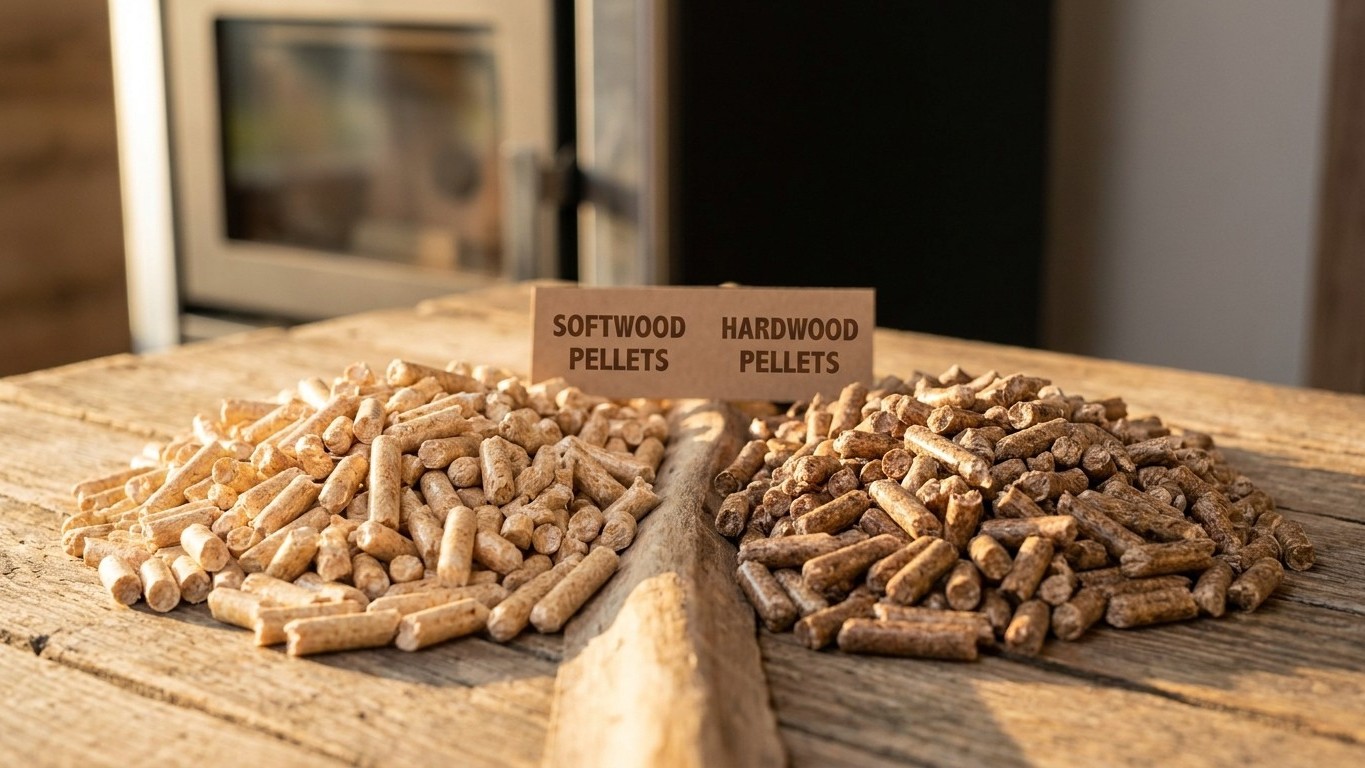

Softwood pellets typically pack more heat per pound than hardwood pellets, because the resins in pine, fir, and spruce carry more stored energy than dense hardwood fiber. But that’s not the whole story. The U.S. EPA notes that pellets “can differ significantly in how well they’re made and how well they burn,” which means a well-made hardwood pellet can easily outperform a sloppy softwood batch. Species is a starting point, not a verdict.
The answer surprises people

Firewood burners have it drilled into them: hardwood is king. Oak, maple, and hickory split into dense rounds that burn long and hot, while pine and fir get dismissed as “kindling wood” that flares up fast and disappears. So it trips people up when they learn that in pellet form, the softwoods often come out ahead on heat output. The resin content that makes softwood a poor choice for a log burning slowly in an open fireplace becomes an asset once that wood is ground down and compressed.
Here’s the mechanism. Pellets aren’t burned as solid logs, they’re burned as a compacted mass of sawdust and wood fiber pressed under extreme pressure through a die. That compression is what actually determines density, not the species sitting in the hopper. A softwood pellet and a hardwood pellet can come out of two different mills at nearly identical densities, but the softwood one often carries a heat advantage because its natural resins are more energy-dense per unit of weight than the cellulose-heavy structure of hardwood.
The word “often” matters here, and it’s doing real work. This isn’t a fixed rule you can bank on with every bag. A hardwood pellet made from clean, dry mill scraps and pressed properly can burn just as hot, sometimes hotter, than a softwood pellet cut with bark or made from wetter feedstock. The EPA’s own language on this is worth sitting with: pellets differ in “how well they’re made and how well they burn,” and that statement doesn’t single out species at all. It points at manufacturing.
That’s the real lesson buried in the softwood-versus-hardwood question. Species gives you a reasonable expectation, and softwood usually nudges the needle toward higher heat output per pound. But the mill that pressed the pellet, the moisture content going in, and whether bark and bits of dirt got mixed into the feedstock will do more to determine how a bag performs in your stove than the tree it came from. Buying on species alone is buying half the picture.
| Factor | Softwood pellets | Hardwood pellets |
|---|---|---|
| Typical resin content | Higher | Lower |
| Heat output per pound | Often higher | Often lower, but varies by mill |
| Common species used | Pine, fir, spruce | Oak, maple, birch |
| Density source | Set by the pellet press, not the species | Set by the pellet press, not the species |
Ash is the practical difference
Heat output is the number people chase, but ash is what they actually deal with every day. Anyone who’s run a pellet stove through a full winter knows the real annoyance isn’t the Btu rating printed on the bag, it’s whether they’re scraping the burn pot every morning or every third day. That distinction has less to do with softwood versus hardwood and more to do with what else ended up in the pellet besides wood fiber.
Bark is the biggest culprit. Bark carries more mineral content than the wood underneath it, and minerals don’t burn, they turn into ash. A pellet made from clean, debarked softwood can produce noticeably less ash than a hardwood pellet made with bark left on, and the reverse is just as true. Additives and binders used to help pellets hold together during pressing can also add to the ash load, regardless of species. The EPA puts it plainly: “Lower quality pellets may provide less heat and create a fine dust. Higher quality pellets tend to burn cleaner and produce less ash.” Nowhere in that guidance does species get named as the deciding factor.
Clinker formation is the ash problem people notice too late. Clinker is what happens when ash minerals fuse into a hard, glassy chunk inside the burn pot, usually because the ash content was high and the burn ran hot enough to melt those minerals together. Once clinker forms, air flow through the burn pot drops, the fire smothers itself, and the stove needs a full manual clean-out rather than a quick scrape. Bark content and pellet quality drive clinker risk far more than whether the bag says pine or oak on the label.
None of this is a one-time chore. The EPA is direct about it: “Pellet stoves need to be regularly cleaned to ensure that the stove runs efficiently and safely. Additionally, you should have your stove professionally cleaned at least once a year.” That yearly service catches what daily scraping misses, ash buildup in the exhaust venting, the auger area, and the heat exchanger. For a full walkthrough of what that maintenance schedule should look like week to week, the pellet stove cleaning and maintenance guide breaks down the routine in more detail.
Testing on your own stove
Every stove has its own personality, and that’s really the deciding factor in this whole debate. Two identical bags of pellets can behave differently depending on the auger feed rate, the burn pot design, and how the combustion air is set on a particular unit. That’s why the most useful test isn’t reading pellet marketing, it’s running one bag through your own appliance for a week and writing down what you see.
Start with a single bag of one type, softwood or hardwood, and burn it under normal conditions for about a week. Track three things: how much ash collects and how often you’re scraping the pot, how warm the room actually gets compared to your usual setting, and whether you notice fine dust when you pour pellets into the hopper. Then switch to the other type and repeat the same week under similar weather and Thermostat settings. The comparison that comes out of your own living room will tell you more than any bag label.
The mechanics behind that test matter too. As the EPA explains, “the pellets are poured into a hopper, which automatically feeds into the stove,” and that hopper-and-auger system needs power to run: “Pellet stoves need an electrical supply to work because they use motorized components to feed the fire and blow out hot air.” A power blip during your test week will skew the results, so note any outages before drawing conclusions.
Efficiency numbers give you a ceiling to compare against. The EPA notes that “EPA-certified pellet stoves usually fall into the 70-83% efficiency range, while heating capacities range from 8,000-90,000 Btu per hour,” and the agency currently certifies “over 90 different pellet stoves.” Where your unit sits in that range is on the appliance label or the owner’s manual, not on the pellet bag. And that manual carries real weight: some stoves specify a fuel type or a minimum pellet quality, and if yours does, that instruction overrides any general softwood-versus-hardwood preference. Running fuel the manufacturer doesn’t recommend can affect performance and, in some cases, the warranty.
Safety basics apply no matter which pellet type wins your test. The U.S. Fire Administration recommends you “keep anything that can burn at least 3 feet from all heat sources including fireplaces, wood stoves, radiators, space heaters or candles,” and that “maintaining heating equipment and chimneys by having them cleaned and inspected each year by a professional” isn’t optional, whichever fuel you settle on.
Common questions
Do softwood pellets burn faster than hardwood pellets?
Burn rate depends more on the auger feed setting on your stove than on species. What softwood pellets more often deliver is higher heat per pound, not necessarily a faster burn through the hopper.
Are hardwood pellets bad for pellet stoves?
No. A well-made hardwood pellet with low bark content and proper moisture levels can burn cleanly and efficiently. Quality of manufacture affects performance more than the species label.
Can mixing softwood and hardwood pellets cause problems?
Most stoves handle a mix without issue, since the auger and burn pot respond to pellet size and moisture more than species blend. Check your owner’s manual if it specifies a fuel type.
How do I know if a pellet bag is high quality?
Look for minimal fine dust in the bag, consistent pellet length, and low bark content. The EPA notes that “higher quality pellets tend to burn cleaner and produce less ash,” so tracking ash output in your own stove over a week of use is a reliable check.