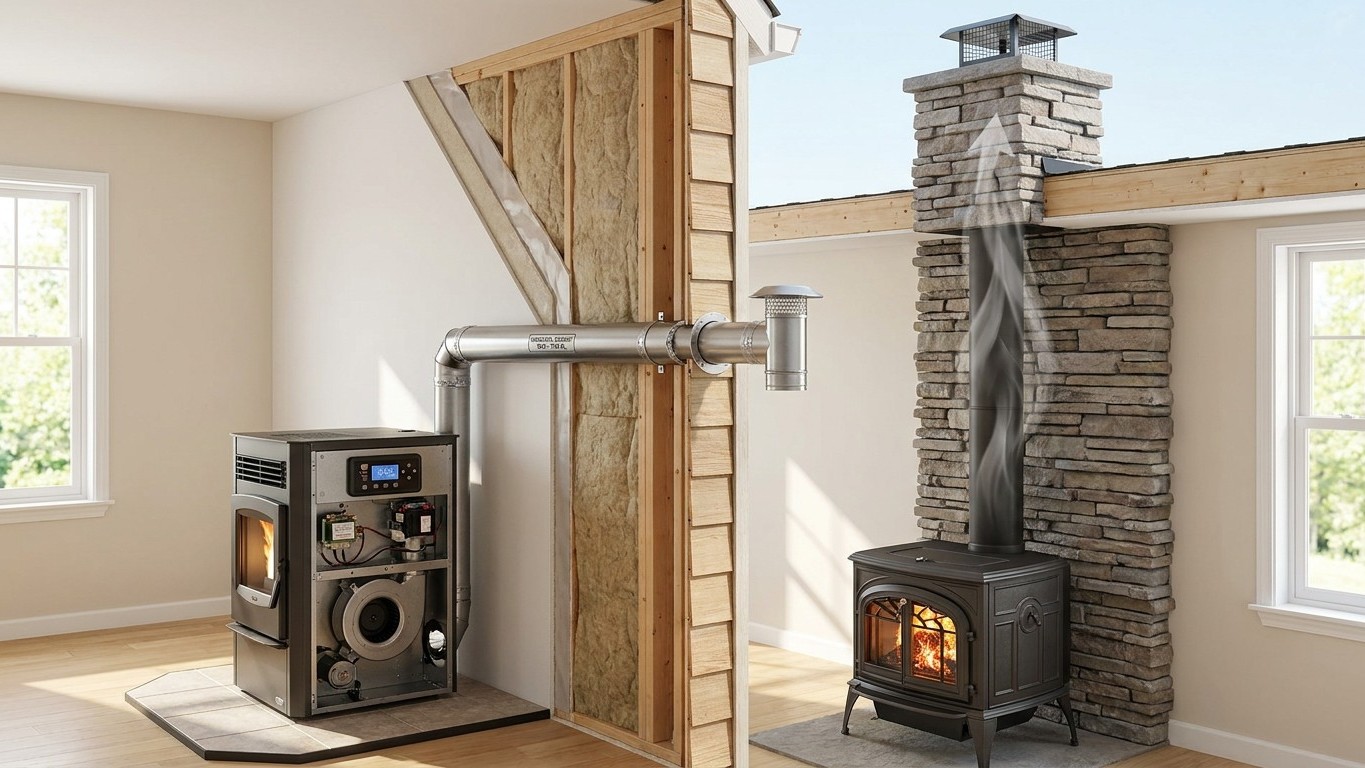

A pellet stove vents through a small, powered pipe instead of a tall masonry flue, which is the single fact that separates it from every wood-burning chimney system. A blower forces the exhaust out, often straight through an exterior wall, so the stove doesn’t need rising heat to pull smoke upward. That mechanical difference is why installation rules, clearances, and troubleshooting steps for a pellet stove look nothing like the chimney playbook most homeowners already know.
A forced vent, not a draught

A wood stove works because hot gas rises. The chimney’s height and temperature difference create a natural draught, pulling smoke up and out. A pellet stove doesn’t rely on that physics at all. It has a combustion blower that mechanically pushes exhaust through a pipe, and because that pipe is pressurized rather than dependent on rising heat, it can run horizontally through a side wall, drop, or turn corners in ways a masonry chimney never could.
This is also why a pellet stove needs power to operate in the first place. As the U.S. EPA puts it, “Pellet stoves need an electrical supply to work because they use motorized components to feed the fire and blow out hot air.” Lose electricity, and the stove doesn’t just dim, it stops venting correctly. There’s no draught to fall back on. The same motorized logic governs fuel delivery: “The pellets are poured into a hopper, which automatically feeds into the stove.” Combustion, feed rate, and exhaust are all managed together by the appliance, not by the chimney’s shape.
That coordinated system is also efficient. The EPA notes that “EPA-certified pellet stoves usually fall into the 70-83% efficiency range, while heating capacities range from 8,000-90,000 Btu per hour.” A wide Btu range means pellet stoves serve everything from a single room to a modest whole-house heating job, and the agency currently “certifies over 90 different pellet stoves,” so the market isn’t a handful of niche products, it’s a real category with meaningful variety in size and output.
None of that changes the basic safety math around the appliance itself. The U.S. Fire Administration advises to “keep anything that can burn at least 3 feet from all heat sources including fireplaces, wood stoves, radiators, space heaters or candles.” That guidance applies to a pellet stove exactly as it would to any other heat source in the room, regardless of how the exhaust leaves the house. The venting pipe is doing different work than a chimney flue, but the appliance still throws real heat, and the clearance around it still matters.
The terminal outside, and what must stay clear
Because a pellet stove vents through a wall rather than a roof, the part of the system a homeowner actually sees and can inspect is the exterior terminal, the cap where exhaust exits the house. It sits low, often just a few feet off the ground, which makes it far more exposed to yard debris than a chimney cap ever is. Snow drifts against it in winter. Leaves pile up in fall. Wasps and small birds treat the warm, sheltered opening as a good spot for a nest. Shrubs planted too close eventually grow into the airflow path entirely.
All of that matters because a blocked terminal doesn’t just reduce airflow, it stops the stove from running. Every certified pellet stove has a pressure switch that monitors exhaust flow, and when that flow drops below a safe threshold, the switch shuts the unit down rather than let exhaust back up into the room. A stove that quits mid-cycle because the terminal is packed with snow isn’t malfunctioning. It’s doing exactly what it’s supposed to do. Homeowners who want the full picture of why a stove cuts out, and how to tell a blocked-vent shutdown from an electrical or feed problem, can check the stove shutdown page for that breakdown.
What a homeowner can reasonably check
- Clear snow, ice, and leaf litter from around the terminal after storms
- Trim shrubs and landscaping back so nothing grows into the vent path
- Check for nests or debris at the start of each heating season
- Keep the terminal away from windows, doors, and walkways where exhaust could re-enter the house or bother foot traffic
Vent residue is part of this picture too, and it isn’t only about weather. The EPA points out that “pellets can differ significantly in how well they’re made and how well they burn. Lower quality pellets may provide less heat and create a fine dust. Higher quality pellets tend to burn cleaner and produce less ash.” A stove fed poor-quality fuel builds up more fine ash and residue inside the vent pipe over a season, narrowing the passage and making the terminal more prone to restriction even without a single leaf touching it. Fuel choice, shows up at the exhaust end of the system just as much as it does in the firebox.
Using an existing chimney
Homeowners replacing a wood stove or fireplace insert often ask whether the old masonry chimney can simply be reused for a pellet appliance. Sometimes it can, but the arrangement is more particular than it looks. A pellet stove’s exhaust runs cooler than a wood fire’s, and it moves through the system under mechanical pressure rather than by rising naturally. Feeding that exhaust into a wide-open, unlined flue built for a roaring wood fire is a mismatch: the gas cools further as it travels through all that extra volume, condensation can form on the masonry, and the draught assumptions the original chimney was built around simply don’t apply to a powered vent.
The usual fix is a dedicated liner sized to the pellet stove’s output, run down through the existing chimney so the exhaust travels through a passage built for it rather than the old oversized flue. Getting that liner sizing, the connector pipe, and the transition between stove and chimney correct is where the real technical judgment lives, and it’s not something to improvise from general knowledge. This is squarely an installer’s decision, made in consultation with the appliance’s own installation manual and the local code office that will need to sign off on the work. Every stove model has different venting specifications, and every jurisdiction applies its own inspection requirements, so there’s no universal number that covers every chimney retrofit.
What is universal is the need for upkeep once the system is running. The EPA is direct about this: “Pellet stoves need to be regularly cleaned to ensure that the stove runs efficiently and safely. Additionally, you should have your stove professionally cleaned at least once a year.” The U.S. Fire Administration puts the same expectation in broader terms, advising homeowners to “maintain heating equipment and chimneys by having them cleaned and inspected each year by a professional.” A repurposed chimney doesn’t get a pass on that schedule. If anything, a liner running through an old masonry flue benefits from a professional’s eyes at least annually, since buildup inside a reused chimney isn’t always visible from the room below.
Common questions
Can a pellet stove vent straight through a wall without any chimney at all?
Yes. Because the blower forces exhaust out rather than relying on rising heat, many installations run a short horizontal pipe straight through an exterior wall to a low outdoor terminal, with no chimney involved.
Why did my pellet stove suddenly shut off in the middle of a snowstorm?
The most common cause is a blocked exterior terminal. Snow or ice restricting airflow triggers the stove’s pressure switch, which shuts the unit down as a safety measure rather than letting exhaust back up into the house.
Does pellet quality really affect how the vent performs?
It can. Lower-quality pellets tend to produce more fine dust and ash, which builds up inside the vent pipe over a season and can narrow the passage faster than higher-quality pellets that burn cleaner.
Is it cheaper to reuse an old chimney than to vent through a wall?
That depends on the liner work required and the specific installation, and it’s a question for the installer quoting the job rather than a general rule, since chimney condition and stove specifications vary by house.