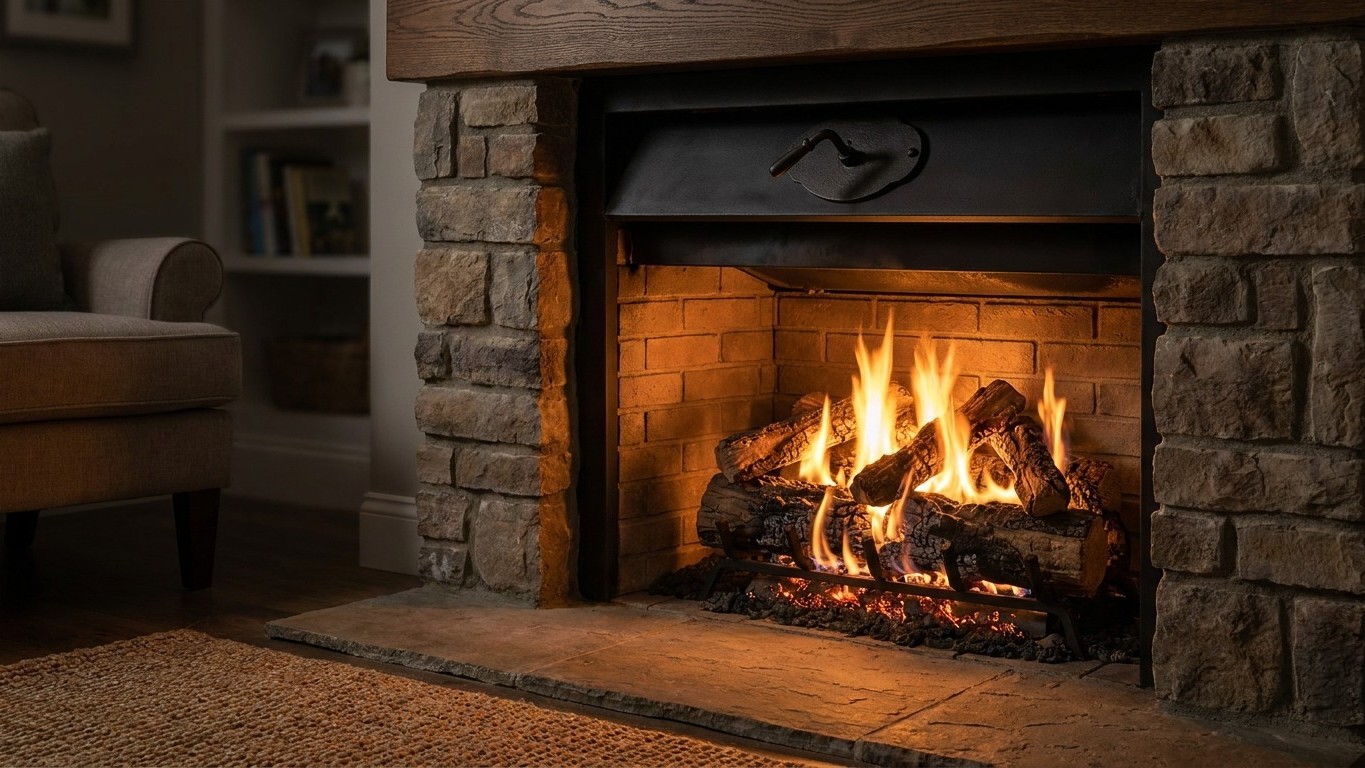

A gas log set answers the “decoration or heat” question with a flat “it depends on the type.” A vented set is pure ambiance, built to send almost all its heat up an open chimney. A vent-free set can actually warm a room, because it’s engineered to run with the damper closed. Knowing which one is installed changes everything about how it should be used.
A burner in an existing fireplace

A gas log set is not a fireplace. It’s an appliance: a steel or brass burner pan fitted with a gas line, topped with individually placed ceramic or refractory logs, dropped into a masonry or prefab firebox that was originally built for wood. The burner lights, gas flows through ports hidden among the logs, and the flame pattern is shaped to mimic a real wood fire flickering across split oak or birch.
In the traditional version of this setup, the damper stays open the entire time the set is burning, exactly as it would for an actual wood fire. That open flue is doing its job: it’s carrying combustion byproducts and smoke-like water vapor up and out of the house. The tradeoff is that the flue is also carrying away most of the heat the burner produces. Warm air near the ceiling of the firebox gets pulled straight up the chimney instead of radiating into the living room.
That’s why a vented log set is classified as a decorative appliance rather than a heating appliance. The flame looks convincing, sometimes more convincing than a vent-free set because the open draft lets the fire dance and roll the way real wood does. But the room around it doesn’t get noticeably warmer. Homeowners sometimes discover this the first cold evening they run one, expecting a wood-stove-like heat output and getting instead a nice glow and very little change on the thermostat.
None of that makes a vented log set a bad purchase. If the goal was always ambiance, low maintenance, and the ability to flip a switch or press a remote instead of hauling firewood and cleaning up ash, a vented set does exactly what it was designed to do. The mistake is expecting it to double as a space heater. It won’t, because the design deliberately routes heat outdoors along with the smoke. Anyone shopping for warmth needs to look at a different category of product entirely, which the later sections in this cluster cover.
Vented and vent-free log sets are different products
The single most important distinction in this category isn’t brand or log style, it’s whether the appliance is vented or vent-free, because that determines how the damper is supposed to be positioned. Get it backwards and the appliance isn’t operating the way it was engineered to.
A vented gas log set requires the damper fully open, every time it runs, the same as an open wood fire. Combustion products, carbon monoxide included, exit through the flue. Close the damper on a vented set and those products have nowhere to go but into the room.
A vent-free log set is the opposite case: it’s designed to operate with the damper closed, and it releases everything it produces, including water vapor, directly into the living space. That’s only considered acceptable because of a specific safety component built into the burner.
What the oxygen depletion sensor actually does
According to the U.S. Consumer Product Safety Commission, currently manufactured unvented gas-fired room heaters carry an oxygen depletion sensor (ODS) as part of the industry’s voluntary standard. The ODS monitors the oxygen level in the room and shuts off the gas supply before carbon monoxide can build up to a life-threatening concentration. It’s worth knowing the regulatory history here too: the CPSC actually revoked its own mandatory ODS standard back in 1984, at a point when 95 to 100 percent of manufacturers were already complying voluntarily. So the presence of an ODS today rests on industry practice and voluntary standards, not an active federal mandate.
The CPSC also points out the basic vulnerability of any unvented appliance: because it has no outside vent for its combustion products, it depends entirely on ordinary room ventilation. Inadequate airflow, a door left closed, a maladjusted burner, any of these can allow dangerous levels of carbon monoxide to accumulate even with an ODS present. Carbon monoxide has no color and no odor, so a working CO alarm is the only way a household would actually detect a problem before it became serious.
| Type | Where combustion products go | Damper position |
|---|---|---|
| Vented | Outdoors, through the existing flue | Open, always |
| Direct-vent | Outdoors, through a sealed wall terminal; draws combustion air from outside | Not applicable (sealed system) |
| Vent-free | Released into the room, including water vapor | Closed |
The U.S. Fire Administration’s general heating-safety guidance applies regardless of which type is installed: “Keep anything that can burn at least 3 feet from all heat sources including fireplaces, wood stoves, radiators, space heaters or candles.” It also recommends that homeowners “maintain heating equipment and chimneys by having them cleaned and inspected each year by a professional.” And on any appliance, at any time: if there’s a gas smell, that outranks every other instruction on this page. Leave the house and call the gas utility or fire department from outside.
When to buy an insert instead
If the actual goal is heat, not the appearance of a fire, a gas log set of either type is the wrong tool. A sealed gas insert is the appliance built for that job, and the difference in design explains why.
An insert is a closed combustion box that fits into the existing fireplace opening, sealed behind glass rather than open to the room. Two configurations dominate the market. A direct-vent insert draws its combustion air from outside through a coaxial pipe and exhausts through a sealed wall or chimney terminal, so it doesn’t compete with the household’s air for oxygen and doesn’t send heated room air up a flue. A vent-free insert, like a vent-free log set, releases its combustion products into the room and carries the same ODS-based safety expectations discussed above. Either configuration is designed around heat retention: the sealed glass front stops the warm room air from being pulled into the firebox and carried away, which is exactly what happens with an open log set burning behind an open damper.
The conversion is a different project than a log set
Swapping a wood-burning fireplace for a gas insert isn’t a matter of dropping a new burner into the same opening. It typically involves lining or capping the existing flue, running a new gas line, and matching the insert’s venting requirements to the specific chimney and clearances on site, work that a qualified installer and the local code office both need to sign off on. That’s a meaningfully bigger project than placing a decorative log set in a chimney that already draws properly, and it’s the subject covered in depth on this site’s guide to Converting a Wood Fireplace to a gas insert.
The decision, then, comes down to what the fireplace is actually for. A household that lights a fire a few nights a year for the look and sound of it, with the furnace doing the real heating work, is well served by a vented log set and an open damper. A household trying to offset furnace use, heat a room the furnace doesn’t reach well, or ride out a power outage with warmth still coming from the fireplace, is describing an insert’s job description, not a log set’s. Buying the wrong one for the goal is the single most common regret in this category, and it’s avoidable simply by naming the goal before shopping.
Common questions
Can a vented gas log set heat a room at all?
Some heat radiates from the flame and logs, but the open damper carries most of it up the flue. It’s built as a decorative appliance, not a heating one.
Does a vent-free log set need the damper open or closed?
Closed. That’s the reverse of a vented set, and mixing up the two is one of the more common and dangerous errors homeowners make with this equipment.
Is a carbon monoxide alarm necessary with a vent-free set even though it has an ODS?
Yes. Carbon monoxide has no color or smell, so an alarm is the only way a household would detect a problem the ODS didn’t fully prevent.
What should someone do if they smell gas near a log set or insert?
Leave the house immediately and call the gas utility or fire department from outside. That instruction overrides every other step on this page.