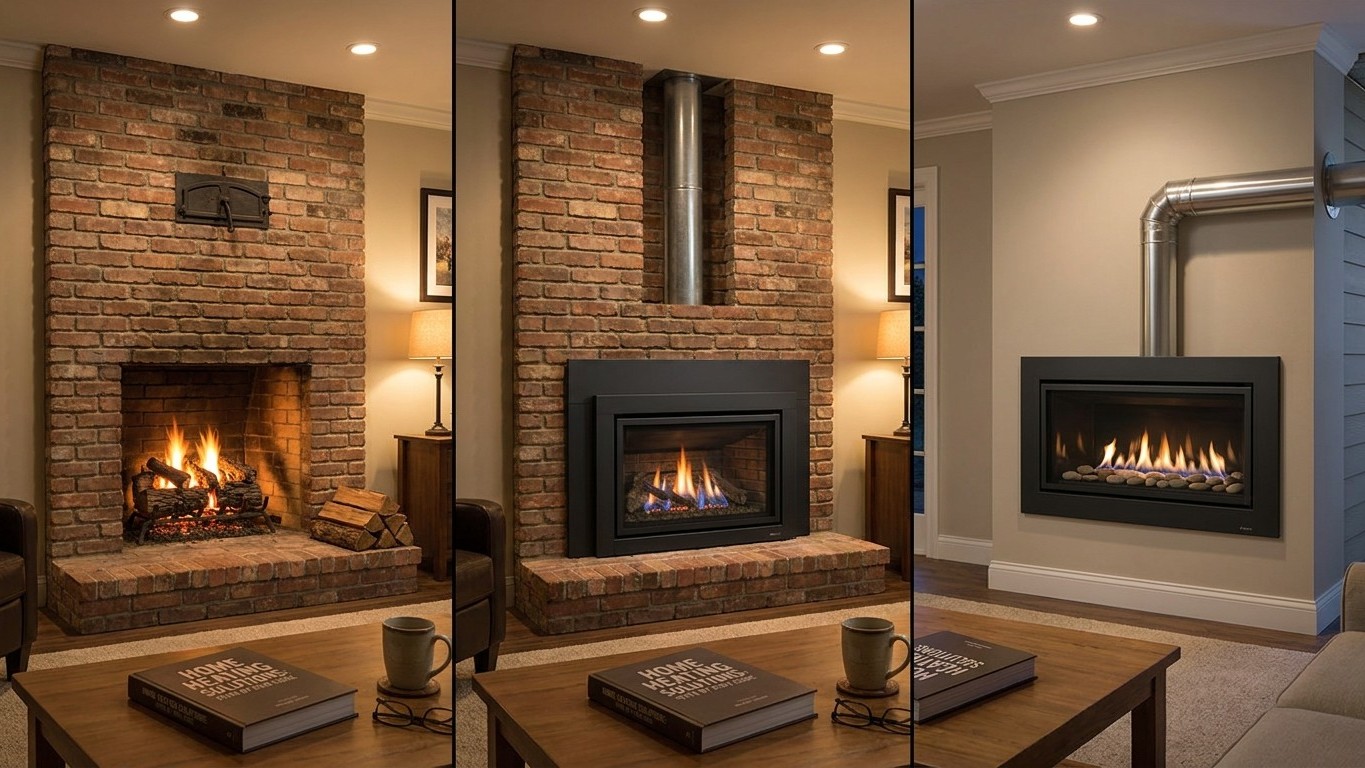

Converting a wood-burning fireplace to gas isn’t one project. It’s three different ones, and the answer to “how do I do this” depends entirely on which one you’re actually asking about. A gas log set slides into an existing firebox with no venting changes. A gas insert seals that opening completely and needs its own flue liner. A direct-vent unit skips the old chimney altogether. Picking the wrong path first is where most confusion starts.
Three different projects, one question

People say “convert to gas” and mean wildly different things. The cheapest option, a vented or vent-free log set, is decorative first and functional second: logs sit on a grate inside the existing masonry opening, connected to a gas line, and the damper stays open (for vented sets) or gets sealed (for vent-free). No new appliance, no sealed firebox, minimal heat output for the vented version. It looks like a fire. It mostly isn’t meant to heat the room.
A gas insert is a different animal entirely. It’s a self-contained, sealed metal firebox that slides into the old masonry opening and gets vented through a liner run up the existing chimney. This is the option people choose when they want the fireplace to actually replace part of the heating bill, not just look pretty on a cold evening. It’s also the option that requires the most structural work: a liner, a gas line, and usually electrical for a fan.
The third path, a new direct-vent unit, isn’t really a “conversion” so much as a demolition and rebuild. The old masonry opening gets bricked over or removed, and a factory-built direct-vent fireplace goes in its place, venting through a wall or a small pipe rather than the original flue. This is the route for homeowners who want a completely different footprint, or whose chimney is in bad enough shape that reusing it doesn’t make sense.
| Project | What it is | What it heats | What happens to the chimney |
|---|---|---|---|
| Gas log set | Decorative logs in the existing firebox | Little to none (vented) / the room directly (vent-free) | Stays as-is, damper open or sealed depending on type |
| Gas insert | Sealed firebox appliance in the old opening | The room, meaningfully, with a blower | Needs a liner sized to the appliance |
| Direct-vent built-in | New factory-built unit replacing the masonry opening | The room, with sealed combustion | Original flue abandoned or removed |
Every one of these three is governed by how it vents. A vented appliance sends combustion products outdoors through a flue. Direct-vent pulls its combustion air from outside and exhausts through a sealed wall terminal. Vent-free releases everything it produces, water vapor included, straight into the room. That distinction decides almost everything else about safety, cost, and what your chimney needs to become.
The chimney is not reusable as-is
Here’s the part that catches people off guard: a masonry flue built for a wood fire is the wrong size and the wrong temperature for a gas appliance. Wood fires burn hot and push a lot of volume up the flue, so that flue was sized generously. A gas appliance burns cooler and produces less volume, and when that smaller output rattles around inside an oversized, unlined masonry flue, the exhaust cools too fast. Condensation forms. Draft gets unreliable. That’s why a gas insert normally goes in with its own liner, a smaller conduit run down inside the old chimney that matches the new appliance instead of the old one.
The liner isn’t optional hardware picked for peace of mind. It’s what makes the appliance work the way it’s designed to. Whether it needs to be insulated, what diameter it has to be, and how it connects at the top and bottom are all decisions the installer makes based on the specific appliance’s venting requirements and on what the local code office requires for that installation. Nobody outside those two references, the appliance’s own installation manual and your local code, should be the one calling that shot.
This is also where the vented-versus-vent-free choice matters again. A vent-free log set doesn’t use the flue for exhaust at all, so it sidesteps the liner question, but it introduces a different one: everything the flame produces stays in the house. Currently manufactured unvented gas-fired room heaters carry an oxygen depletion sensor under the industry’s voluntary standard, a device meant to shut off the gas before carbon monoxide can build to a life-threatening level, according to the U.S. Consumer Product Safety Commission. That standard is voluntary now; the CPSC revoked its own mandatory version back in 1984, by which point the agency says 95 to 100 percent of manufacturers had already fallen in line anyway.
An unvented appliance has no outside vent for what it burns and depends entirely on ordinary room ventilation, the CPSC notes, and inadequate airflow or a poorly adjusted burner can let dangerous levels accumulate. Carbon monoxide has no color and no smell, so a working alarm in the room is the only way a household finds out something’s wrong. That single fact should weigh into which of the three conversion paths makes sense for a given house, well before liner diameter or firebox size ever come up.
Getting gas to the fireplace
None of these three projects work without a gas line reaching the firebox, and that line doesn’t get run by whoever’s handy with tools on a Saturday. It’s a licensed plumber or gas fitter’s job, tied into the home’s existing gas supply, sized for the new appliance’s demand, and pressure-tested before anything gets lit. Depending on the house, that might mean running new pipe through a finished wall, under a floor, or up through a chase built specifically for the insert. It’s frequently the most disruptive part of the whole conversion, more so than the liner work itself.
When you’re getting quotes, ask the installer three things directly: whether the existing gas meter and supply line have capacity for the new appliance without upgrading elsewhere in the house, whether the shutoff valve location will be accessible after the fireplace is finished, and whether the same visit covers both the gas line and the liner, or whether you’re coordinating two separate contractors. Fireplace shops that sell and install gas inserts regularly subcontract the gas line work, and knowing who’s responsible for what before the job starts avoids a lot of finger-pointing later.
This is also the point where the vented-versus-vent-free decision needs to be locked in, because it changes what the installer is even quoting. A vent-free log set might not need a liner at all, just a gas line and a properly sized flame; a vented insert needs both a line and a liner run. If you haven’t settled that question yet, it’s worth working through before calling anyone for a quote, since it changes the scope of the entire job.
Whatever gets installed, the U.S. Fire Administration’s basics still apply the same way they did to the wood fire before it. Keep anything that can burn at least 3 feet from all heat sources including fireplaces, wood stoves, radiators, space heaters or candles. And maintain heating equipment and chimneys by having them cleaned and inspected each year by a professional, gas appliance or not. If at any point during or after installation you smell gas, that outranks everything else on this page: leave the house and call from outside.
Common questions
Can I convert a wood fireplace to gas myself?
The gas line connection and any liner work need to be done by licensed professionals, both for safety and because most local code offices require permits and inspections for gas appliance installations. A homeowner can certainly manage the cosmetic side, like choosing a surround or mantel, but the mechanical work isn’t a do-it-yourself project.
Do I need to remove my chimney to install a gas insert?
No. A gas insert is specifically designed to use the existing masonry opening and chimney, though it needs a liner run through that chimney sized to the new appliance rather than the old wood-burning setup.
Will a gas log set heat my house the way the wood fireplace did?
A vented log set is mostly decorative and produces little usable heat since much of what it generates goes straight up the flue. A vent-free log set puts more of its heat into the room because nothing is vented outside, but that comes with the ventilation considerations described above. A gas insert is the option built for actual heat output.
How do I know if my house is ready for a gas insert versus a log set?
That depends on the condition of your existing chimney, whether gas service already reaches near the fireplace, and how much heat output you actually want from the finished appliance. It’s worth reviewing the vented-versus-vent-free comparison before getting quotes, since that choice determines what an installer needs to check on-site.