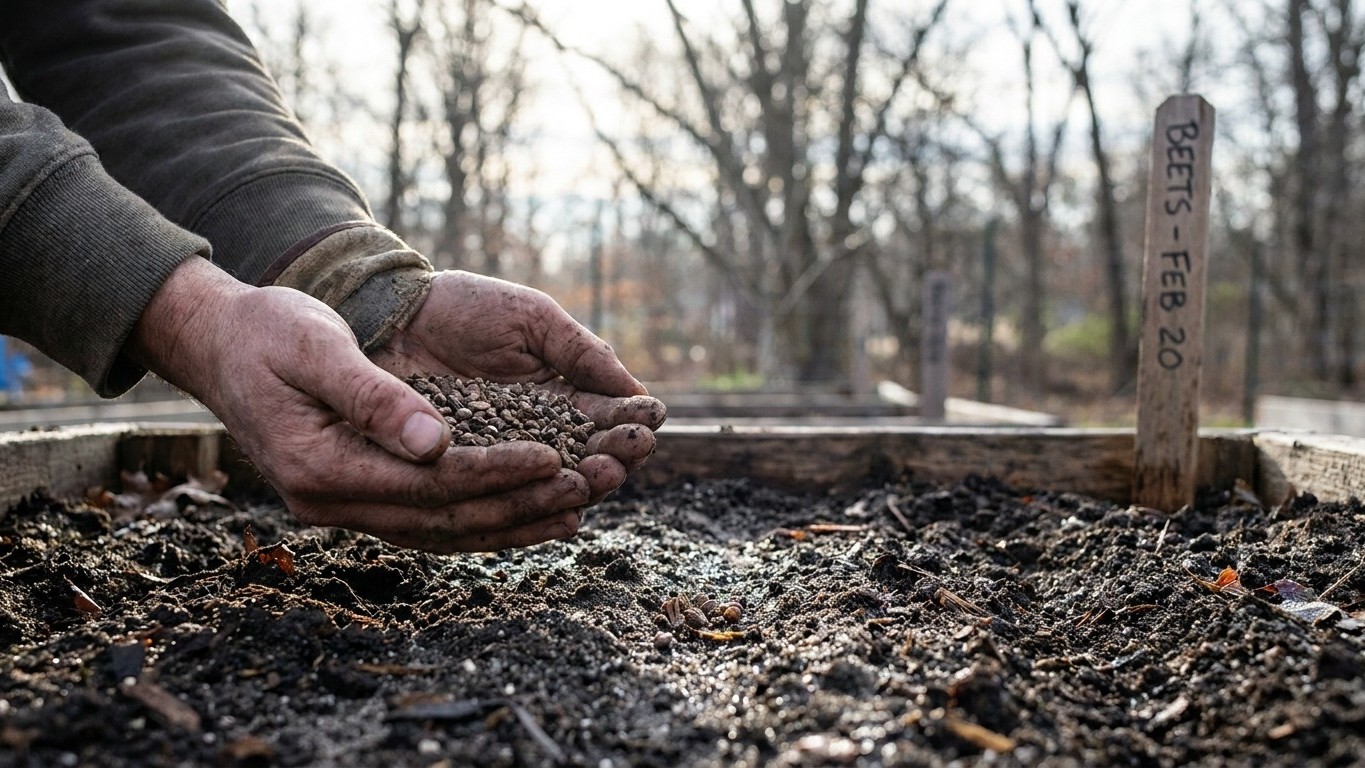

In most of southern Ontario, that means sowing beets two to three weeks ahead of the average last spring frost of April 30, so roughly mid-to-late April for direct seeding into the garden. But that date comes from one weather station, and the soil under your feet may hold water very differently than the province’s typical profile. Here’s what actually decides whether that seed turns into a sweet root or a woody, split one.
The short answer
Ontario’s mapped agricultural soils skew toward Luvisols, a forest-derived order where clay has washed down out of the topsoil over time, leaving a lighter surface layer sitting on a denser clay-rich subsoil. Luvisols cover 39 percent of the province’s mapped surface, more than any other order, with Gleysolic soils a distant second. The median surface reading across nearly 850 mapped components comes out to a loam-to-silt texture: 43 percent sand, 17 percent clay, and 41 percent silt, with organic matter around 4.3 percent and a pH near 6.5, just on the acid side of neutral. Drainage is classed as good.
For a beet, that’s a mixed picture. Beets do best in deep, sandy, well-drained ground rich in organic matter, according to Utah State University Extension, and Ontario’s typical profile checks the organic matter box comfortably at 4.3 percent. But the texture leans heavier and finer than beets prefer, and the defining trait of a Luvisol, that denser clay band sitting below the surface, is exactly the kind of subsoil that can stop a taproot cold and push it sideways or into a fork. A pH of 6.5 sits inside the range most beet growers consider workable, so that part isn’t the concern here. The compaction below the surface is.
On heat, the dataset behind this page doesn’t carry a published count of how many days a year Toronto or any other Ontario city crosses 90°F, so that figure isn’t published here. What the beet research does establish is a mechanism worth carrying forward: temperatures above 85°F combined with water stress make the root turn woody. Southern Ontario summers do produce stretches above that threshold, even without an exact day count on record for this page, which is reason enough to plan irrigation around the hottest weeks rather than assume the Great Lakes moderate everything.
None of this replaces a soil test from your own garden. Ontario spans hundreds of individual soil series across its agricultural belt, and this median describes a starting assumption, not the dirt at the bottom of your raised bed. River flats, drained wetland, and any lot a builder has regraded will read completely differently from the provincial norm.
The six weeks that decide it here
Sowing two to three weeks ahead of April 30 lands most of the crop’s first six weeks in the same stretch every year: mid-April through late May, sliding into early June depending on when you actually got seed in the ground. That window is where the season’s outcome mostly gets decided, because Utah State University Extension ties early water stress directly to premature flowering, not to later heat. The two failures run on separate clocks, and this is the clock that matters first.
Southern Ontario spring in that window tends to swing rather than settle. Cold, wet stretches off the Great Lakes can sit over the region for days, followed by a run of dry, sunny weather that dries out the top few inches of soil fast, especially in a lighter-textured bed that’s been worked and amended. That swing is the risk profile to plan around: not a steady drought, but sudden dry gaps between wetter periods, arriving right when a young beet seedling has the shallowest root system it will ever have.
Because April 30 is an average and not a guaranteed cutoff, treat it as the middle of a range rather than a safe line. Half the years on record at the Toronto Pearson station saw frost arrive later than that date, which means an early sowing carries real frost exposure on top of the moisture swings already described. The practical response is the same one growers use everywhere: watch the ten-day forecast rather than the calendar, and keep row cover on hand for the two or three weeks after seeding, regardless of what the average predicts.
Bolting risk, specifically, concentrates in that first six-week stretch whenever a dry spell lands on a seedling that hasn’t been watered consistently. It has nothing to do with July heat. A beet that bolts in June already made that decision back in April or May, when the soil around its roots went dry for longer than it should have.
What goes wrong here
- Dense subsoil forks the taproot. The clay band typical of a Luvisol sits close enough to the surface in many Ontario gardens to deflect a growing beet root sideways or split it. Loosen the bed to at least 12 inches before sowing, and avoid walking on planting rows to keep that layer from compacting further.
- Silt-heavy topsoil crusts over after rain. With silt making up 41 percent of the median texture, a hard rain followed by sun can seal the surface before tiny beet seedlings push through. Keep a light mulch or a thin layer of finished compost, no more than 1 inch per 100 square feet per Utah State University Extension’s guidance, over the row until germination is done.
- A dry week in the first six weeks triggers bolting. This is the water-stress failure, distinct from heat, and it shows up as a beet that sends up a flower stalk instead of bulking a root. Water on a consistent schedule through mid-to-late May regardless of whether the top inch of soil looks dry.
- Sowing right on the average frost date instead of before it. Since April 30 is a midpoint and not a safe cutoff, seedlings up too early can meet a hard frost in roughly half of all years. Keep cover material ready through mid-May.
- Late-season heat on top of uneven watering turns roots woody. Once temperatures push past 85°F, any lapse in soil moisture at that point produces the fibrous, tough texture beet growers dread. Mulch heavily as summer arrives and keep watering steady rather than letting the bed dry out between soakings.
Common questions
Do I need to test my own garden’s soil before sowing?
Yes. The provincial median described here, a loam-to-silt texture with about 17 percent clay, comes from nearly 850 mapped soil components across Ontario’s agricultural zone, not from any single garden. A basic soil test tells you where your own bed sits relative to that median, particularly on drainage and clay content, both of which matter more to a beet’s root shape than the average does.
How many days does a beet take from seed to harvest in Ontario?
Beets are sown directly in place, and the maturity clock starts at seeding, not at transplant, since beets don’t transplant well. Utah State University Extension doesn’t attach a single Ontario-specific day count on this page’s source material, so growers should track their own sowing date and check root size directly rather than rely on a fixed number.
Are bolting and woody roots the same problem?
No, and treating them as one is the most common mistake. Bolting comes from water stress in the first six weeks after sowing, while a woody root comes from heat above 85°F later in the season, especially when combined with a separate lapse in watering. Fixing one doesn’t fix the other; both call for consistent moisture, but at different points in the plant’s life.
Does Ontario’s slightly acid soil need lime for beets?
The province’s median surface pH runs about 6.5, which sits inside the range beet growers generally consider workable without amendment. That said, this is a provincial median, not your own reading, and a garden that has been heavily composted, limed, or built on fill could sit well outside that number in either direction.