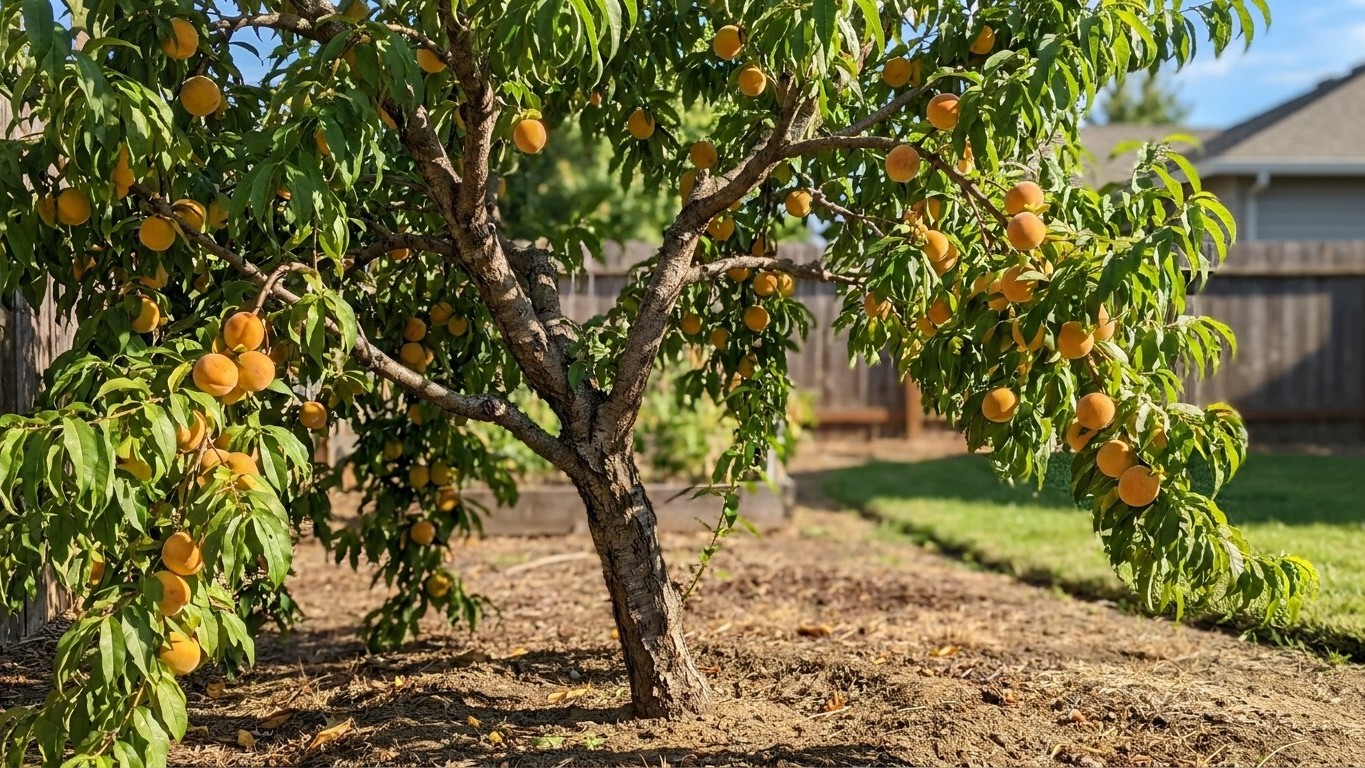

Prunus persica, better known as the peach (and nectarine), survives across USDA zones 5a-9b, but that range only tells you where the wood can take the winter. Whether it actually fruits comes down to full sun, sharp drainage, enough room to grow into an open, spreading tree, and a couple of questions about pollination and bearing age that this fact sheet simply does not answer. Here is what the data says, and where it stops.
Where it will and will not survive
The USDA hardiness range for Prunus persica is 5a-9b. That is the number that matters most for a woody plant, because a tree either survives its coldest winter night or it does not; there is no replanting a fruit tree the way you replant an annual.
Read it as a boundary, not an invitation. Below the bottom of this range, winter cold is expected to kill or severely damage the tree. Above the top of it, conditions fall outside what the species is rated to handle. Neither end is a guess to be confirmed later with a dead tree; it is the reason to check before buying.
A range also describes survival, not comfort. A peach tree hardy to 9b is not necessarily happy there, and one at the cold edge of 5a is not necessarily thriving either, just standing. Where a tree sits inside that band affects how it grows, how reliably it blooms, and how much stress it carries into a fruiting season, even when winter cold alone won’t kill it.
The safest move is to look up your own zone rather than assume one from the county over, since hardiness can shift with elevation and local microclimate. This site’s hardiness zone guide breaks the USDA map down by state and county for exactly that reason.
One more thing worth flagging: the growing data behind this page comes from the North Carolina Extension Gardener Plant Toolbox. The USDA hardiness range itself is a national standard and applies everywhere. Any regional planting advice tied to North Carolina’s own coastal, piedmont, or mountain zones is local to that state and should not be carried over to a reader gardening somewhere else.
What it is called, and why that matters here
The common names in circulation for Prunus persica are Clingstone peach, Common Peach, Freestone peach, Nectarine, Peach, and White peach. The source lists them alphabetically, and none of the six is marked as the official or preferred name, which is exactly why this page is titled with the botanical name instead.
Some of that list needs unpacking rather than picking a favorite. Clingstone and Freestone are not different plants or even different fruit colors; they describe whether the flesh separates cleanly from the pit or clings to it, a trait that varies by cultivar within the same species. White peach refers to flesh color rather than a separate species. Nectarine causes the most confusion of all: it is not a hybrid or a different fruit tree, but the same species carrying a recessive gene that produces smooth, hairless skin instead of the fuzzy coat typical of a peach.
That means a supplier tag reading “Nectarine” and one reading “Peach” can both be Prunus persica, just expressing a single gene differently. It is a genuinely confusing situation, not a case of one name being right and the others wrong, and it is worth knowing before you assume a nectarine and a peach need different care.
Alongside the common names, the source classifies the plant type as Edible, Poisonous, Tree, all at once. That combination is not a contradiction: the fruit is the edible part, while another part of the plant, the seed, carries the poisonous label discussed below. Foliage is deciduous, so expect the tree to drop its leaves each fall and regrow them each spring, standard behavior for this kind of stone fruit.
The site it needs to actually crop
Survival and fruiting are not the same test, and the growing conditions on record for Prunus persica split cleanly between the two.
| Condition | What the source lists | Survival or yield |
|---|---|---|
| Light | Full sun (6+ hours of direct sun daily) | Yield: a tree can live in partial shade but is unlikely to fruit well there |
| Soil texture | Clay, high organic matter, loam (silt), sand | Survival: broad tolerance across texture types |
| Soil pH | Acid (below 6.0), Neutral (6.0-8.0) | Survival: wide range accepted |
| Drainage | Good drainage, moist | Survival: standing water is the more likely threat than dry soil |
| Growth rate | Rapid | Not settled by the facts whether this affects fruiting timeline |
| Maintenance | High | Not settled by the facts what specific tasks this covers |
Full sun is the one condition where the source is unambiguous about the fruiting consequence: less than six hours a day and the tree is working against itself. The soil tolerances, by contrast, read as survival ranges, meaning a Prunus persica can stand in clay or sand, acid or near-neutral ground, without that alone deciding whether it bears fruit.
Habit is listed as open, rounded, spreading, which describes shape rather than a number. The facts here do not give a specific mature spread in feet, and that gap deserves attention rather than a guess, because a spacing mistake is the error that costs a reader the most later, long after a tree is already established too close to a fence, wall, or driveway. Before planting, confirm the exact mature width and height from the nursery tag or grower, since an open, spreading habit at maturity can require considerably more room on both sides than a young sapling suggests.
When it crops, and whether it needs a partner
Bloom time for Prunus persica is listed as spring, given as a season rather than a calendar date, since flowering shifts earlier or later depending on latitude and elevation. What that season tells you matters more than the exact week: peach trees are early spring bloomers by nature, and an early bloomer is the tree a late frost catches. A cold snap after the buds open can wipe out a season’s fruit set even on a tree that survived winter without trouble.
What this page cannot tell you is whether a single tree will set fruit on its own or needs a second, compatible tree nearby to pollinate it. Fruit trees split both ways within the same genus; some Prunus species are self-fertile, others require a partner, and guessing from the family name alone is how a reader ends up with one tree, years of blooms, and no fruit. The same goes for how long a young tree takes to bear its first crop, another figure that varies by cultivar and is not part of this fact sheet.
Both questions are worth asking directly before buying:
- Does this specific tree or cultivar need a second, compatible variety nearby to produce fruit?
- How many years should I expect before it bears its first meaningful crop?
A nursery or supplier selling a named cultivar should have straight answers to both. Planting first and finding out later is the more common, and more expensive, order to do it in.
What the fruit is, and what it is for
The source describes the fruit as a juicy, fleshy stone fruit that ripens in summer, yellow to orange in color and often tinged with red, built around a large, rough pit. Skin covered in fine hairs marks it as a peach; a recessive gene that produces smooth, hairless skin instead marks the same species as a nectarine. Fruit shape runs round to slightly oval, generally about 3 by 3 inches.
On use, the source states plainly: fruit edible raw or cooked. That covers both eating it fresh out of hand and using it in cooked preparations, without the source specifying further detail beyond those two categories.
Anyone who has bitten into a ripe peach knows what that description leaves out: the flesh is sweet, juicy, and fragrant, with enough acidity to keep the sweetness from being flat, which is exactly why it works both eaten plain over a sink and cooked down into something else. That is ordinary sensory knowledge about a fruit most American readers have already eaten, not a claim about any particular cultivar’s sugar content or specific taste profile, which varies tree to tree and is not something this fact sheet addresses.
One warning carries real weight here: the seed, or pit, contains hydrogen cyanide and should be discarded rather than eaten. That applies to the hard stone at the center of the fruit, not the flesh around it, and it is the kind of detail worth passing along exactly as the source states it rather than softening.
What it resists, and what it does not
Resistance, wherever it shows up on a plant label, describes a tendency, not a guarantee. A resistant plant is less likely to be seriously damaged by a given pressure; it is not immune, and calling something deer-resistant is not the same as saying deer will leave it alone.
For Prunus persica, the growing data behind this page does not include a resistance list at all, no pest tolerances, no disease resistance ratings, nothing to compare against a challenge and score as strong or weak. What it does list is that the tree attracts butterflies and other pollinators, which speaks to what visits the flowers, not to what the plant fends off.
That is a real gap, and it is worth naming rather than filling in with assumptions or names of pests and diseases the source never mentions. Stone fruit trees in general face known pressures, but attaching any specific one to this species without it appearing in the sourced facts would be a guess dressed up as data.
There is a second, separate gap layered on top of the first: even a full resistance list for the tree itself would say nothing about what attacks the fruit specifically once it forms. Foliage and fruit face different pressures, and a tree rated tough against whatever affects its leaves or bark can still lose a crop to something that only bothers the ripening peach. This fact sheet carries none of that information either, so treat fruit-specific pest and disease questions as a separate line of research, not something answered here.
Common questions
Can Prunus persica survive in zone 4?
No, based on the USDA range given here of 5a-9b. Zone 4 falls below the bottom of that range, meaning winter cold there is expected to exceed what the tree can tolerate.
Is a nectarine a different tree than a peach?
No. Both are Prunus persica. A nectarine’s smooth, hairless skin comes from a recessive gene within the same species, not from being a separate plant.
Does a peach tree need a second tree to produce fruit?
This fact sheet does not say. Pollination requirements vary by cultivar within the genus, so confirm self-fertility or the need for a compatible partner tree directly with the supplier before planting.
Is the peach pit safe to eat?
No. The source states the seed contains hydrogen cyanide and should be discarded. Only the fruit’s flesh is listed as edible, raw or cooked.