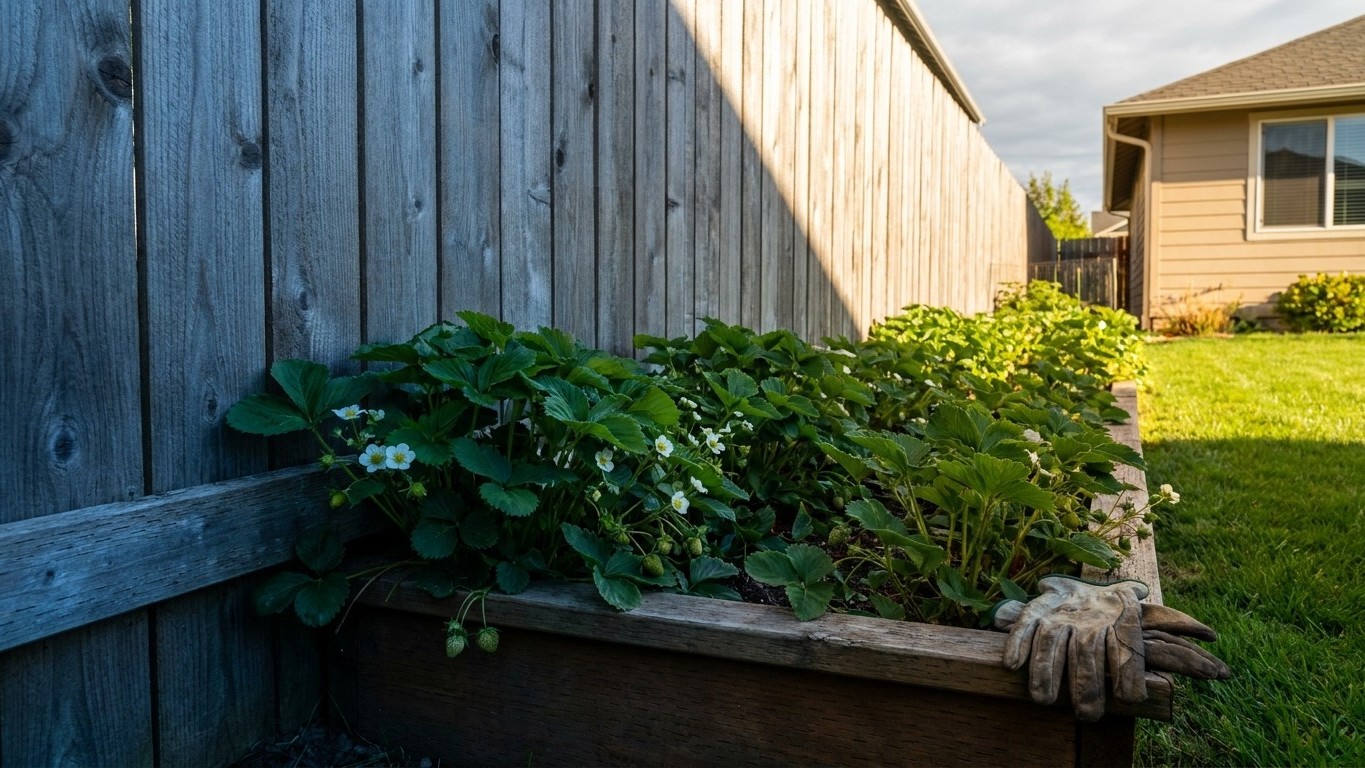

Plant strawberries on the north side of a fence, wall, or slope, and do it on purpose. Utah State University Extension recommends this siting specifically because it delays bloom until the risk of a killing spring frost has passed, protecting the earliest and largest blossoms rather than exposing them to an early, unprotected start.
The short answer
The counter-intuitive advice from Utah State University Extension is direct: Strawberry blossoms are vulnerable to late spring frosts, and those early flowers are the ones that produce the largest berries of the season. A bed with southern exposure warms faster, blooms earlier, and crops sooner, but that head start comes with a cost. Those early blossoms sit exposed right when a late cold snap is most likely to roll through. A north slope or the north side of a fence or building holds late-winter shade a little longer, which keeps the plants dormant and delays bloom until the frost danger has genuinely passed.
This is not a workaround or a compromise. It is the deliberate trade at the center of strawberry siting: you give up a few days or weeks of earliness in exchange for keeping the biggest fruit of the season instead of losing it to a frost that killed the flower before it ever became a berry. Growers chasing the earliest possible harvest sometimes choose southern exposure anyway, and that is a legitimate choice, but Utah State University Extension frames it clearly as the riskier one.
None of this changes the plant’s baseline sun requirement. Strawberries still need at least eight hours of full sun each day of the growing season to produce at their maximum capability, according to the same source. A north-facing site still needs to deliver that sun exposure once the growing season is underway; what changes with north siting is only the pace of warming in late winter and early spring, not the total light the bed receives through summer. The two requirements, plenty of summer sun and a slower late-winter warm-up, are not in conflict once you understand that they operate on different parts of the calendar.
Soil matters just as much as siting. Utah State University Extension specifies loamy or sandy soils as ideal, noting that heavy clay reduces plant vigor and raises disease pressure. Raised beds are the fix where clay is unavoidable, since they solve the drainage problem that clay creates without requiring a different location altogether.
What actually decides it
Why north beats south for frost timing
The mechanism behind the north-side rule is shade, not cold. A north-facing slope or wall blocks the low winter sun just enough to keep soil and buds cooler for longer into the season. That lag delays the plant’s internal signal to break dormancy and push out blossoms. Since the biggest berries of the year come from the earliest flowers, protecting those flowers from a late frost is worth more than getting them a week or two sooner. Utah State University Extension also notes that covering blooming plants with tarps or blankets on cold nights adds a second layer of protection once flowering has begun, whether the bed faces north or not.
Soil texture and salt tolerance
Drainage and salinity decide plant health as much as siting decides bloom timing. Loamy or sandy soils let roots breathe and water move through; heavy clay does the opposite, holding water around the crown and inviting disease. Raised beds correct that without moving the whole planting scheme. Salt is the other threshold worth knowing exactly: strawberry plants are highly sensitive to salt, and Utah State University Extension puts a number on it, greater than 1.8 ECe dS/m causes stunting, marginal leaf scorch, severe yield reduction, and even plant death. That is not a gradual decline you can nurse a plant through. It is a hard line.
Rotation history and disease
Where a bed sat before, and for how long, decides whether disease shows up later. Utah State University Extension advises against keeping strawberry beds in the same place for more than five years, and against planting where peppers, tomatoes, potatoes, eggplant, or okra have grown recently, because those crops harbor the Verticillium wilt pathogen. A new strawberry bed inherits whatever pathogen load is already in that soil, regardless of how well the site is sited or how good the drainage is.
How to do it
- Pick a north-facing slope or the north side of a fence or building for the bed, accepting a later bloom in exchange for protecting the largest early berries from spring frost.
- Confirm the site will still get at least eight hours of full sun each day once the growing season is underway, since north siting only delays late-winter warming, it does not reduce summer light.
- Test the soil and rule out anything with a salt reading above 1.8 ECe dS/m, since that threshold causes stunting, leaf scorch, yield loss, and plant death in strawberries.
- Choose loamy or sandy soil where possible; where the site is heavy clay, build a raised bed to fix the drainage problem instead of relocating.
- Check the planting history of the site and skip any ground that has grown peppers, tomatoes, potatoes, eggplant, or okra recently, since those crops harbor the Verticillium wilt pathogen that will persist in the soil.
- Set out dormant bare-root plants. Because the plants are dormant at planting time, there is no need to wait for frost danger to pass before putting them in the ground.
- Once the plants bloom, watch overnight forecasts and cover blooming plants with tarps or blankets on cold nights to protect flowers and developing fruit.
- Spread winter mulch in late November to protect the crowns through the cold months.
- Apply the season’s fertilizer in August, timed to support the plant heading into the following year’s crop.
- Plan ahead for rotation: mark the calendar to move the bed to new ground within five years, before Verticillium pressure or general soil fatigue sets in.
What goes wrong
- Southern exposure blooms too early and gets frosted. A bed sited for early warmth pushes blossoms out before spring frost risk has passed, and those early flowers, the ones that would have produced the largest berries, are killed outright. The remedy is siting: a north slope or the north side of a structure delays bloom until the danger window has largely closed.
- A cold night catches the plants in bloom anyway. Even well-sited beds can face a late, unexpected frost once flowering starts. Covering blooming plants with tarps or blankets on cold nights protects the open flowers and any fruit that has already set.
- Heavy clay soil chokes the roots. Clay reduces vigor and raises disease pressure by holding water where roots and crowns don’t want it. A raised bed corrects the drainage without requiring a new location.
- Salt levels creep past the threshold. Once soil salinity passes 1.8 ECe dS/m, strawberries respond with stunting, marginal leaf scorch, severe yield reduction, and death. There is no way to nurse a plant back once salt damage is severe; the only real fix is testing soil before planting and avoiding saline ground altogether.
- The bed follows tomatoes, peppers, potatoes, eggplant, or okra. Those crops harbor the Verticillium wilt pathogen, and once it’s established in the soil there is no cure for it. Prevention is the only real answer: skip ground with that planting history, and move strawberry beds to new soil within five years regardless.
Common questions
Does a north-facing bed still ripen fruit on time? It ripens later than a south-facing bed would, since the whole point of the siting is to delay bloom. Utah State University Extension frames this as a trade for protecting the largest early berries from frost, not a way to speed up the season.
Can strawberries be started from seed to save money? Utah State University Extension’s guidance addresses dormant bare-root plants, not seed-started ones. Bare-root plants go into the ground while still dormant, which is also why there’s no need to wait for frost danger to clear before planting them.
How do I know if my soil is too salty for strawberries? A soil test that reports ECe in dS/m will tell you. Anything above 1.8 ECe dS/m puts strawberries at risk of stunting, leaf scorch, yield loss, and death, according to Utah State University Extension.
Is five years a hard rule for moving a strawberry bed? Utah State University Extension advises against keeping a bed in the same spot for more than five years, tied directly to the buildup of the Verticillium wilt pathogen from prior crops like tomatoes, peppers, potatoes, eggplant, or okra. Moving the bed before that point is The Only Way to sidestep a disease that has no cure once established.