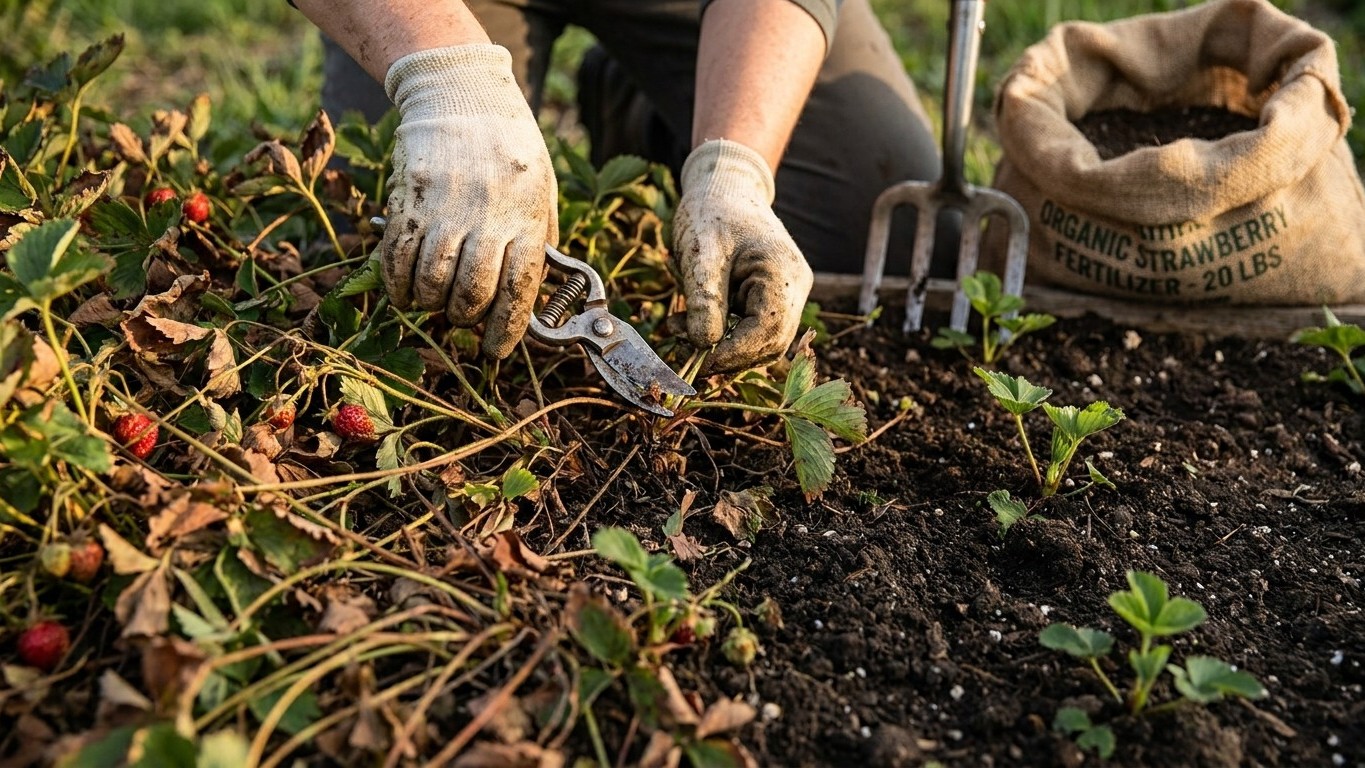

Renovating a Strawberry bed means cutting back, feeding, and thinning the row the moment harvest ends, not in fall and not the following spring. Skip that window and a matted-row planting thins out and declines within a couple of years. Do it on schedule, and the same bed keeps sending up new daughter plants and paying you back season after season.
The short answer
According to Utah State University Extension’s guide Strawberries in the Garden, a matted row of June-bearing strawberries doesn’t produce its first crop until the spring of the second growing season. That’s already a full year of waiting before you see a single berry. Renovation is what protects that investment once the harvest finally starts.
The Extension’s instruction is specific: rows “should be renovated immediately after harvest is complete.” Not weeks later, not once the leaves start to yellow in fall. The task list for that moment includes removing weeds, cultivating the bed down to narrower rows, and fertilizing and irrigating so the planting pushes out new daughter plants and gets them rooted while the season still has warmth left. Growers can also choose to hand-pull the oldest, woody, multicrowned plants to free up space for those new arrivals.
The reason this single pass of work buys another season comes down to how a matted row actually grows. Left alone, a strawberry planting keeps sending out runners until the row turns into a tangle of crowded, aging plants competing for the same strip of soil. Renovation interrupts that decline on purpose. It clears out the competition, feeds the soil right when new roots are forming, and makes room for the plants that will carry next year’s crop. Without it, the same planting that took a full year to reach production starts thinning out just as it hits its stride.
None of this applies to a freshly planted bed still in its first growing season. Those plants get their blossoms removed rather than a renovation cut, because there’s no harvest yet to renovate after. Renovation only enters the picture once a matted row has actually fruited, and from that point on it becomes the yearly task that keeps the bed worth keeping.
What actually decides it
Why the first year skips harvest entirely
Strawberries go into the ground as dormant, bare-root crowns rather than seeds, and because the plants are dormant at planting, there’s no need to wait until all frost danger has passed the way you would with a tender transplant. But that early start doesn’t translate into an early crop. Utah State University Extension notes that a matted-row planting of June-bearers won’t produce its first crop until the second growing season. The blossoms that appear during that first year get removed on purpose, before renovation ever comes into play, so the plant spends its energy building roots and crowns instead of ripening fruit it isn’t ready to support. Renovation picks up the job once that foundation is in place and the bed has actually produced a harvest worth protecting.
Why renovation happens right after harvest, not later
The timing isn’t arbitrary. Doing the work “immediately after harvest is complete” lines up renovation with the exact window when the plant is shifting from fruiting mode into producing new runners and daughter plants. Cultivating the bed down to narrower rows removes the crowding that built up during harvest, and fertilizing and irrigating right then pushes the plant to root those new daughters while the growing season still has enough time left to establish them. Wait until fall and that rooting window has largely closed for the year.
Why old, woody crowns get pulled
A multicrowned plant that’s been in the row for a couple of seasons has already done its best fruiting. Hand-pulling those oldest, woody crowns during renovation isn’t cosmetic tidying, it’s making physical room in the row for the daughter plants that will carry the next crop. Leave them in place and they simply keep competing with younger, more productive plants for the same soil and water.
How to do it
Utah State University Extension lays out renovation as a sequence tied to the harvest itself, followed by two later tasks tied to specific months. Here’s the order:
- As soon as the last berries are picked, remove weeds from the row before they get a foothold in the loosened soil.
- Cultivate the bed, narrowing the matted row so plants aren’t competing shoulder to shoulder.
- Apply 5 to 8 pounds of 10-10-10 fertilizer per 100 feet of row at this renovation stage.
- Irrigate right after fertilizing to promote the formation and rooting of new daughter plants.
- Optionally, hand-pull the oldest, woody, multicrowned plants to make room for the new daughters coming in.
- In August, apply an additional 3 pounds of 10-10-10 per 100 feet of row, timed to ensure good flower bud formation for the following season.
- In late November, spread clean straw or shredded tree leaves over the bed to a depth of 3 to 6 inches. Skip heavy mulches like grass clippings, which smother the plants instead of protecting them.
- Come spring, remove the mulch as soon as new growth starts appearing from the crown, keeping in mind that the emerging flower buds are sensitive to frost once that protection is gone.
What goes wrong
- Skipping renovation altogether. Left unrenovated, a matted row keeps getting more crowded every season until production drops off. The fix is simply doing the work immediately after harvest, every year, rather than treating it as optional maintenance.
- Mulching with the wrong material. Grass clippings and other heavy mulches smother the plants instead of insulating them. Clean straw or shredded tree leaves, spread 3 to 6 inches deep in late November, do the job without suffocating the crowns.
- Removing mulch too casually in spring. Once that protective layer comes off, the emerging flower buds are exposed and sensitive to frost. Pulling mulch the moment new growth appears from the crown is the right cue, but it means staying alert to a late cold snap right after.
- Leaving old woody crowns in the row. Multicrowned plants that have already had their best seasons keep taking up space and resources. Hand-pulling them during renovation clears room for the new daughter plants that will actually produce next year’s crop.
- Skipping the August fertilizer application. The renovation-time feeding isn’t the only one that matters. Missing the additional 3 pounds of 10-10-10 per 100 feet in August can mean weaker flower bud formation for the following season’s crop.
- Plant viruses. Some problems that show up in an aging or declining bed trace back to viral infection rather than poor renovation timing, and there’s no cure once a plant is infected. The only real response is removing affected plants rather than trying to nurse them back.
Common questions
When exactly should you renovate a strawberry bed?
Immediately after harvest is complete, according to Utah State University Extension. There’s no calendar date attached; the trigger is the end of the fruiting period, not a specific week of the year.
Does this same renovation process apply to everbearing or day-neutral varieties?
The renovation routine described by Utah State University Extension, including the timing right after harvest, the fertilizer rates, and the narrowing of rows, is written specifically for matted-row plantings of June-bearing strawberries. The source doesn’t detail an equivalent renovation schedule for everbearing or day-neutral types, so it’s worth treating those as a separate case rather than assuming the same steps apply.
What happens if you skip renovation for a year?
The row doesn’t get the benefit of thinned competition, fresh fertilizer timed to root formation, or removal of the oldest woody crowns. Over time that shows up as a more crowded row and a decline in productivity, since the whole point of renovation is interrupting that overcrowding before it sets in.
How long does a properly renovated bed keep producing?
Utah State University Extension frames renovation as the practice that keeps a planting “productive for multiple seasons,” repeated as an annual task right after each harvest rather than a one-time fix. The bed’s productive life depends on keeping up that yearly cycle, not on a single renovation early on.