
Carrots take 70 to 100 days from seed to harvest, and because the crop is sown directly in the ground rather than transplanted, that clock starts the day seed touches soil, not weeks later. Counting Back From your local last frost date only works once you know that date for your part of Oregon, since the state runs from coastal valleys to high desert. But before any calendar math matters, there’s a bigger question: what’s actually in the ground you’re planting into?
The short answer
Oregon’s official state soil is the Jory series, named by state law in 2011 and recognized under the USDA NRCS State Soils program. It’s an Ultisol, a soil type that’s old, heavily weathered, and leached of nutrients over a long stretch of time. The surface layer runs slightly acid, with a pH around 5.6, and it’s a clay-heavy mix: 14 percent sand, 34 percent clay, and 52 percent silt, with organic matter sitting around 5.0 percent. Despite all that clay, it’s classified as well drained.
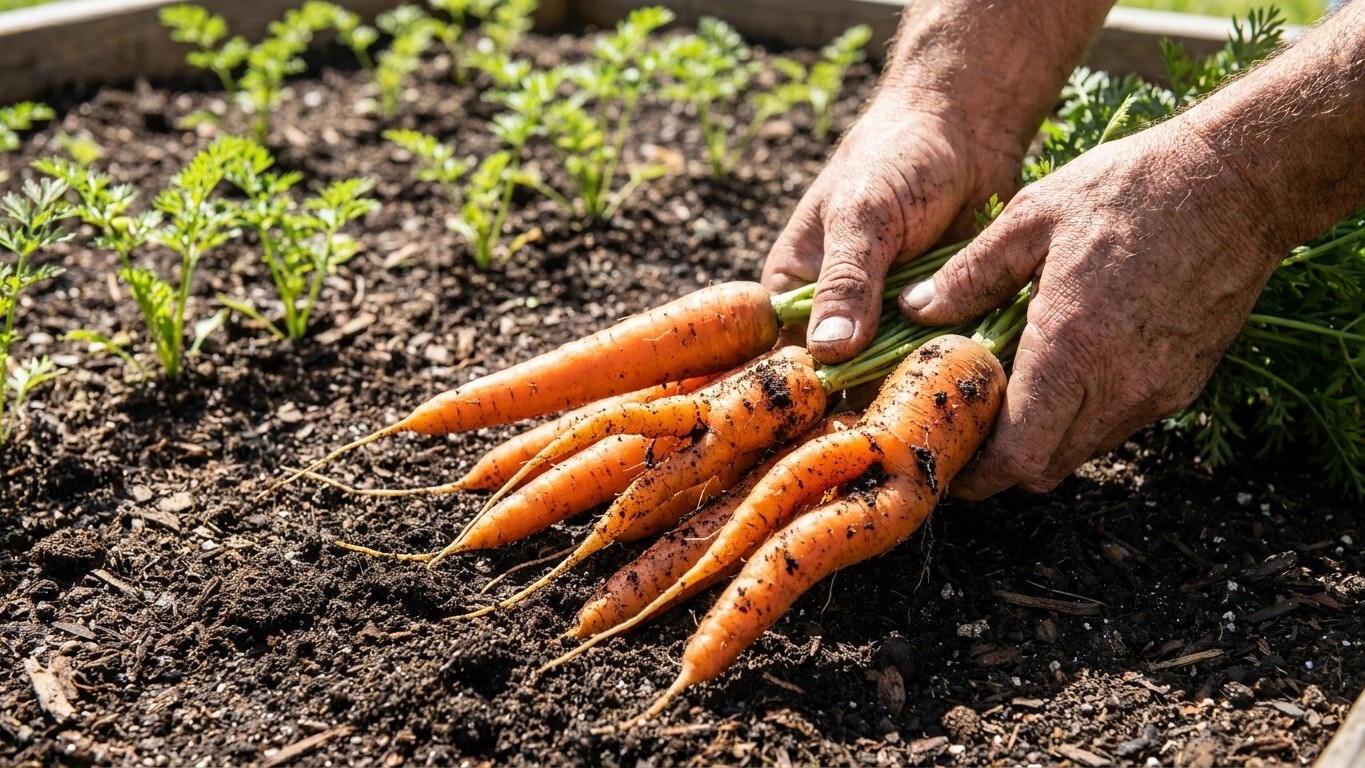
That combination sends a mixed signal for carrots. Carrots want deep, sandy, well-drained soil rich in organic matter, according to Utah State University Extension. Heavy or rocky ground makes the root fork instead of growing straight, because the taproot hits resistance and splits around it rather than pushing through. Jory’s drainage checks out fine, but a soil that’s 34 percent clay and 52 percent silt is a long way from the loose, sandy texture a carrot root prefers. Left unamended, that kind of ground is a strong candidate for forked, stubby, or twisted roots.
The fix isn’t a different vegetable or a different variety. Utah State University Extension is direct about the remedy for heavy soil: plenty of compost worked in, plus double digging to loosen the ground well below where the root will travel. Where the clay runs deep or the yard has been graded and compacted by past construction, a raised bed filled with a loose, amended mix sidesteps the problem entirely rather than fighting it season after season.
Here’s the catch with all of this: the Jory series describes what the state’s soil scientists consider representative ground for Oregon as a whole, drawn from measurements across 119 mapped components of that series. It is not a description of your backyard. Oregon carries hundreds of distinct soil series across its valleys, foothills, and river terraces, and a lot has changed once a builder, a farmer, or decades of yard work have touched a particular lot. Treat the Jory numbers as a starting point for what the region’s ground tends to do, not a diagnosis of the bed you’re about to plant.
The test that settles it in your own garden
State soil surveys can’t tell you what’s twelve inches under your own tomato bed. The only way to know is to check it yourself, and none of it requires lab equipment.
- Dig a test hole at least a foot deep. Use a spade or a long trowel where you plan to sow carrots, and pay attention to how easy or hard the digging is. Hitting rock, hardpan, or a dense clay layer partway down tells you the root zone is shallower than it looks from the surface.
- Look at what comes out of the hole. Stones, gravel, or chunks of dense, sticky clay are red flags for forking. Loose, crumbly soil with few obstructions is a better sign.
- Do a hand-texture check. Take a moist handful and squeeze it into a ribbon between your thumb and fingers. Soil that ribbons long and feels slick leans heavy in clay. Soil that won’t hold together at all leans sandy. Something in between, that holds a shape briefly and then crumbles, is closer to a workable loam.
- Watch how the hole drains. Fill your test hole with water and come back later in the day. If the water is still sitting there, hasn’t moved, and the surrounding soil stays soggy, drainage is poor and roots will struggle for oxygen. If it disappears quickly and the soil dries out fast, you’re dealing with sandy, fast-draining ground that will need more organic matter to hold moisture for germination.
None of these steps replace a formal soil test if you want pH and nutrient numbers, but they answer the one question that actually determines whether carrots will grow straight in that spot: is the ground loose enough, deep enough, and drained well enough for a taproot to move through it undisturbed.
What goes wrong here
- Forking in heavy ground. Clay-rich soil like Jory, or any garden bed with a similar tight, silty texture, resists the taproot as it grows down, and the root splits or curls around obstructions instead of running straight. Utah State University Extension’s answer is to work in generous amounts of compost and double dig the bed before sowing, loosening the soil well past the depth the root will reach. Where the clay runs deep, a raised bed filled with a looser mix removes the problem instead of managing around it.
- Poor germination during a hot spell. Carrot seed is small and sits close to the surface, and a heavy or silty soil surface can crust over as it dries, sealing in the moisture the seed needs and blocking the tiny seedling from pushing through. A sudden warm, dry stretch right after sowing makes this worse. Keeping the seedbed consistently moist through germination, and a light covering that shades the surface without smothering it, keeps that crust from forming in the first place.
- Splitting from uneven water. Roots that get a dry stretch followed by a heavy soak tend to grow fast and crack under the sudden swelling. This shows up most in beds that dry out between waterings and then get flooded rather than watered on a steady rhythm. An even watering schedule, rather than sporadic deep soaks, keeps root growth steady instead of stop-and-start.
Common questions
Can I sow carrots directly in Jory soil without amending it?
Given its 34 percent clay content, sowing directly into unamended Jory-type ground puts carrots at real risk of forking. Utah State University Extension’s guidance for heavy soil is to work in compost and double dig before planting, or to build a raised bed with a looser mix if the clay runs deep.
How do I know if my garden matches the state soil?
You won’t know without checking. The Jory series is one soil type among hundreds mapped across Oregon, and the only reliable way to know what’s under your own beds is to dig a test hole, feel the texture, and watch how it drains, as outlined above.
Does Oregon’s soil pH affect carrot growth?
The Jory series runs slightly acid at the surface, around pH 5.6. That figure describes the mapped state soil, not your garden’s actual pH, which can vary widely depending on your specific soil series and any amendments made over the years. A soil test is the only way to know your bed’s actual number.
Should I use raised beds for carrots in Oregon clay soil?
Where a test hole shows dense, sticky clay with poor drainage, a raised bed filled with a loose, well-drained mix is often simpler than trying to double dig and amend heavy native ground every season. Where the native soil turns out looser and drains well, in-ground beds with compost worked in can work just as well.