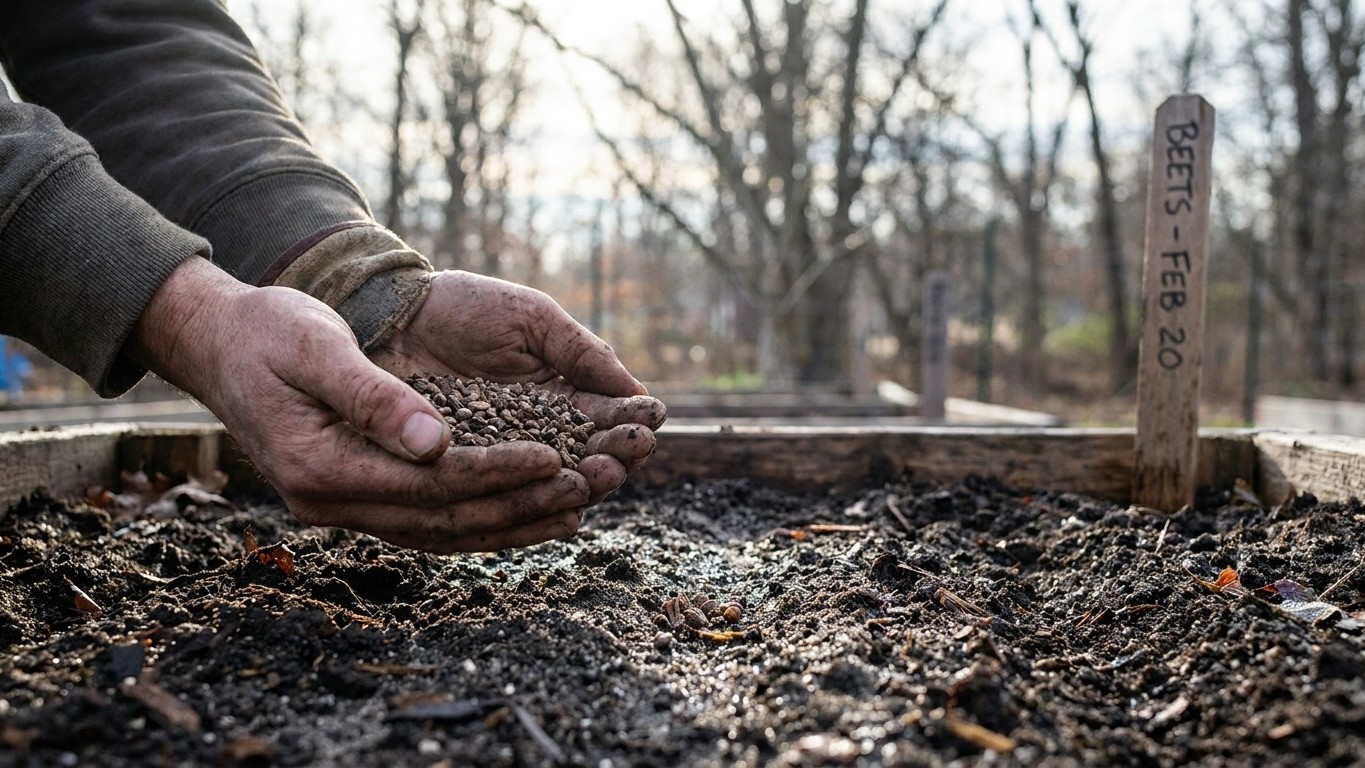

The direct answer: sow beets outdoors in Prince Edward Island roughly two to three weeks before the average last spring frost, which the Charlottetown A station puts at May 16. That lands most sowings in late April to early May, as soon as the ground can be worked. From there, succession sowings can carry beets through the growing season, since the crop is direct-seeded and never transplanted.
The short answer
Prince Edward Island’s mapped agricultural soils lean overwhelmingly toward Podzol, the acid, leached profile that forms under conifer cover once rain has stripped the bases out of the topsoil. It covers about 33 percent of the province’s mapped surface, more than any other order, and the median surface reading across 542 sampled components comes in strongly acid, around pH 4.8. Texture runs sandy: 66 percent sand, 7 percent clay, 27 percent silt, with organic matter around 2.2 percent and drainage classed as imperfect.
For a beet, that mix is a mixed bag. Utah State University Extension notes that beets want deep, sandy, well-drained soil rich in organic matter, so PEI’s sand content is an asset. But 2.2 percent organic matter is thin, and the same guidance caps amendment at no more than 1 inch of composted material per 100 square feet, worked in before sowing rather than added heavily all at once. “Imperfectly drained” is the other flag: a sandy topsoil can still sit wet if what lies beneath it doesn’t move water well, which matters for a seed that rots easily in soggy ground.
On heat, the extension research is specific about the threshold that hurts a beet: air above 85 F combined with water stress is what turns a root woody. How many days a year Charlottetown crosses 90 F isn’t published in the records used for this page, so no count is given here, but it’s worth knowing that the 85 F woodiness threshold sits below that mark anyway, which means even a mild, humid Island heat spell can matter if the soil has gone dry at the same time.
None of this is a verdict on any one garden. Prince Edward Island’s agricultural land runs across hundreds of mapped soil series, and the Podzol median described here is a starting point, not a diagnosis. Coastal loam, a river-bottom pocket, or a lot that’s been graded and filled for a house can all behave nothing like the provincial median. A soil test remains the only way to know what’s actually under a given yard.
The six weeks that decide it here
Sowing two to three weeks ahead of the May 16 average last frost means the first six weeks of a beet’s life on Prince Edward Island fall into a fairly well-known stretch of the Island’s spring. Wrapped by the Gulf of St. Lawrence and the Northumberland Strait, PEI’s spring tends to run cooler and damper for longer than inland areas at a similar latitude, with soil lagging behind air temperature into May. That maritime dampness cuts two ways for a beet crop.
On one hand, a spring that stays consistently moist works in the crop’s favor during the exact window that matters most. Utah State’s research is specific that water stress in the first six weeks is what pushes beets to bolt, sending energy into a flower stalk instead of a root. A cool, damp Island spring, if it holds, lowers that particular risk compared with a region prone to early dry spells.
On the other hand, the same imperfectly drained, sandy-over-slow soil described earlier can sit wet after a run of spring rain, which slows germination and invites rot rather than drought stress. And the frost date itself needs a plain caution: May 16 is a mean from Environment and Climate Change Canada’s 1981-2010 normals, not a safe cutoff. In one year out of two, the last frost falls later than that date. Sowing on the early edge of the two-to-three-week window, in a spring that turns out colder than average, can put young beet seedlings in the ground before the real frost risk has passed, a separate concern from the bolting risk tied to dry soil, and one worth watching soil and forecast for rather than the calendar alone.
The Charlottetown A record is also just one station. Northern or upland districts of the Island commonly run behind it, so a garden well outside the Charlottetown area should treat the whole window as shifted later, not identical.
What goes wrong here
- Wet, cold seed rot after a rainy spring stretch. The province’s imperfectly drained profile, layered under sandy topsoil, can pool moisture right where beet seed sits. Raised rows or raised beds give the excess water somewhere to go and keep seed from sitting in saturated ground.
- Bolting from an early dry snap. Even in a generally damp Island spring, a week or two without rain during those first six weeks is enough to trigger the water stress that sends beets to seed instead of root, per Utah State’s findings. Consistent watering through that early window, rather than watering only when the soil looks visibly dry, is the fix.
- Thin, low-organic-matter soil starving the root. At roughly 2.2 percent organic matter, the province’s typical soil doesn’t carry much reserve fertility for a root crop. Work in compost ahead of sowing, capped at the recommended 1 inch per 100 square feet so the bed isn’t over-amended.
- Woody roots from a summer heat-and-dry combination. Beets that cruise through a cool, damp spring can still turn tough later if a warm spell above 85 F coincides with dry soil. Mulch and steady watering during any hot stretch protect root texture even after the bolting risk has passed.
- Sowing too early against a variable frost date. Because the May 16 average is a midpoint and not a guarantee, an early sowing in the two-to-three-week window can meet a late frost in roughly half of all years. Watching soil condition and short-range forecasts, rather than sowing strictly by date, reduces that risk.
Common questions
What is the best month to sow beets in Prince Edward Island?
Based on the Charlottetown A station’s average last frost of May 16, sowing two to three weeks earlier puts most plantings in late April to early May. Gardens outside the Charlottetown area, especially northern or upland districts, should expect that window to run later.
Can beets be sown more than once in a season on PEI?
Yes. Because beets are direct-seeded rather than transplanted, later sowings can follow the first once soil conditions allow, giving a spread harvest rather than one large crop maturing all at once. Each sowing still needs its own six-week window of steady moisture to avoid bolting.
Does Prince Edward Island’s acidic soil affect beets?
The province’s mapped Podzol soils run strongly acid, with a median surface pH around 4.8. Utah State University Extension’s guidance for beets focuses on soil depth, drainage, and organic matter rather than a specific pH target, so the practical step here is a soil test on the actual garden plot rather than assuming the provincial median applies.
Why do beets bolt or turn woody in Island gardens?
These are two separate failures with two separate causes. Bolting comes from water stress during the first six weeks after sowing, when the plant is still small. Woodiness comes later, when air temperature above 85 F combines with dry soil during root growth. Keeping soil consistently moist addresses both, but at different points in the season.