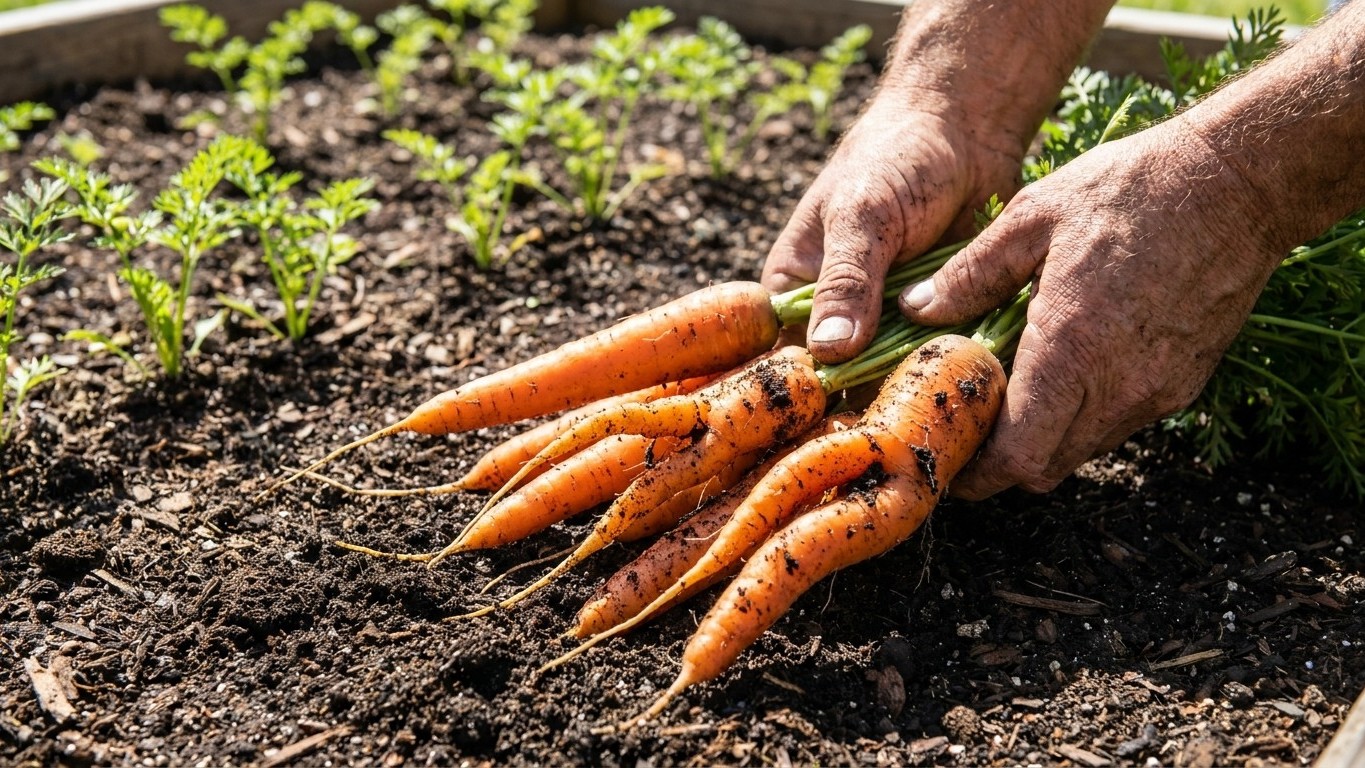

Sowing carrots in Quebec means dropping seed directly into the ground once it can be worked in spring, timed backward from your local last-frost date since carrots run 70 to 100 days from seeding to harvest, with no transplant step to shift that math. But hitting the right week does little good if the ground itself twists the root as it grows. Across Quebec’s farmland, one soil profile shows up more than any other, and it changes how you should plan the bed before you ever touch the calendar.
The short answer
The most common soil across Quebec’s mapped agricultural land is a Podzol, the acid, leached soil type that forms under conifer stands where centuries of rain have washed the mineral bases out of the topsoil. It covers about 36 percent of the mapped surface, more than any other order, with Gleysolic soils, typically wetter and slower to drain, running second. Where the Podzol shows up, the median surface reading works out to roughly 51 percent sand, 15 percent clay and 34 percent silt, a loam to sandy loam, with organic matter around 6.2 percent and a surface pH near 5.5, on the slightly acid side. Drainage in this profile is classed as well drained.
Quebec’s dominant profile, translated for a carrot bed
That texture is closer to what a carrot wants than a lot of gardeners assume. Utah State University Extension is blunt about the crop’s preference: carrots want deep, sandy, well-drained soil rich in organic matter, and heavy or rocky ground makes the root fork rather than run straight. A sand-dominant loam with under a fifth clay and good drainage does not fit the description of “heavy” soil that forces a fork. The organic matter figure, at 6.2 percent, is respectable too, though the source gives no target number to compare it against, so treat that as a favorable sign rather than a guarantee.
Where it still goes wrong
The catch is that 36 percent leaves 64 percent of the mapped surface in something else, and Gleysolic ground, second most common, behaves nothing like a well-drained Podzol. If your plot sits low, holds water after rain, or has been built up with fill by a previous owner, none of the median numbers above apply to you. Where the ground does run heavy, rocky, or compacted, whatever soil order it technically belongs to, the fix is the same one Utah State names: work in plenty of compost, double dig to break up the compacted layer, or skip the fight entirely and grow in a raised bed filled with loose, amended soil.
Treat every figure above as a starting point, not a verdict on your own dirt. A single province spans hundreds of distinct soil series, and the survey behind these numbers covers only the mapped agricultural regions, not the far north of the province. A backyard plot half a mile from a river, a patch of muskeg, or ground a contractor scraped and refilled during construction can sit nowhere near the median. The only way to know what you actually have is to check it yourself.
The test that settles it in your own garden
None of the provincial figures above can tell you what’s under your own raised bed or backyard plot. A short hands-on check will, and it takes less time than a trip to the garden center.
- Dig a hole where you plan to sow, going down as deep as your spade will comfortably reach, and look straight down the sides. Note the color change between layers, any stones or gravel you hit, and how far down the loose topsoil actually runs before it turns dense or compacted.
- Pull a handful from partway down the hole and squeeze it. If it holds a tight ribbon shape and feels slick, you’re dealing with a clay-heavy soil that will fork a carrot root unless it’s loosened and amended. If it falls apart the moment you open your hand and feels gritty, that’s sand leaning toward the other extreme, fast-draining but often short on the organic matter carrots need to hold moisture evenly.
- Fill the hole with water and watch what happens. Water that vanishes almost immediately points to a fast-draining, sandy profile. Water that sits and barely moves for a long stretch signals poor drainage, closer to a Gleysolic profile than the well-drained Podzol that dominates the province’s mapped farmland, and a strong candidate for a raised bed instead of an in-ground row.
- Check for stones and hardpan by pushing a metal rod or a long screwdriver straight down. Where it stops well short of a foot or two, you’ve found a compacted or rocky layer that will deflect a growing taproot exactly the way heavy clay does, and the same remedy applies: break it up, or build up instead of down.
None of these steps replace a lab soil test, but they take under an hour and they’ll tell you more about your own bed than any provincial average ever could.
What goes wrong here
- Forking roots in heavy or rocky pockets. Even where the provincial median leans sandy loam, plenty of individual yards sit on compacted, clay-rich, or stony ground that splits a taproot into two or three legs the moment it hits resistance. Work in generous compost and double dig the bed before sowing, or sidestep the problem with a raised bed filled with loose, amended soil.
- Poor germination during a hot, dry stretch. Carrot seed is slow to sprout under the best conditions, and a crusted, dried-out surface layer stalls it further or stops it cold. Keep the seedbed consistently damp until seedlings appear, and a light mulch or a board laid over the row until germination starts can help hold moisture where a hot spell would otherwise bake the surface.
- Splitting roots from uneven watering. A dry spell followed by a heavy soak swells the root faster than the skin can stretch, and it cracks. A steady watering rhythm, rather than feast-or-famine watering, keeps roots growing at an even pace all season.
- Slow, stunted growth on unamended acid ground. The provincial median surface pH sits near 5.5, on the acid side. The source behind these numbers gives no ideal pH target for carrots, so this isn’t grounds to add lime on a guess, but it is a reason to run a basic soil test on your own bed if growth looks weak despite decent texture and drainage.
Common questions
Does Quebec’s soil need lime before planting carrots?
The province’s dominant mapped soil runs slightly acid, with a median surface pH near 5.5, but no source cited here gives a target pH for carrots, so there’s no fixed number to aim for. If growth looks poor despite good texture and drainage, a soil test on your own bed is the way to check, rather than adding lime on assumption.
Can carrots grow directly in clay-heavy soil in Quebec?
They can, but the roots will likely fork unless the ground is amended first. Working in plenty of compost and double digging to loosen the compacted layer is the standard fix; a raised bed filled with loose, amended soil is the simpler workaround where the clay runs deep.
How long from sowing to harvest should I count?
Carrots run 70 to 100 days from the day you sow the seed, since the crop is never transplanted. That window, not a transplant date, is what you count backward or forward from when planning around your local last-frost date.
Is the soil the same across all of Quebec?
No. The Podzol profile described here is the most common one found across the mapped agricultural regions, covering roughly 36 percent of that surface, with Gleysolic soils a close second. A province spans hundreds of distinct soil series, the survey doesn’t cover the far north, and any individual yard, especially one disturbed by construction, can look nothing like the median.