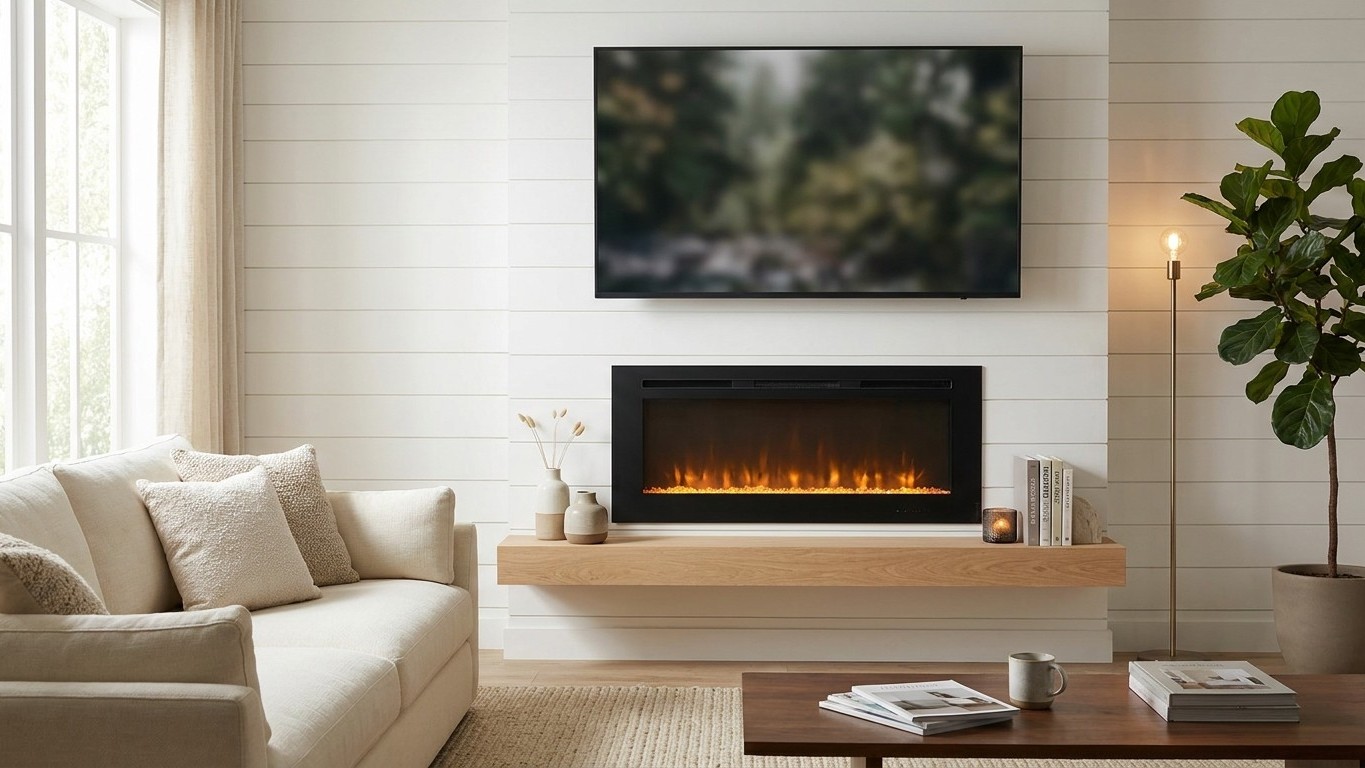

Yes, in most cases a TV works fine above an electric fireplace. Unlike a wood or gas unit, an electric fireplace burns nothing, so there’s no flue heat, no soot, and no open flame threatening the screen. The real variable is airflow: where the unit’s grille sends its warm air. Check the owner’s manual before mounting anything, because that single detail changes the answer from “sure” to “not there.”
Usually yes, and here is why
An electric fireplace isn’t a fire at all. It’s a heater with a light show. The flickering flame effect comes from LEDs and a moving reflector, nothing more; the actual warmth comes from a resistive heating element and a fan, the same basic setup you’d find in a portable space heater. That distinction matters for a TV mounted above, because it means there’s no combustion byproduct rising up the wall the way there is with a gas insert or a wood-burning firebox.
No flue means no chimney heat baking the drywall behind a mounted screen. No combustion also means no carbon monoxide, no need for combustion air, and no water vapor condensing inside the wall cavity, three things that genuinely complicate TV placement above gas appliances. An electric fireplace sidesteps all of it. That’s the honest advantage of the category, and it’s the main reason installers treat electric units so differently from anything that burns fuel.
The wattage tells the real story
A plug-in electric fireplace running on a standard 120-volt household circuit is built at or below roughly 1,500 watts, which works out to about 5,000 Btu per hour. That’s enough to warm one room. It is not a furnace, and it isn’t pushing house-level heat loads up a wall. Compare that to how much energy a gas fireplace insert can put out, and the gap explains why electric units get an easier pass for above-mount television placement.
None of this erases basic caution around any heat-producing appliance. The U.S. Fire Administration is direct about it: “Keep anything that can burn at least 3 feet from all heat sources including fireplaces, wood stoves, radiators, space heaters or candles.” A television isn’t flammable in the way a curtain or a stack of newspapers is, but the spirit of that guidance still applies to clearance and common sense. The agency also reminds people to “Turn space heaters off when leaving the room or going to bed,” and an electric fireplace’s heating function is, functionally, a space heater built into a mantel. Treat it like one.
So the mechanism that makes a TV above an electric fireplace generally fine isn’t the absence of flame. It’s the absence of combustion. What still needs checking, every time, is where that 1,500-watt heater actually sends its warm air once the fan kicks on.
Front-venting and top-venting
This is the detail that actually decides the answer, not the general category of “electric fireplace.” Manufacturers build these units two different ways. A front-venting model pushes its warm air out through a grille near the base or front face, aiming that airflow into the room, roughly at ankle to knee height for anyone standing nearby. A top-venting model does the opposite: the grille sits along the upper edge of the unit, and the warm air rises straight up the wall in front of it.
See the problem. A top-venting unit installed under a mounted television is aiming a steady stream of warm air directly at the screen, hour after hour, every time the heater runs. Electronics don’t love sustained heat exposure. Manufacturers of both fireplaces and TVs publish operating temperature ranges for a reason, and repeated exposure to warm airflow can shorten the working life of a display or trigger a unit’s internal thermal shutdown sooner than expected.
How to identify which type you have
Look for the vent grille itself. It’s usually a slotted or perforated panel, either running along the top edge of the fireplace surround or set into the lower front panel below the flame display. If you can’t tell by looking, the installation manual will specify it in plain language, often with a diagram showing airflow direction. That same manual will list a minimum clearance distance from the top of the unit to anything mounted above it, including a television, and that number is not a suggestion to skip.
| Vent type | Airflow direction | TV-above compatibility |
|---|---|---|
| Front-venting | Out into the room, low angle | Generally suitable, check listed clearance |
| Top-venting | Upward along the wall | Avoid mounting a TV directly above; airflow hits the screen |
If the unit is top-venting and the television location is non-negotiable (say, it’s the only wall that fits the room layout), the workaround isn’t to ignore the manual. It’s to look at recessed or built-in electric fireplace models designed with rear or side venting specifically so the wall space above stays clear, or to shift the TV mount off-center enough that it’s outside the direct airflow path. Either option beats running a top-venting heater straight at a screen for years and hoping nothing degrades.
Height, comfort and the neck
Heat clearance isn’t the only reason to pause before drilling into that wall. Even with a fireplace that vents perfectly safely below a mounted screen, the mantel-and-TV stack usually puts the display noticeably higher than where eyes naturally land during relaxed viewing. Fireplaces sit at a standard mantel height for a reason tied to the fire, not the screen, and stacking a TV on top of that inherits a height problem that has nothing to do with electricity or venting at all.
Ergonomics research on screen viewing, the kind used by workplace safety and display manufacturers alike, generally points to eye level or slightly below it as the comfortable zone for a monitor or television watched for extended periods. Mount a screen well above that line, and the viewer’s neck tilts back to compensate. Do that for a two-hour movie and it’s tolerable. Do it every evening for years and it’s the kind of low-grade strain that shows up as stiffness nobody quite connects to the TV on the wall.
What to measure before you drill
Sit in the main viewing spot, whether that’s a sofa or a recliner, and mark eye height with a piece of tape on the wall. That’s the target center-point for the television, not the fireplace mantel. Then measure the vertical distance from that mark down to the top of the fireplace surround. If that gap is small, mounting close to standard eye level might actually work with this particular fireplace. If the gap runs a foot or more, a swivel or tilting mount can help correct the angle, tipping the screen downward to reduce the upward eye strain even when the mount point itself sits high.
Some households solve the whole problem by choosing a wall-mounted electric fireplace positioned lower, or a smaller freestanding unit placed elsewhere in the room, and hanging the TV at proper eye height on a separate section of wall entirely. There’s no rule requiring the two to share the same vertical axis just because that’s the familiar living-room arrangement. Function first, then aesthetics; it’s a wall, not a shrine.
Common questions
Does an electric fireplace produce enough heat to damage a TV mounted above it?
A standard 120-volt plug-in unit runs at or below about 1,500 watts, roughly 5,000 Btu per hour, which is a modest, single-room heat load rather than an industrial output. Direct, sustained airflow from a top-venting model is the actual risk, not the appliance’s overall wattage.
Do electric fireplaces produce carbon monoxide risk for a TV or a room?
No. Electric fireplaces burn nothing, so there’s no combustion, no carbon monoxide, and no need for a flue or combustion air supply, unlike gas or wood-burning units.
How do I know if my fireplace is front-venting or top-venting?
Look for the grille location: a panel near the base or front face means front-venting, while a grille along the top edge means top-venting, aiming warm air up the wall. The installation manual states this directly along with a minimum clearance figure for anything mounted above.
Is mounting a TV above a fireplace bad for my neck even if the heat is fine?
Often, yes. Mantel height typically sits well above comfortable eye level for seated viewing, so a TV placed directly above can force a prolonged upward neck tilt. Measuring eye height from the main seating spot before mounting, and using a tilting bracket if needed, addresses this separately from any heat concern.