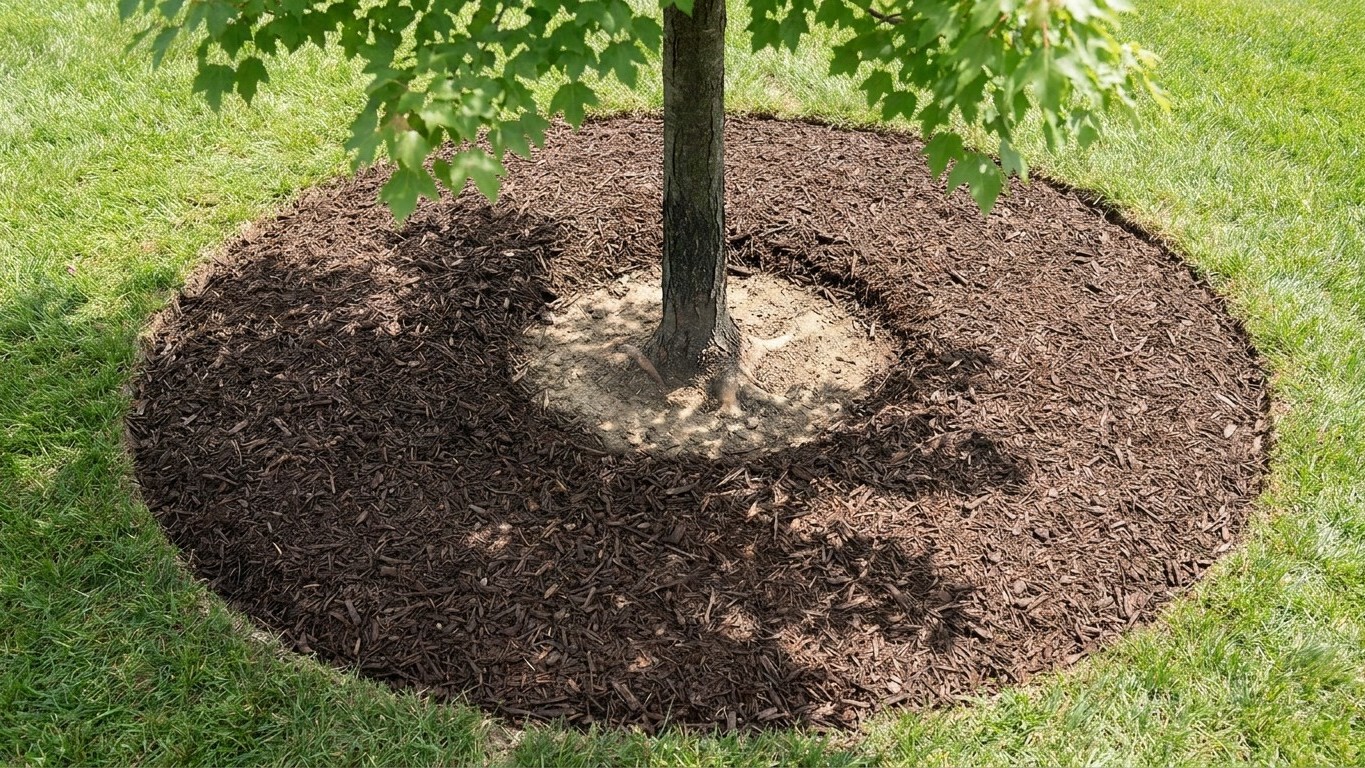

The right way to mulch a tree is a flat ring, 2 to 3 inches deep, spread out to at least the edge of the branches if possible, pulled back 6 inches from the trunk so the bark and root flare stay visible and dry. No cone, no pile against the trunk. That single shape change, ring instead of volcano, is the difference between mulch that helps a tree and mulch that slowly kills it.
What mulch is actually for

Mulch does four jobs, and none of them require it to touch the trunk. It moderates soil temperature, keeping roots cooler in summer heat and buffered from hard freezes in winter. It slows evaporation, so the soil under it stays moist longer between waterings, which matters most in the first two years after planting when the root system is still small and shallow. It suppresses the grass and weeds that would otherwise compete with a young tree for water and nutrients, a rivalry the tree usually loses because turf roots are faster and denser near the surface. And it keeps mowers and string trimmers away from the trunk, which sounds like a minor convenience until you look at how many landscape trees carry a scar, or a dead strip of bark, right at ground level from a mower deck clipping the base on a routine pass.
That last point deserves more weight than it usually gets. Mower and trimmer damage at the trunk base is one of the most common, and most preventable, causes of tree failure in yards and along streets. A trimmer line can girdle a thin-barked young tree in a single season of weekly passes, cutting through the living tissue just under the bark that moves water and sugars up and down the trunk. A wide, visible mulch ring does the fence’s job without a fence: nobody runs a mower into a 3-foot circle of bark chips, and there is nothing left for a trimmer to catch.
What mulch is not is worth saying plainly, because the marketing on some bagged products blurs the line. Mulch is not fertilizer. Bark and wood chips break down slowly and return some organic matter to the soil over years, but that is a soil-structure benefit, not a nutrient program, and a tree showing yellowing leaves or weak growth needs a diagnosis, not a thicker mulch layer. Mulch is also not a substitute for water. It slows moisture loss, it does not create moisture. A newly planted tree still needs a deliberate watering routine through its first one to two growing seasons, mulch or no mulch, especially through the dry stretches that hit different regions at different times of year depending on local rainfall patterns.
The volcano, and why it kills
The mulch volcano is a mound piled high and tight against the trunk, often a foot or more deep, tapering up like a small cone. It shows up constantly on new plantings, in shopping center parking lots, along new subdivision streets, in yards where a landscaping crew mulches by habit rather than by the tree’s actual needs. It is also one of the most damaging things done to an otherwise healthy young tree, and the damage is slow enough that nobody connects the mound to the decline until years later.
The mechanism is simple once you separate bark from root. Bark is built to shed water and stay relatively dry; it is not root tissue, and it does not tolerate constant moisture the way roots do. Pile wet mulch against a trunk and that bark stays damp for weeks at a stretch, especially in shaded or humid conditions. Damp bark softens, then decays, opening the door to fungal and bacterial problems that spread into the living tissue underneath. The same damp, dark environment is exactly what rodents look for. Voles in particular will tunnel through a mulch volcano all winter, gnawing bark at the base of the trunk while the mound hides them from predators and from the homeowner’s view. Girdled bark from vole feeding can kill a young tree just as effectively as a trimmer line, and the mulch pile is often what made it possible.
There is a second, slower failure built into the volcano shape. Roots grow toward moisture and loose soil, and a deep mulch pile against the trunk offers both. Over time, roots can grow up into the mulch itself and circle around the base of the trunk instead of spreading outward and down. Those circling roots eventually thicken and constrict the trunk from the outside, a condition arborists call girdling roots, and it can take years to become visible and by then it is often not fixable.
NC State Extension states it directly: “Pull mulch 6 inches away from the base of plants to prevent bark decay and vole damage.” Both reasons matter, and the vole half is easy to forget because it does the damage in winter, under a mound, when nobody is out checking on the tree. The visual check is simpler than a tape measure: standing back from the tree, the trunk should be visible, not swallowed by mulch. A correct ring has a gap at the middle, bark exposed at the base, root flare showing where the trunk widens into the ground. If mulch touches the trunk anywhere, it is a volcano regardless of how tidy the edges look.
What to use, and what to avoid
Most common mulch materials do the same basic job (moderating temperature, holding moisture, blocking weeds) but they differ in how long they last, how they look, and how they behave if they’re piled too thick or laid the wrong way.
| Material | Suits | Trade-off |
|---|---|---|
| Shredded bark | General landscape use, slopes (it knits together and resists washing away) | Breaks down over a year or two, needs regular topping up |
| Wood chips | Larger areas, informal or naturalistic beds, trees in lawns | Coarser look, slower to break down than shredded bark, can float in heavy rain |
| Compost | Improving soil structure while mulching, vegetable and perennial beds near trees | Breaks down fastest, sometimes carries weed seeds if not fully finished |
| Straw | Vegetable gardens, temporary winter protection | Looks messy in ornamental settings, can mat if wet |
| Gravel | Drought-tolerant plantings, areas prone to fungus gnats or slugs in organic mulch | Does not improve soil, reflects heat, harder to remove or adjust later |
Two habits are worth avoiding outright. Sheet plastic laid under mulch is sold as a weed barrier, but it blocks water and air exchange as thoroughly as it blocks weeds, and roots that need both suffer for it. Fresh grass clippings piled thick around a tree are another common shortcut that backfires: a thin layer can be fine, but a heavy mat of fresh clippings compacts, excludes air, and goes anaerobic, turning slimy and sour rather than breaking down cleanly.
Landscape fabric gets a gentler verdict, because it is not useless, just temporary in practice. It suppresses weeds reasonably well for a season or two while it is clean and taut. After that, windblown soil and organic debris settle on top of it, mulch particles work into that layer, and eventually weed roots and even fine tree roots find their way into the mat itself. At that point removing the fabric without damaging roots underneath is difficult, and many homeowners just mulch over it indefinitely, defeating the point. For a tree meant to stay in the ground for decades, plain mulch renewed as needed does the job with far less to undo later.
Topping up without burying
Mulch is meant to decompose. That is the whole mechanism, organic matter breaking down and returning something to the soil, but it also means the ring thins out over a year and needs replenishing. This is exactly where a correctly built ring quietly turns into a volcano: someone adds a fresh layer every spring without checking what’s already there, and by year three or four the mulch is a foot deep and pressed against the trunk, built up one well-meaning inch at a time.
A short check before adding anything prevents that drift:
- Pull existing mulch back from the trunk with a rake or by hand, clearing at least 6 inches around the base.
- Confirm the root flare, the point where the trunk visibly widens into the ground, is still exposed and not buried under old mulch or soil.
- Break up any matted or crusted layer, which forms over a season of rain and prevents water from soaking through.
- Only then add fresh mulch, filling in to reach a depth that suits the target, not stacking a new layer on top of whatever is already there.
NC State Extension gives the target plainly: “Provide a 3-inch layer of mulch to reduce water loss and maintain uniform soil moisture and temperature around roots.” and, on general weed control, “A 2-inch to 3-inch layer of mulch suppresses most annual weed seeds and makes it easy to hand-pull any that do germinate.” That range is a target to top up to, not a floor to build past. If 2 inches of old, settled mulch remain after raking, adding roughly an inch brings the ring back to depth. If the existing layer is already at 3 inches, it needs breaking up and redistributing, not more material.
The same spring check is a natural moment to look at any staking left from planting. NC State Extension notes that growers should “Remove all staking within one year after planting or growth may be reduced,” adding that “It may be possible to remove stakes for fall-planted trees by midspring.” The one-year mark is a ceiling, not a goal, and a tree that has rooted in well and holds steady when gently pushed usually does not need the stakes it still has.
Common questions
Can mulch touch the trunk if it’s only a thin layer?
No. Even a thin layer against the bark keeps it damp and gives voles cover at the base. The 6-inch clearance applies regardless of depth; a thin ring that touches the trunk still causes the same bark and rodent problems as a thick one.
How wide should the mulch ring extend?
As wide as practical, ideally out to the edge of the branch canopy, since that’s roughly where the active feeder roots spread. In a lawn setting, even a 3-foot to 4-foot circle is a meaningful improvement over mulch stopping a few inches from the trunk.
Does dyed or colored mulch cause any of these problems?
The color itself isn’t the issue; the shape and depth are. A volcano of dyed mulch fails the tree the same way a volcano of plain bark does. There’s no reliable evidence tying dye color to bark or root health one way or the other, so the ring shape and clearance matter more than the product’s appearance.
Do repellents help keep voles out of mulch near trees?
There’s no solid evidence that repellent products reliably keep voles from tunneling through mulch, and claiming otherwise would be misleading. The clearance itself, exposed bark with no damp mulch cover at the base, remains the tested, verifiable way to make the trunk a less attractive target.