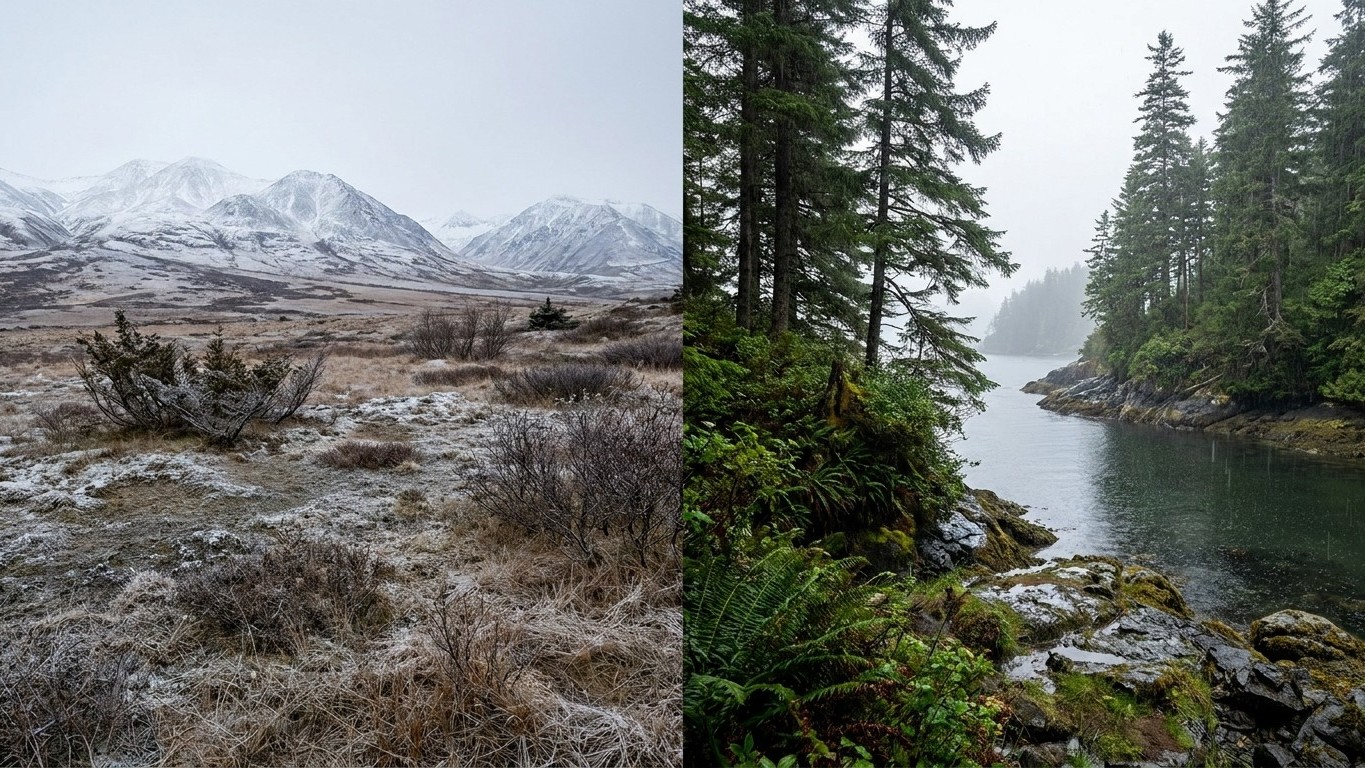

Maine’s USDA hardiness range runs from 3b up to 6a, and against the 65 landscape plants tracked on this site, the split comes out to 30 hardy across the entire state, 34 hardy in only part of it, and a single one that fails everywhere within Maine’s borders. That last number is the one worth knowing before you dig a hole.
What Will Not Survive a winter in Maine
A hardiness range tells you the coldest average annual extreme temperature a plant can take and still come back the next spring. It says nothing about whether the plant will look good, fruit well, or thrive, only whether it lives. That distinction matters at both ends of a range: the warm edge of a listing is frequently a heat ceiling, not a cold one, so a plant rated hardy in Maine can still sulk through a Maine summer without ever being at risk of dying over winter.
Against that backdrop, exactly one of the 65 plants this site tracks fails across the whole of Maine’s 3b-6a span. The common fig, Ficus carica, doesn’t show up as survivable in any zone the state reaches. Its own hardiness range starts warmer than the 6a ceiling Maine tops out at along the coast, which means even the mildest pocket of the state, Portland and the immediate shoreline, sits below where a fig can reliably overwinter outdoors.
| Plant | Where it fails | Kind of mismatch |
|---|---|---|
| Ficus carica (common fig) | Everywhere in Maine, 3b through 6a | Too cold, its range begins above the state’s warmest zone |
That’s the entire list of outright losses. Every other plant this site documents for fruit, perennial, shrub, and tree categories survives somewhere in Maine, which is the point of the next section: somewhere isn’t everywhere, and the gap between the two is where a lot of disappointed gardeners end up.
One more note on that fig row before moving on. A gardener who has grown figs successfully in southern Maine dooryards using container culture or hard winter protection isn’t contradicting this table. The hardiness data describes an unprotected plant left to face the average extreme minimum on its own. Wrap it, pot it, bury it, and you’ve changed the conditions the rating assumes. That’s a legitimate workaround, just not what a hardiness zone measures.
The plants that work in part of the state and not the rest
Thirty-four of the plants tracked here land in the middle bucket: hardy somewhere in Maine, not hardy everywhere in it. This is the group a statewide yes-or-no answer would get wrong for roughly half the people reading it, because Maine’s own range covers four full zone steps, from 3b in the northern interior to 6a along the immediate coast.
Looking at where each of these 34 plants actually fails, the pattern runs almost entirely in one direction: cold-end exclusion. None of them drop out at the warm 6a edge; all of them drop out somewhere between 3b and 5b, with the difference being how far up that cold ladder the exclusion climbs.
Plants shut out of zone 3b only
This is the largest group, and it covers a mix of fruiting plants, perennials, shrubs, and trees: Diospyros virginiana, Morus rubra, Prunus domestica, Pyrus communis, Rubus idaeus, Rubus occidentalis, Sambucus canadensis, Heuchera americana, Monarda didyma, Phlox paniculata, Salvia nemorosa, Hylotelephium spectabile, Ilex glabra, Itea virginica, Kalmia latifolia, Weigela florida, Betula nigra, Cercis canadensis, Nyssa sylvatica, Platanus occidentalis, and Quercus rubra. Anyone gardening outside the coldest interior pocket of the state can generally count on these.
Plants shut out of zones 3b through 4b
A smaller group needs a milder floor still: Asimina triloba, Fragaria virginiana, Fragaria x ananassa, Prunus persica, Amsonia hubrichtii, Lavandula angustifolia, Buxus sempervirens, Fothergilla gardenii, Cornus florida, and Liquidambar styraciflua. These need to be in zone 5a or warmer within Maine to have a shot.
Plants shut out of zones 3b through 5b
Three plants need the mildest ground the state offers, zone 6a specifically: Hydrangea macrophylla, Lagerstroemia indica, and Magnolia grandiflora. That’s a narrow strip, mostly the immediate coast.
None of this is guesswork about why, and none of it needs to be. Figuring out which of these bands applies to your own yard starts with knowing your zone, and Maine’s zone runs from cold inland valleys to a mild coastal edge over a fairly short distance. The insulation page for Maine on this site carries the county-level zone picture, which is the fastest way to place your own address on this ladder before shopping from any of the lists above.
The soil and the summer they will be planted into
Maine’s official state soil, the Chesuncook series, is a Spodosol, the acid, sandy, strongly leached soil type that forms under conifer forest. Its surface horizon runs about 35 percent sand, 12 percent clay, and 53 percent silt, with a surface pH near 5.1, solidly acid, and it’s rated moderately well drained. That combination favors root systems that don’t tolerate sitting in wet ground, since winter wet, not winter cold, kills more woody perennials and shrubs than the freeze itself does.
The organic matter figure recorded for this series, about 53 percent, is worth a pause. That number describes a natural forest floor with an intact litter layer, not a dug and amended garden bed. A cultivated planting hole on Chesuncook-type ground, or on whatever series actually sits under a given yard, won’t carry anything close to that once it’s been turned, and the acidity, texture, and drainage of a specific lot can differ completely from the state series, especially on filled ground, riverbank soil, or anywhere a house was built. A soil test remains the only way to know the actual numbers for a specific bed.
Layered onto that ground is Maine’s summer rainfall: about 11.2 inches across June, July, and August, with July the driest month at 3.43 inches, June at 4.15, and August at 3.57. Read alone, that figure suggests a reasonably well-watered summer. Read against a sandy, acid Spodosol, it means something different: sand lets water move through fast, so the same 3.43 inches that would sit in a clay-heavy bed for a week can be gone from a sandy one within a day or two. A single summer thunderstorm dumping an inch of rain in an hour also behaves differently than the same inch spread over a slow, soaking day, mostly running off rather than reaching root depth. None of that converts cleanly into a watering schedule; it’s a reason to keep a rain gauge on the actual property and judge from there rather than from a regional average.
When to plant, here
Maine’s last spring frost, at the reference station used for these normals, falls between April 22 and May 1. The first fall frost arrives between October 9 and October 21. Those two windows bracket the growing season, and they also bracket the two stretches when it makes sense to put a woody plant in the ground.
The logic behind both windows is the same: a newly planted tree or shrub needs time to grow roots into the surrounding soil before it’s asked to do anything else, whether that’s leafing out and drawing water in spring or shutting down and facing a hard freeze in fall. Plant too close to either frost date and the root system hasn’t caught up with what the top of the plant needs.
| Window | What it suits | Main risk |
|---|---|---|
| Spring, after the last frost (April 22 – May 1) | Most trees, shrubs, and perennials; gives a full season of root growth before winter | A late cold snap after an early warm spell can still damage new growth |
| Fall, before the first hard frost (October 9 – October 21) | Many shrubs and hardy perennials, since cooler air and warm soil favor root growth over top growth | Roots need to establish before the ground freezes solid; less margin the later the planting |
These two dates are averages built from a single reference station’s 1991-2020 record, not a guarantee for any given year or any given town. Coastal Portland runs on the mild end of Maine’s spread; inland and northern parts of the state see frost arrive earlier in fall and linger later in spring, which shortens the fall planting window considerably for anyone gardening near the cold end of the state’s 3b-4b territory. And whatever a plant’s mature drought tolerance rating says, it describes an established root system, not a plant in its first season. Every new planting needs regular watering through that first year regardless of how drought-tolerant it will eventually become.
Where to read about each one
For the plants that do suit Maine across its full 3b-6a range, the trees include Acer rubrum, Acer saccharum, Amelanchier canadensis, Carpinus caroliniana, Ginkgo biloba, Juniperus virginiana, Picea abies, Pinus strobus, Quercus alba, Thuja occidentalis, and Tilia americana. The shrub list covers Aronia arbutifolia, Clethra alnifolia, Hydrangea paniculata, Ilex verticillata, Physocarpus opulifolius, Spiraea japonica, Syringa vulgaris, and Viburnum dentatum. Among perennials, Achillea millefolium, Asclepias tuberosa, Baptisia australis, Anacis verticillata, Echinacea purpurea, Iris sibirica, and Rudbeckia fulgida all clear the state’s coldest zone as well as its mildest.
Beyond that core list sit the 34 plants covered above that only work in part of the state, and knowing which zone band a given address falls into decides whether any one of them belongs on a shopping list. The hardiness figures behind every plant named on this page come from a university extension plant database, crossed against the local zone data this site maintains for Maine specifically. That’s a separate system from the adaptation ranges used elsewhere on this site for apple varieties, which measure something else entirely and shouldn’t be read as interchangeable with the zone hardiness numbers used here.