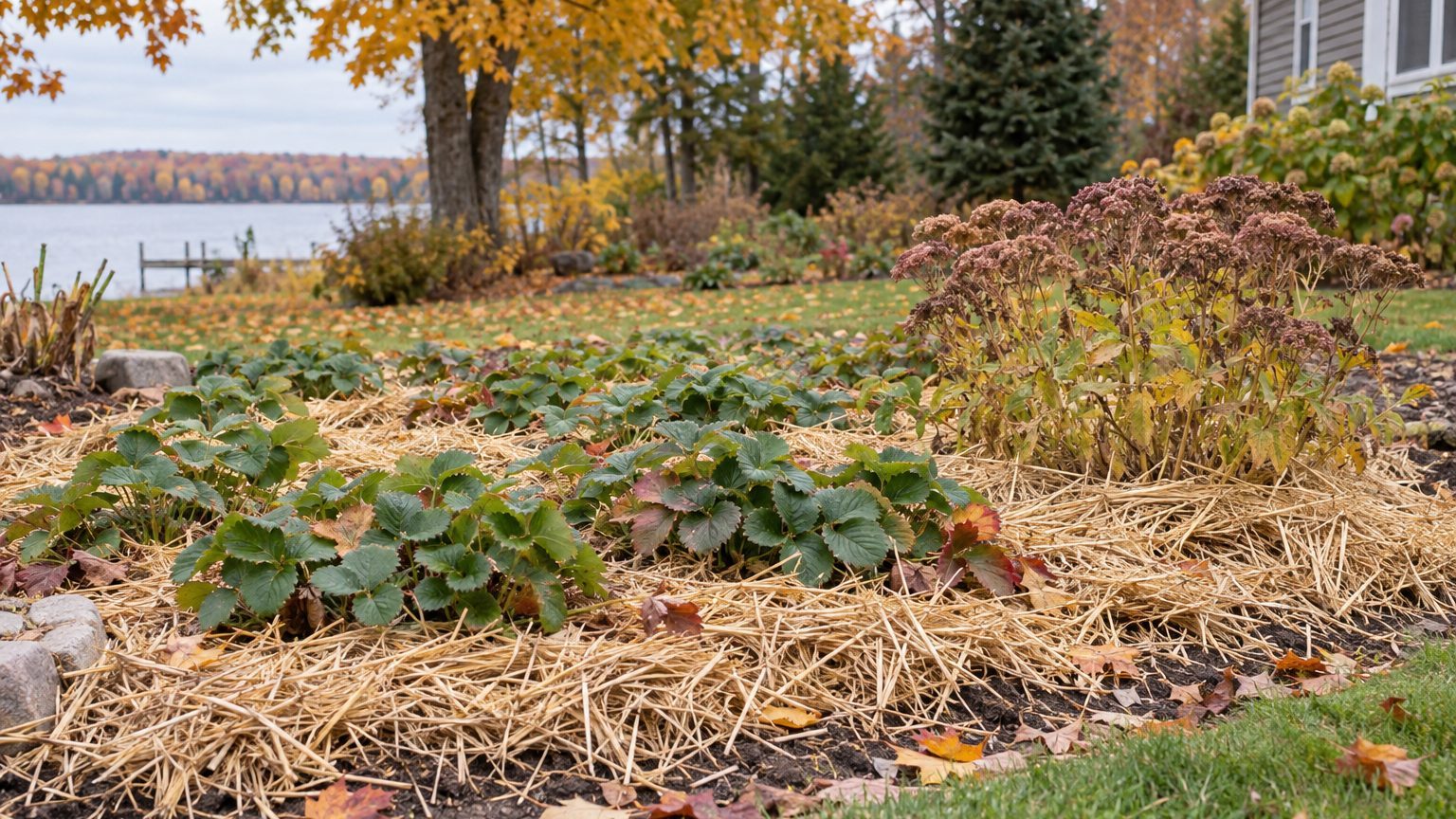

In Maine, winter mulch goes on after the ground starts to freeze, not when the first frost shows up. In Portland, NOAA’s 1991-2020 Climate Normals put the first 32°F freeze between October 9 and October 21 (the 30 to 70 percent probability band). The mulch waits until several hard nights have chilled the soil. Inland and farther north, frost arrives earlier, so the whole schedule moves earlier on the calendar.
When to put winter mulch down in Maine
Most gardeners think of mulch as a blanket that keeps plants warm. In a Maine winter it works closer to the opposite. Its job is to keep the soil frozen once it freezes, so the ground doesn’t thaw on a sunny January afternoon and refreeze that night. Those repeated swings are what push shallow crowns up out of the soil. Put the mulch down too soon and you insulate warm soil instead. That invites rot, and it gives mice and voles a cozy place to set up before the cold has any say.
And the ground does freeze here. NOAA’s Climate Normals for Portland, the reference station for these figures, show a mean daily minimum of 15.6°F in the coldest month. That is an average of the night lows, not the record low, so individual nights run well below it. The USDA Plant Hardiness Zone Map (2023 edition, built on 1991-2020 data) lists Maine as 3b to 6a. The zone map measures the average annual extreme minimum, which is a different question from when to spread straw, and Portland sits at the mild coastal end of that range.
The range to write down
Start from the first fall frost, then wait. For Portland the first 32°F freeze falls between October 9 and October 21, according to the NOAA NCEI 1991-2020 normals. Winter mulch belongs after that window has passed and the soil has begun to freeze, typically several weeks of cold nights later, in late fall. Watch the garden rather than the calendar. Perennial tops have blackened or yellowed, strawberry plants have stopped growing, and the surface of the soil is stiff and crusty in the morning. Then it’s time.
A first frost that arrives on schedule doesn’t mean the ground is ready. A frost is a cold night, and freezing soil takes a string of them. If you mulched the week the tomato vines blackened, you would be a good while early.
Adjusting for where you garden
The colder the location, the earlier the sequence starts. Northern and higher-elevation gardens see their first fall frost sooner than Portland’s October 9 to October 21 range, so the soil freezes sooner and the mulching window opens earlier on the calendar. Gardeners there can’t borrow Portland’s dates. Look up the local first-frost range on the First and Last Frost Dates in Maine page, then apply the same logic: frost first, freezing soil next, mulch after that.
Coastal gardens near Portland have the reverse problem. Milder stretches in December are more common, and a thaw can arrive after mulch is on. Leave it in place. Pulling mulch off because of a warm week only restarts the freeze-thaw cycle it is there to prevent.
Strawberries
Strawberries are the plant most worth mulching in a Maine garden, and the reason is the crown. That short, woody base at the center of each plant holds next year’s flower buds, and it sits right at the soil surface. Bare cold can kill it. Heaving can lift it out of the ground and snap the roots, leaving the crown exposed to wind. A plant can look fine going into winter and be dead by April.
Clean straw is the standard material. It is light, it stays fluffy enough to let air move, and it lets water through. Choose straw that has been baled without much seed head, because grain in the bale sprouts as a lawn-like mat in your bed. Hay is the usual mistake. It carries weed seed, and it packs down wet. Shredded leaves can work in a pinch, but whole leaves mat into a soggy layer over the crowns, so I would skip them here.
For depth, the figures I can cite come from NC State Extension. The Extension Gardener Handbook says: “A 2-inch to 3-inch layer of mulch suppresses most annual weed seeds and makes it easy to hand-pull any that do germinate.” On moisture, it says: “Provide a 3-inch layer of mulch to reduce water loss and maintain uniform soil moisture and temperature around roots.” That’s a North Carolina source, and it was written mostly with weeds and moisture in mind, not Maine winters. Even so, the two sentences agree on the order of depth. Straw compresses as snow and rain settle it, so apply it loosely to that range. More is not better. A deeper pile just holds more wet against the plants. If you’re growing a full patch, the Growing Strawberries page covers the rest of the year.
The timing follows the general rule. Wait until the plants are dormant and the soil is beginning to freeze. In Portland that is after the October 9 to October 21 first-frost range, not during it. Cover the whole bed so the crowns are hidden, and stop there.
Spring is the second half of the job, and people forget it. Pull the straw back from the crowns when new growth starts and the first pale-yellow leaves appear under the mulch, which is usually after the snow has melted and the soil has thawed. Rake it into the aisles between rows, where it keeps berries clean and weeds down. Leave it within reach so you can pull it back over the plants if a hard frost is forecast during bloom. Open flowers are far more vulnerable than dormant crowns.
Perennials and borderline plants
Most established, native-adapted perennials in Maine do not need winter mulch. They have been through the cold before. The candidates are plants at the edge of what your spot can handle, and anything new. A perennial planted this fall hasn’t grown a deep root system yet, so it is the most likely to heave. The same goes for shallow-rooted plants like hardy mums, and for shrub roses, lavender, and other plants sold as marginal for northern gardens. The USDA map gives a statewide range of 3b to 6a, and where you fall inside it matters. Two neighbors in the same state can be working with very different winters.
Portland’s coldest-month mean daily minimum of 15.6°F (NOAA Climate Normals, 1991-2020) says something useful about the coast, but plants get hurt by the cold extremes, not the mean. That’s the logic behind mulching anything borderline. Inland, the cold gets deeper, and the risk grows with it.
The depth guidance is the same range quoted above from NC State Extension: 2 to 3 inches for weed control, 3 inches for moisture and root temperature. It’s a range for a bed, not for stacking against a stem. Shape it as a ring around the crown, not a pile on top of it. Mulch that touches the crown holds moisture against the stem and gives rodents a sheltered spot to chew. Leave a small gap of bare soil or clear space at the base. The same principle is laid out in detail in Mulching Without Killing the Plant.
| Plant group | Mulch for winter? | Where it goes |
|---|---|---|
| Strawberries | Yes, in all of Maine | Cover the whole bed with loose, clean straw |
| Perennials planted this fall | Yes | Ring around the crown, not touching it |
| Borderline or marginally hardy plants | Yes, especially inland and north | Ring around the crown, bare soil at the base |
| Established, well-adapted perennials | Usually not needed | Optional light ring for weeds and moisture |
Herbs deserve their own mention. Woody types like thyme and sage resent wet feet as much as cold. Their winter needs are covered in Getting Perennial Herbs Through the Winter. The rule for timing is the same. Mulch borderline perennials after the ground starts to freeze, later than the October 9 to October 21 first-frost range in Portland, and earlier on the calendar in colder parts of the state. Use a light material, keep it off the crown, and leave it there until spring growth is clearly under way.
What goes wrong
Almost every mulch failure in a Maine garden comes down to timing or material. The four problems below look different in the garden, and each has its own fix.
Mulching too early
When mulch goes on right after the first frost, the soil underneath is still warm and damp. Crowns stay wet, and rot sets in over the following weeks. You find it in spring as mushy, brown centers on plants that looked healthy in October. The fix is patience. In Portland the first frost comes between October 9 and October 21 (NOAA NCEI normals), but the soil freezes later than that.
Mulch that mats and rots
Whole leaves, wet grass clippings, and thick layers of fine material pack into a slick sheet that blocks air. Underneath, you get a slimy, sour-smelling layer sitting on the crowns. Use straw, or shredded leaves in a thin layer, and keep to the 2-inch to 3-inch range from NC State Extension. Fluff it with a fork if it has flattened after a wet stretch.
Voles and mice
A thick layer of mulch laid down before the ground freezes is an inviting shelter. Voles tunnel under it, and by spring you can find bark stripped from shrub bases and strawberry crowns chewed to nothing. Waiting until the ground has frozen gives rodents less time to settle in. Keep mulch pulled a few inches away from woody stems, and keep the bed clear of tall grass around the edges.
Forgetting to uncover in spring
Leaving strawberry straw on too long is the quiet one. Plants grow pale and leggy under it, and the crowns stay cold and wet while the season moves on. Check the bed as soon as the snow is gone. When you see yellow new leaves, rake the straw off the crowns and into the aisles. For other seasonal timing, the Maine guides cover the rest of the calendar.
Common questions
Should I mulch strawberries right after the first frost in Maine?
No. In Portland the first frost falls between October 9 and October 21 (NOAA NCEI 1991-2020 normals), but the mulch belongs on after the ground begins to freeze, which is later. Frost by itself only tells you the plants have gone dormant. Wait for the soil to stiffen in the morning.
How deep should winter mulch be?
NC State Extension gives a 2-inch to 3-inch layer for weed suppression, and a 3-inch layer for moisture around roots. Stay within that range. Deeper mulch holds too much wet, and it turns a ring into a volcano when piled against stems.
Is straw or hay better for strawberries?
Clean straw. Hay carries weed seed and mats down when wet, which is bad news for crowns. Look for straw with little grain left in it, or the bed will sprout a crop of its own.
When do I take the mulch off in spring?
Pull it back from the crowns when new growth starts and pale-yellow leaves show through the straw, usually once snow has melted and the soil has thawed. Rake it into the aisles rather than hauling it away. Then you can cover the plants again on a frost night if flowers are open.