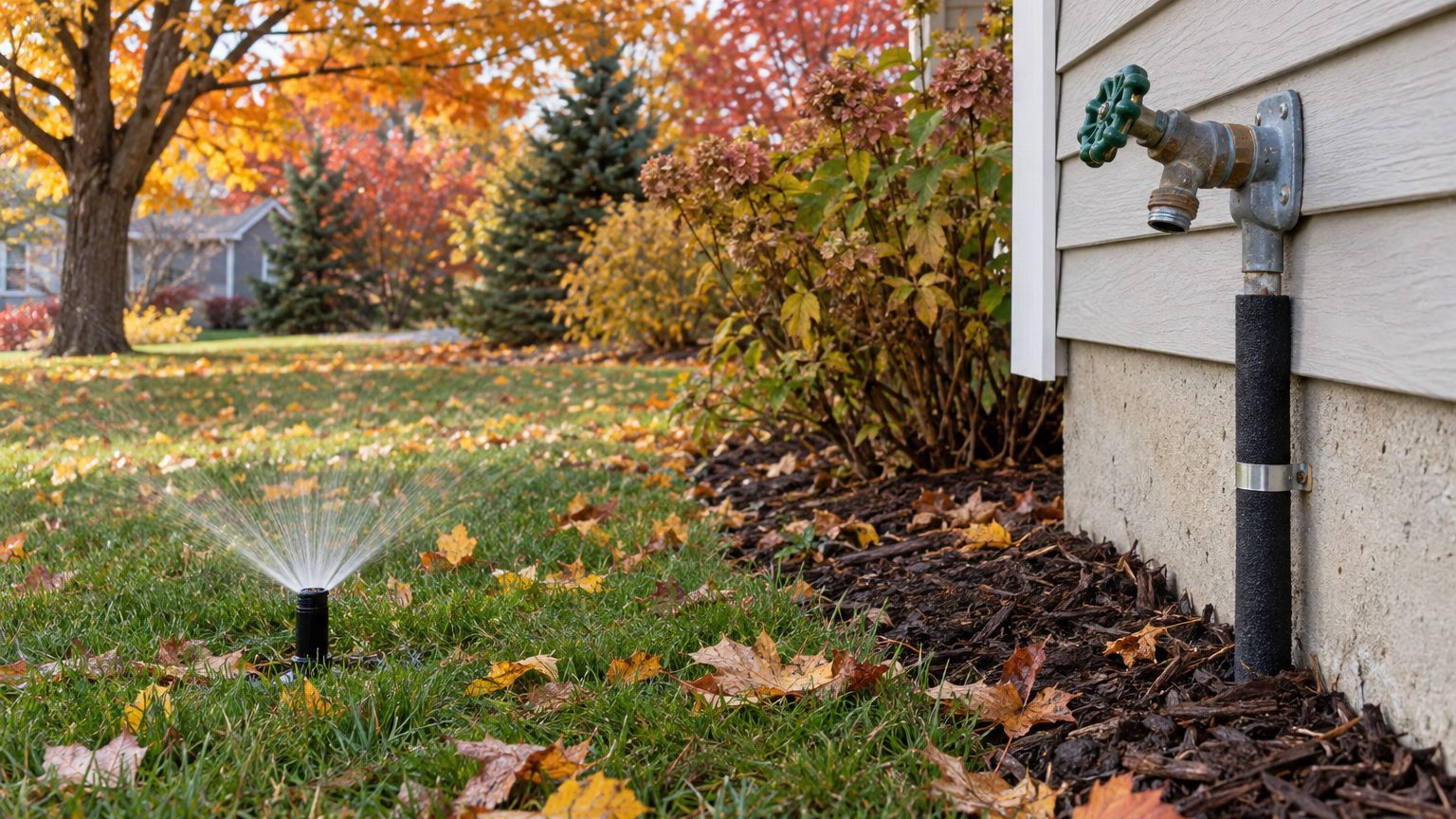

Empty sprinkler lines and outdoor taps in Maine by early October in the southern coastal part of the state, and earlier the farther inland or north you live. Waiting for a forecast that says “freeze tonight” is how lines split and hose bibs crack. Coastal Portland has the mildest fall calendar in Maine, so its dates work as the latest safe baseline. Everything below starts there and covers how to shift the work, what to do at each spot, and where the usual failures hide.
When to do it in Maine
In Portland, the first 32°F freeze typically arrives between October 9 and October 21, according to NOAA’s NCEI 1991-2020 Climate Normals, so the job belongs in the days before that range opens. The rule is to winterize before the first hard freeze, not after the first light one. NOAA’s figures put the odds of that first 32°F reading at 30 to 70 percent across those dates, which means some years it comes before the window even starts. Plan to have sprinklers drained and outdoor taps shut off before the October 9 to October 21 stretch begins.
Why a light frost is a warning, not a deadline
A light frost whitens the lawn and blackens the tomato vines. It rarely freezes water inside a buried line. That is exactly why it fools people: the grass looks wrecked, the pipes are fine, and the next week turns sunny and mild, so the job slides. Then a clear, windless night drops well below freezing and the water sitting in an above-ground backflow preventer turns to ice. Treat the first frost on your lawn as proof the window is closing, and finish the work that weekend.
Portland’s dates are the ceiling, not the target
Portland sits at the mild end of the state. Inland towns and northern Maine see their first fall freeze earlier, so the draining, blowing out and tap shutoff all move earlier too, never later. If you live well north or at higher elevation, do not use the October 9 to October 21 range as your plan. Use it as the last possible moment and work backward from there.
Nothing about Maine’s winter is marginal. NOAA’s 1991-2020 normals for Portland put the mean daily minimum of the coldest month at 15.6°F, and that is the average night, not the worst one. Water left in a line does not face one brief dip below freezing. It faces months of it. So the shortcut that works in milder states, where a quick drain or a few foam covers might get by, does not apply here. A full shutdown is the standard job every year.
One common mix-up is worth clearing up. The USDA Plant Hardiness Zone Map 2023 lists Maine as 3b-6a, but that system is built on a single variable, the average annual extreme minimum temperature. It describes how cold the coldest night of the year gets, which matters for shrubs. It says nothing about when the first fall freeze arrives, so do not use your zone to schedule plumbing. Use your local first-freeze timing instead, and check the Maine guides for other seasonal jobs that run on the same calendar.
Lawn prep follows a similar schedule. The last watering of the season has to happen before the blowout, so if you are overseeding or giving the turf a final soak, do that first. The steps for Winterizing a Lawn fit around the same few weekends.
Sprinkler lines: drain or blow out
Why trapped water does the damage
Water expands as it turns to ice, and a sealed pipe has nowhere to put the extra volume. The pressure builds until the weakest spot gives way. In a sprinkler system that is rarely the long run of buried pipe. It is the fittings, the valve bodies, the sprinkler heads and, above all, the backflow preventer, which sits above ground with a lot of water trapped in a compact brass or plastic body. A crack from freezing is invisible in fall and obvious in spring, when the pressure returns and water sprays from a split that took a single cold night to make.
Three ways to empty the lines
Manual draining uses drain valves at the low points of the system. You open them, let gravity pull water out, and close them again. It costs nothing but it leaves pockets behind wherever the pipe dips or a head sits lower than the run feeding it. Automatic drains open on their own when pressure drops and let water out of each zone. They work when they are installed at real low points and kept clear of debris, but a stuck one holds water all winter and nobody finds out until April.
Compressed-air blowout pushes the water out zone by zone with a compressor connected at the blowout port. It clears the water that gravity leaves behind, and it is the method built for places with long, hard winters. Here is how the three compare:
| Method | How it works | Fit for Maine |
|---|---|---|
| Manual drain | Open low-point valves, let gravity empty the lines | Leaves water in dips and heads; a helper step, not the whole job |
| Automatic drain | Valves open when pressure falls | Fails quietly if clogged or badly placed; do not rely on it alone |
| Compressed-air blowout | Air pushes water out of each zone | The standard choice for a climate with a 15.6°F coldest-month minimum |
In practice, shut off the water supply to the system first, open any manual drains, then run the air through each zone in turn. Go through every zone, including any drip zones, and make sure the controller is set to its off or rain mode so it does not run dry over the winter. Blow out every zone with compressed air before the October 9 to October 21 range opens, whether or not your system has automatic drains. If the backflow preventer sits above ground, insulating it afterward adds a layer of protection.
When a professional is the sensible choice
Compressed air is not a casual weekend task. Too much pressure can burst fittings and throw parts, which is why eye protection matters and why you never stand over a backflow preventer during the blowout. If you do not own a compressor, if you are unsure how much pressure your system can take, or if the system has a pump or no blowout port, hire someone. The same goes if you inherited the system and have no map of the zones. A service call for a few hours of work costs far less than replacing valves and heads that split.
Outdoor faucets and hoses
Outdoor faucets are simpler than sprinklers, and because they are simple, people skip the steps. Start by disconnecting every hose, along with splitters, timers, and any attachments on the spout. Drain the hoses and store them somewhere dry. A hose left coiled on the ground with water in it is a small problem by itself, but one left attached to a faucet is a larger one, which is covered below.
Next, find the interior shutoff valve for that faucet, usually in a basement, crawl space or utility area near where the line passes through the wall. Turn it off. Then go outside, open the faucet and leave it open so the water between the shutoff and the spout can run out. Leaving the tap open all winter lets any remaining water expand into the open air rather than against a closed valve. That is the whole process: turn the interior valve, open the outside tap. Do it the same weekend as the sprinkler blowout, before the October 9 to October 21 window opens. For the full walkthrough, see Winterizing Outdoor Faucets Before the First Freeze.
Why a frost-free faucet still fails with a hose attached
A frost-free faucet keeps its shutoff seat deep inside the warm side of the wall, at the end of a long stem. When you close it, the water in the barrel is supposed to run out through the spout and leave the exposed part of the pipe empty. That only works if the water can leave. A hose attached to the spout, even a short one, holds water in the barrel, and a spray nozzle or timer does the same. The water freezes inside the pipe and splits it, often in the section hidden inside the wall, where you will not see anything wrong until spring. You turn the tap on, hear a hiss, and find water running down the inside of the wall or dripping from the basement ceiling.
The fix costs nothing: take the hose off every fall, even with a frost-free model. The design is sound, but it needs the water to drain. More on how these work is in Frost-Free Outdoor Taps.
Stop at the valves. Replacing a faucet, adding a shutoff, fixing a slope or soldering anything is plumber’s work. Turning valves and removing hoses is the extent of the do-it-yourself job.
What goes wrong here
The most likely failure in Maine is the early cold snap. NOAA’s band of 30 to 70 percent for a first 32°F freeze between October 9 and October 21 in Portland tells you the first freeze can land before that range starts, and it lands sooner inland and north. A homeowner who planned to do the work “in a couple of weekends” finds out on a Tuesday morning that the pipes have frozen. The fix is to schedule the job for the weekend before the range opens. If a freeze is forecast before you have drained, do the taps and the backflow preventer first, then the zones. Those are the parts most likely to crack.
The forgotten hose comes second. It is usually the one at the back of the house, behind a bush, hidden by a garden cart. In spring it shows up as a spray inside the wall, a wet stain on a basement ceiling, or a faucet that will not shut off. Walk the perimeter and check every tap before you call the job done. If a pipe does freeze, read up on Frozen Pipes before you touch anything, and call a plumber for anything beyond turning a valve.
The third one is the flooded valve box. The in-ground box that holds the zone valves collects water from rain and snowmelt, and if it sits in a low spot or has no drainage, the valves sit submerged when the temperature falls. A cracked valve body shows up in spring as a zone that will not shut off, a soggy patch of lawn that never dries, or low pressure across the system. Lift the lid in fall, clear out leaves and debris, and confirm there is some way for water to leave the box. Keep the lid in place all winter.
Spring startup catches some of the damage from all three. Open the main supply slowly, walk each zone, and look for spray from the heads and leaks at the backflow preventer. A problem found in April is cheaper than one found in July.
Common questions
Is it too early to blow out sprinklers if early October is still warm?
No. Warm days in early October do not change the odds that a freeze comes between October 9 and October 21 in Portland, or earlier inland. If the lawn still needs water after the blowout, you can hand-water with a hose for a short stretch, then take it off and drain it before the next cold night.
Do I need to blow out the system every year?
Yes. The mean daily minimum in Portland’s coldest month is 15.6°F, based on NOAA’s 1991-2020 normals, so every winter is cold enough to freeze water left in the lines. One skipped year is all it takes to crack a valve or backflow preventer.
Can I leave a hose on a frost-free faucet?
Not through the winter. The hose traps water in the barrel, the water freezes, and the pipe can split inside the wall. Remove hoses and splitters, and leave the tap open.
Does the same timing apply in northern and inland Maine?
No. Portland’s October 9 to October 21 range reflects the mild coastal end of the state. Farther north and inland, the first fall freeze arrives earlier, so the drain, blowout and faucet shutoff should happen earlier as well. If you are unsure, treat Portland’s dates as the last possible moment, not as the plan.