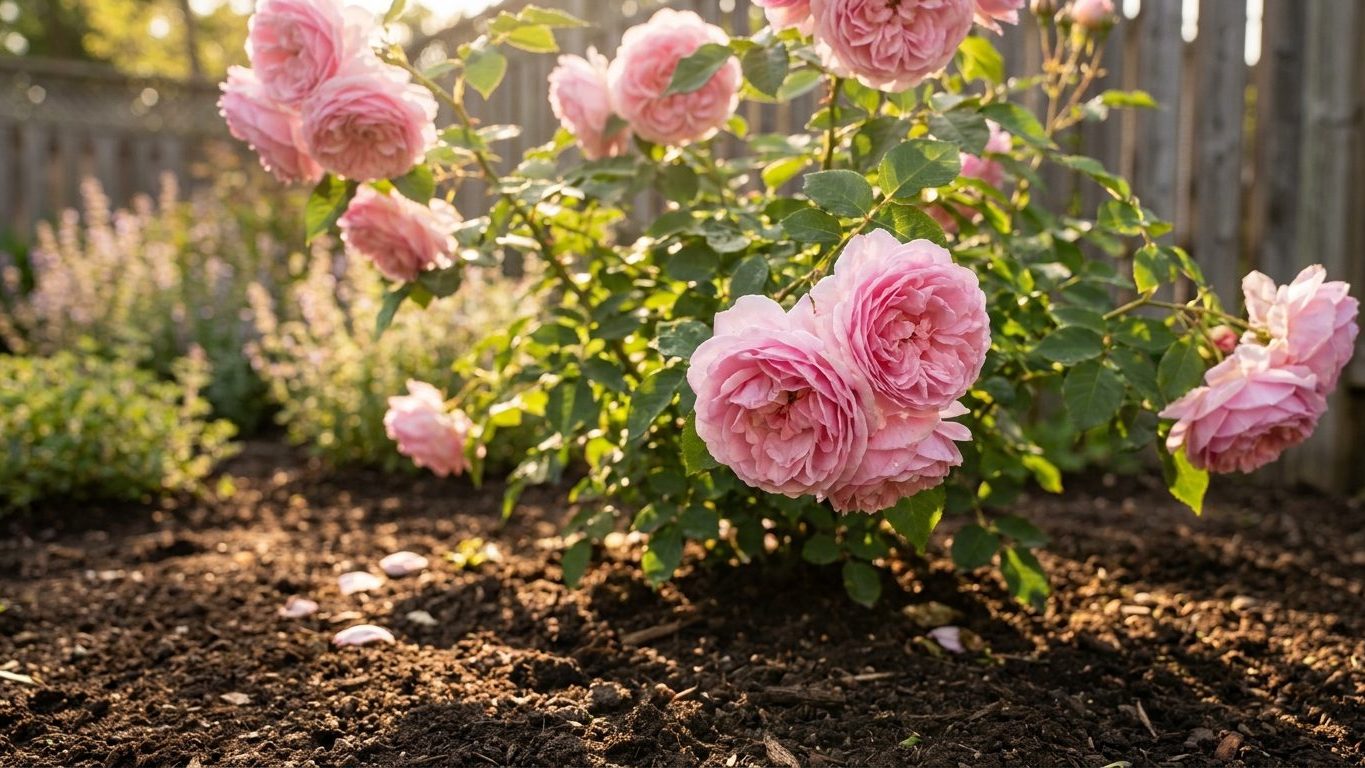

Belinda’s Dream is a shrub rose bred for tough, low-input gardens, and it holds a place on the USDA hardiness map from zone 5a all the way to 11b. It wants full sun, at least six hours of it, and tolerates clay or loam soil across a wide pH band. What decides how it’s cared for, more than anything else, is that it flowers on new wood. That single fact settles the pruning question for the whole life of the plant.
What Belinda’s Dream actually is
Belinda’s Dream belongs to the Shrub group, and the North Carolina Extension Gardener Plant Toolbox describes it plainly: large double pink flowers, fragrant, and carrying the Earth-Kind designation, a program that flags roses proven to perform well in the garden with minimal spraying and feeding.
The genus-level facts from the same source set the boundaries. Hardiness runs USDA zones 5a through 11b, an unusually wide span for one rose. Light needs are non-negotiable: full sun, six or more hours of direct light a day, or bloom suffers. Soil can be clay or loam, with a pH anywhere from acid, below 6.0, to neutral, in the 6.0 to 8.0 range. Size is documented for the genus at 1 to 8 feet tall and 1 to 6 feet wide, depending on cultivar, so the tag on the actual plant, not a group average, tells you how much space to leave it.
Growth rate is medium and maintenance is rated HIGH. And the detail that runs through every later section of this page: Belinda’s Dream flowers on new wood, not old. That’s why the pruning approach for this variety is light pruning only, timed to the reader’s own zone, rather than the hard cutback some other roses tolerate.
What Belinda’s Dream is good for

A rose earns its keep two ways: what it does in a vase, and what it does in the bed. The flower itself is fully double, meaning more than 20 petals per bloom by the genus’s own classification, and the source notes it as fragrant. Which of the five documented fragrance groups it falls into isn’t specified, so fragrance is confirmed but its exact character isn’t published here.
The Earth-Kind label is the more useful signal for garden use. It means the cultivar was field-tested for landscape performance without a routine spray program, pointing this rose toward beds where a gardener wants bloom and toughness without weekly chemical upkeep. That’s a testable, trial-based claim, not a marketing adjective.
Then there’s the hip. Like every rose, Belinda’s Dream sets an accessory fruit that turns from green to red in fall and is edible. But a heavily double, repeat-blooming shrub that gets deadheaded through the season for continued flowering will produce far fewer hips than a rose left to set fruit, since each deadheading cut removes the spent bloom before it can form one. A gardener who wants fall hip color has to choose: keep cutting for repeat bloom, or let a portion of the late-season flowers go to seed instead. The stems, once cut back to 12 to 24 inches at season’s end, are worth leaving standing rather than clearing away, since hollow and pithy canes at that height serve as nesting sites for stem-nesting native bees.
Where it ripens in time, and where it is a gamble
Belinda’s Dream doesn’t ripen the way a tomato does. What it has to do instead is survive winter where it’s planted and still push enough new growth each spring to flower, since new wood is exactly where its blooms come from. That’s why the zone range matters so much more here than for a plant that flowers on wood already a year old.
The documented range, zones 5a through 11b, spans nearly the entire USDA map used for the contiguous US, from areas with winter lows around -20°F up to the near-frost-free bands of the Gulf Coast and southern Florida. At the cold edge, zone 5a, winter lows in the -20°F to -15°F range routinely kill back a portion of the previous season’s canes. Since Belinda’s Dream needs new wood to bloom, dieback isn’t fatal to flowering the way it would be for a rose that flowers on old wood, but severe dieback still costs the plant time it would otherwise spend building bloom-bearing growth. At the warm edge, zone 11b, winter cold essentially isn’t a factor at all, and the growing constraints shift entirely toward heat and humidity management instead.
| Zone band | What it means for this plant | What that requires of the gardener |
|---|---|---|
| 5a-6b (cold edge) | Winter lows regularly damage or kill exposed canes | Protect the crown or graft union going into winter; expect to prune out winterkill each spring before growth resumes |
| 7a-9b (core range) | Moderate winters, full flowering season | Minimal winter protection; the main task shifts to summer disease watch |
| 10a-11b (warm edge) | Little to no winter chill; near-continuous growth | Heat and humidity, not cold, become the main stress to manage |
No published frost-date or bloom-timing data ties Belinda’s Dream to a specific city or weather station, so this page sticks to the zone range NC State documents rather than inventing a local figure.
The two ways a season goes wrong
For this variety, the two failure modes aren’t symmetrical, because it flowers on new wood rather than old. In the north, at the cold edge of its zone range, a harder-than-typical winter kills back canes that would otherwise have carried this year’s flowers. The plant usually survives at the crown, but bloom gets delayed while it regrows the wood it needs, and in a short growing season that delay can mean a thinner flush than a gardener further south sees from the same rose.
In the south and in humid regions generally, cold isn’t the limiting factor at all. The documented disease list for roses, botrytis, blights, powdery mildew, leaf spots, and anthracnose, thrives under the heat and humidity common across the Gulf Coast and much of the Southeast. That pressure runs through the growing season rather than arriving as a single event, which is why Earth-Kind trials for this cultivar focused on performance without a spray program in the first place.
Given that Belinda’s Dream flowers on new wood, winterkill delaying bloom is the more direct threat to whether the plant flowers well in a given year. Disease pressure is a steadier, season-long management task rather than a single lost flush, which is exactly the kind of pressure the Earth-Kind program tests for.
What it resists, and what it does not
The NC State Extension Gardener Plant Toolbox lists the diseases documented for roses generally: botrytis, blights, powdery mildew, leaf spots, and anthracnose. It also names the pests found on roses: Fuller rose beetle, Japanese beetle, rose chafer, rose thrips, southern red mite, and two-spotted mite. Worth flagging: the southern red mite and two-spotted mite are arachnids, not insects, and treating them with an insect-only product is a common, costly mistake.
What the source does not do is grade Belinda’s Dream’s resistance to each of those diseases individually. The Earth-Kind designation signals that the cultivar performed well in field trials without a routine spray program, but that’s a broad garden-performance rating, not a disease-by-disease resistance grade. It would overstate things to say this variety is documented as highly resistant to powdery mildew or anthracnose specifically; the source doesn’t break resistance down at that level, so a gardener should still watch for the diseases and pests listed above rather than assume the Earth-Kind label means immunity.
Growing it without the usual mistakes
The mistake this variety invites more than most is hard pruning. Because Belinda’s Dream flowers on new wood, a light annual pruning, timed to the reader’s own zone, removes winter damage and shapes the plant without cutting away the growth that will carry the coming season’s bloom. A hard cutback done out of habit simply costs flowers here. The exact month depends on the local last-frost pattern, which is why that timing belongs on the page for the reader’s own state rather than a single national date.
Spacing should follow the tag on the actual plant, not a group average: the genus spans 1 to 8 feet tall and 1 to 6 feet wide depending on cultivar, and Belinda’s Dream’s specific mature size determines how much room it needs from neighboring shrubs and structures.
Deadheading through the season keeps repeat bloom coming, since every cut pushes a new shoot. But that same mechanism is why deadheading needs to stop late in the season, timed again to the reader’s zone: continuing to cut late pushes soft new growth that won’t have time to ripen before frost, while the wood that stops being cut ripens and the plant hardens on its own. Hips forming once deadheading stops don’t trigger dormancy themselves, that follows day length and cold, but letting the plant stop pushing new shoots keeps it from carrying soft growth into winter.
Two last practical notes. Check the plant’s tag for whether it’s budded onto rootstock or grown own-root, since winter protection targets the graft union on a budded plant and the crown on an own-root one. And the sharp structures along the stems are prickles, not true thorns; they grow from the outer skin of the stem, which is why they snap off sideways rather than the woody, modified-stem break of a true thorn.
Common questions
Is Belinda’s Dream a climbing rose? No. NC State’s Plant Toolbox lists it in the Shrub group, not among climbing or rambling roses, and its habit and pruning needs follow that classification.
Does Belinda’s Dream need hard pruning to bloom well? No. It flowers on new wood, so light annual pruning, timed to the reader’s own zone, is what the source recommends. Hard pruning removes the wood the season’s flowers would grow from.
Are the thorns on Belinda’s Dream dangerous? They’re prickles, not true thorns. They form from the outer skin of the stem, which is why they can be rubbed off or snap sideways rather than break like a woody, modified stem would.
Do the hips affect when the plant goes dormant? No. Dormancy follows day length and cold, not hip formation. What matters for avoiding soft late growth is stopping deadheading late in the season, since every cut pushes a new shoot that needs time to ripen before frost.