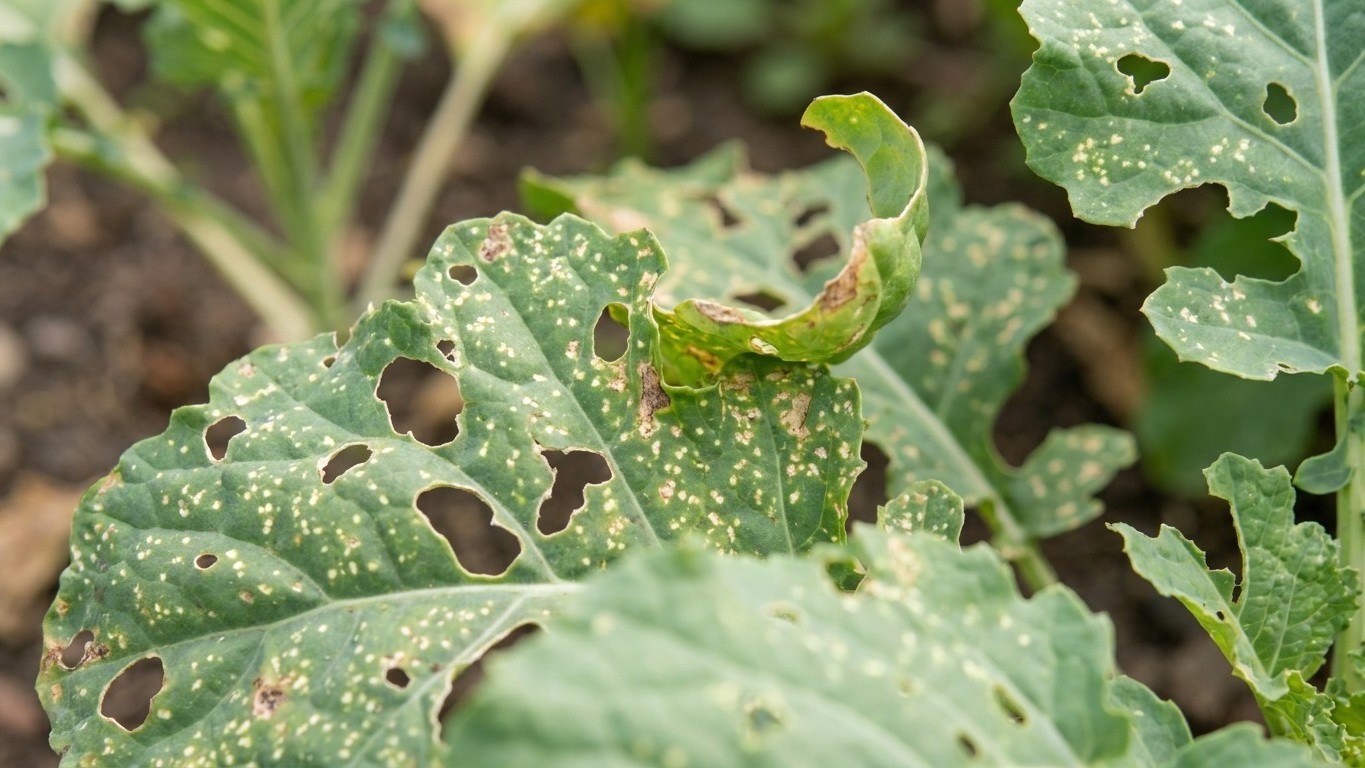

Squash gets attacked from two directions in Montana gardens: chewing insects that arrive off dry rangeland, and piercing insects that go after leaves and fruit directly. Grasshoppers and thrips do most of the everyday damage, brown marmorated stink bug adds occasional fruit scarring, and none of it follows a fixed calendar date so much as the state’s short, unpredictable frost-free window.
Which pests attack summer squash in Montana

Montana State University Extension, Urban IPM, documents five pests established in the state’s home landscapes:
- Brown marmorated stink bug
- Grasshoppers
- Miller moths
- Social wasps
- Thrips
That’s the full list this territory has documented, and it does not go further. Two of those five have no real business on a squash plant. Social wasps don’t feed on plant tissue at all; they hunt other insects and scavenge sugar sources, which makes them a sting hazard once fruit splits and draws them in, but not something that chews a leaf or scars a fruit. Miller moths are the adult flying stage of a moth that shows up in huge numbers some years, and the adults live on flower nectar rather than foliage. Their larval stage, the army cutworm, is a rangeland and field-crop concern, not a pest documented against squash here.
That leaves three worth watching. Grasshoppers are the steadiest chewers in a Montana garden, and outbreaks track dry weather more than anything else, since a hot, cured-out rangeland pushes them toward anything green and irrigated. Thrips work more quietly, rasping at leaf surfaces and inside blossoms, and the damage can be well underway before it’s noticed because it looks like discoloration rather than a hole. Brown marmorated stink bug is the newest of the three, still spreading county by county through the state, and it feeds by piercing rather than chewing, which changes what the damage looks like and What Stops It.
The decision that matters before anything else is identification, not treatment – spraying for a chewer when the actual culprit pierces and sucks wastes both time and product, and a growing season this short doesn’t leave room to guess twice.
When each one shows up, and what it does first
Squash only goes in the ground once frost risk has passed, and that date shifts by valley. The average last spring frost across the reference area falls between April 29 and May 10, and the first fall frost returns between October 1 and October 14, giving a frost-free stretch of roughly five months at best and less at higher elevation. Pest timing follows that window rather than a named month, so “two to three weeks after Transplant” is a steadier marker to use than “in June.”
Grasshoppers build through the season rather than arriving all at once, and pressure usually climbs from midsummer onward as surrounding rangeland dries out. With the reference station averaging 28.3 days a year at 90°F or hotter, a heat spike can push grasshoppers off cured vegetation and into a garden within days. The first sign is ragged notching along leaf edges, working from the outer leaves inward.
Thrips can show up earlier, sometimes within the first few weeks after transplant, and the first sign is a silvery or bronze stippling on the underside of leaves rather than a chewed edge. Left alone, the stippling spreads and flowers can look distorted or fail to set fruit, since thrips feed inside blossoms as well as on foliage.
Brown marmorated stink bug tends to show up later, closer to when fruit is sizing, and the first sign usually appears on the fruit itself: a discolored, slightly sunken dimple where the insect pierced the skin to feed. Because the species is still spreading through Montana counties, its arrival in any one garden is inconsistent year to year, and plenty of gardens see none at all.
Telling the damage apart from everything else
A stressed-looking squash plant does not automatically have a pest on it. Nutrient shortfalls, drought, disease, and simple mechanical damage from wind or a garden tool can all mimic insect feeding before anyone checks closely.
| What you see | Likely cause | What actually distinguishes it |
|---|---|---|
| Silvery or bronze stippling on leaf undersides | Thrips feeding | Tap a leaf over white paper; thrips show up as tiny moving specks |
| Ragged notches along leaf edges | Grasshoppers | Chewing starts at the margin and works inward; look for the insects on hot afternoons |
| Sunken, discolored dimple on fruit skin | Brown marmorated stink bug | Damage is one localized feeding point, not spread evenly across the fruit |
| Whole leaves wilting despite moist soil | Stem-level disease or boring damage, not among the pests documented here | Check the stem base for discoloration or an entry point, then bring it to the county office instead of guessing |
| Yellowing between leaf veins | Nutrient deficiency | Pattern is uniform across the whole plant, not localized to a chewed or pierced spot |
| Curled, crisp leaf edges during a dry spell | Drought stress | Matches the driest weeks of summer, when rainfall averages 0.87 inch for the month, rather than appearing suddenly on one plant |
The detail that separates insect damage from everything else is whether the mark is localized or spread evenly across the plant – an insect feeds in one spot or along one edge, while water and nutrient problems tend to show the same pattern on every leaf at once.
What actually works here, and what is a waste of time
On a growing season this short, timing does more work than any product. Floating row covers placed over young squash right after the last frost date, between April 29 and May 10 across the reference area, keep grasshoppers and thrips from ever reaching the plant, which beats trying to knock back a population that has already settled in. The cover has to come off once flowers open, since squash depends on insect pollination to set fruit, and a cover left on past bloom does more harm than the pests it was meant to block.
Handpicking helps against brown marmorated stink bug in a small backyard bed, since numbers tend to stay low while the species is still spreading through the state, but it does little against a grasshopper flush moving in off dry rangeland in real numbers. A mesh barrier around individual plants holds up better against that kind of pressure than picking insects off one at a time.
Watering matters more than it looks like it should. A plant under drought stress draws thrips faster than a well-watered one, and with the driest summer month averaging just 0.87 inch of rain, a consistent watering schedule does real work that no barrier replaces. Broad insecticide sprays applied without a clear diagnosis are close to a waste of effort here: they knock out the wrong target as often as the right one, strip out the bees a squash flower needs, and buy at most a few days before the same pest returns from the edge of the yard. What’s actually labeled for use on squash in Montana, and when, is a question for the extension service rather than a shelf guess.
Where to check this for your own county
Everything above comes from Montana State University Extension, Urban IPM, and it describes what’s documented at the state level, not what’s necessarily in any one garden. A statewide pest list says nothing about a particular county, and Montana’s conditions vary enough that this matters more than in most states: the USDA Plant Hardiness Zone Map places the state anywhere from zone 3a to zone 6a, and mountain valleys can see a frost in any month even when the reference station’s own frost-free window runs from late April to mid-October.
That range means a garden two counties over can be in the middle of a grasshopper year while another sits with almost none, depending on how dry the surrounding rangeland got and how sheltered the valley is. The statewide list narrows down what’s worth watching for, but it doesn’t replace a local check.
The Montana State University Extension office is the starting point, and each county runs its own office with agents tracking what’s actually showing up locally that season. Bringing in a sample, or a clear photo of the damage and where it sits on the plant, gets a faster and more accurate answer than matching symptoms to a list online. That’s the next move once damage turns up: not a guess at a name, but a call to the county office tied to where the garden actually sits.