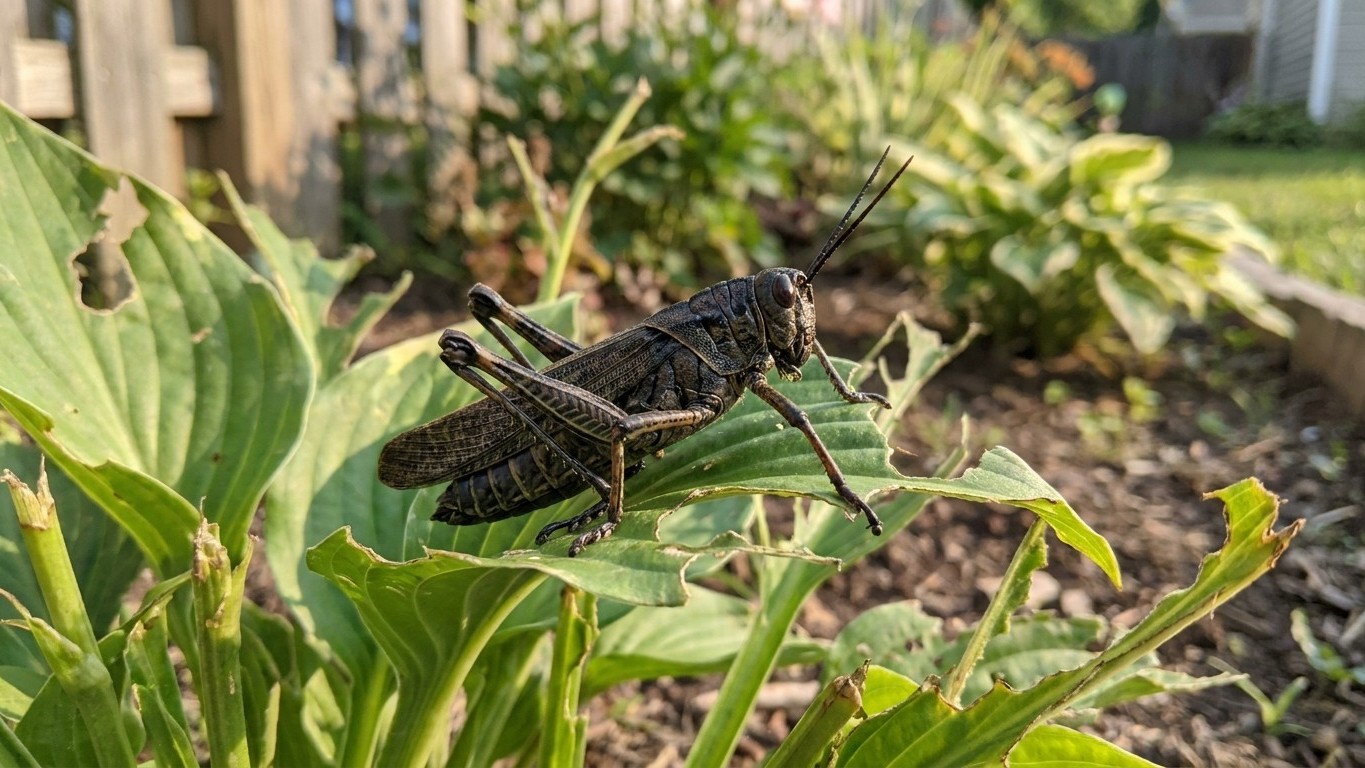

The Eastern lubber grasshopper shows up in Florida gardens from March or April through October or November, with the heaviest numbers in July and August. Nothing stops it outright, but hand-picking, timed egg-pod destruction, and clearing garden debris in late winter cut the population before it grows large enough to strip a bed of foliage overnight.
The weeks to watch

UF/IFAS Extension places this insect in Florida landscapes from March or April to October or November, with numbers peaking in July and August. That’s a long season by grasshopper standards, and it tracks the state’s own growing calendar: warm soil wakes the nymphs, and they don’t slow down until fall temperatures drop.
Nymphs emerge as soil warms
Early in the window, the insect appears as small black nymphs with a yellow or red stripe, clustering on low vegetation. They’re conspicuous but not yet destructive on a large scale. This is the stage worth watching for, because it’s the easiest one to manage before numbers build.
Adults dominate through peak summer
By the time July and August roll around, the survivors have molted into adults, some reaching nearly three inches long. This is when the visible damage jumps, since adult lubbers eat far more per insect than nymphs do, and they’ve had months to spread through a yard. Numbers thin out again as the season turns toward November, when the last adults lay eggs and die off.
UF/IFAS Extension doesn’t break this species into separate spring and fall broods the way it does for some other pests. One generation runs the length of the warm season, and the July-August peak is the single number worth marking on a calendar.
Reading the calendar from your last frost

Lubbers don’t check a calendar. They respond to soil temperature, and that’s exactly why the last frost date matters more than any fixed month. For the Jacksonville area, NOAA’s 1991-2020 climate normals put the last spring freeze between February 16 and March 7. That’s a probability band, not a guaranteed cutoff, drawn from thirty years of station data at the local airport, an inland site where three of those thirty years saw no freeze at all.
Line that frost window up against the UF/IFAS pest calendar and the arithmetic is simple, even if the answer stays a range rather than a single day.
- Start with the last frost window: February 16 to March 7.
- Add the gap to first nymph emergence, which UF/IFAS lists as March or April: that puts the earliest nymphs anywhere from about zero to roughly eight weeks after the last freeze, depending on how the spring runs.
An early, mild spring shortens that gap and pushes nymphs out sooner. A late frost or a cool March stretches it. Either way, this math only works for north Florida conditions like Jacksonville’s. South and central Florida run frost-free most years, and there the growing calendar flips: the pest season stretches through winter, and summer heat becomes the harder stretch to manage, not the frost-free window itself.
What it attacks, and what the damage looks like

The first sign is usually a plant that looks half-eaten overnight, leaves reduced to ragged holes or stripped down to the veins, with no caterpillar or beetle in sight because the culprit has already moved on to the next stem. Lubbers feed in groups when young, so damage tends to appear in patches rather than scattered across a whole bed. Both nymphs and adults chew foliage, but adults do the bulk of the visible destruction simply because of their size and appetite.
UF/IFAS Extension lists this species as a generalist feeder that shows up on a wide range of ornamentals and food crops, including:
- Amaryllis and other bulb foliage
- Crinum lily and iris
- Citrus leaves and young shoots
- Vegetable crops such as tomatoes and peppers
- Cabbage palm and other broadleaf ornamentals
Because it eats almost anything green, identifying the plant on the list matters less than recognizing the pattern: sudden, coarse defoliation with large chew marks, paired with the sight of the grasshopper itself, since it rarely hides once it’s an adult.
How Florida sits in this pest’s range
This site currently documents the Eastern lubber grasshopper for a single territory: Florida. That’s not a claim about how widespread the insect is biologically, since it also ranges across the Gulf Coast and parts of the Southeast. It simply means there’s no second state-level guide on this site yet to compare arrival timing against, so nothing here should be read as a ranking of severity between states.
Within Florida itself, the split runs along the frost line already described. North Florida, including the Jacksonville area used for the frost data above, follows a spring-to-fall pattern anchored to that February-to-March freeze window. Central and south Florida sit outside that pattern almost entirely, since they’re effectively frost-free, and gardeners there deal with the inverted calendar where lubbers can be active well into what would be winter further north. Any advice tied to a specific frost date on this page applies to the northern part of the state, not the peninsula’s frost-free zones.
What actually works against it

Nothing on this list needs a pesticide label to read, and the order matters: start cheap, and stop once the insect is too far along for that step to help.
- Hand-pick nymphs early. Young lubbers cluster together and move slowly, which makes them easy to knock into a bucket of soapy water before they scatter and grow.
- Destroy egg pods in fall and winter. Females lay pods in loose soil after the summer peak. Turning over soil in garden beds during the cooler months exposes and breaks up pods before they hatch the following spring.
- Clear garden debris and tall weeds. Lubbers use uncut vegetation and leaf litter as cover and egg-laying sites, so a cleared bed in late winter removes some of that shelter before nymphs emerge.
- Use row covers on young transplants. This protects small plants during the vulnerable spring window, but it stops working once adults are large enough to walk over or push through the fabric, which happens by midsummer.
- Remove adults by hand once numbers are low. This only makes sense early or late in the season; during the July-August peak, adult lubbers are too numerous and too mobile for hand removal to keep pace.
Once lubbers reach full adult size, most home-scale interventions lose effectiveness fast, since the insect is large, mobile, and largely undeterred by handling. Some gardeners rely on natural predators, but young lubbers carry bright warning colors tied to the toxic plants they feed on, and many birds and predators avoid them for exactly that reason, which is part of why this species persists in yards where other pests don’t.
Common questions
Can Eastern lubber Grasshoppers fly away from a yard?
No. Adults have short, non-functional wings and can’t fly. They move by walking and short hopping, which is part of why hand removal stays a workable option even for adults, if numbers are still low.
Do lubbers come back to the same yard every year?
Often, yes, if egg pods laid in fall aren’t disturbed. Since the species completes one generation per year and lays eggs in the same soil it hatched from, an untreated yard tends to see returning populations each spring.
Are Eastern lubber grasshoppers dangerous to touch?
They’re not venomous, but adults secrete a foul-smelling foam when handled and can spray it several inches. It’s not documented as harmful to skin, but it’s unpleasant enough that gloves are worth using during hand removal.