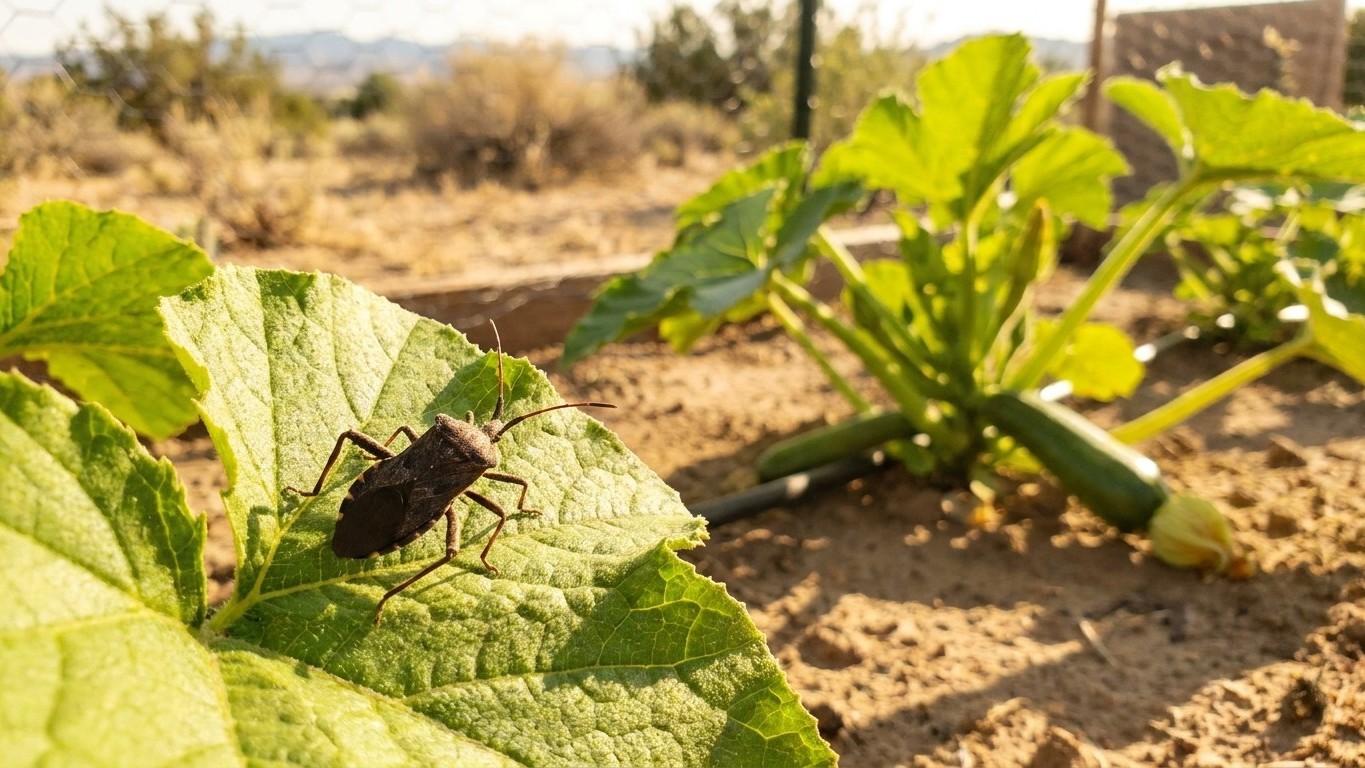

Four insects out of Nebraska’s documented list actually bother a squash plant: squash bugs, squash vine borers, cucumber beetles, and grasshoppers. Cucumber beetles show up first, at the seedling stage. Squash bugs and vine borers follow a few weeks later. Grasshoppers build through the hottest, driest weeks of summer. Each one leaves a different first clue, and that clue is what tells a gardener which problem they’re actually looking at.
Which pests attack summer squash in Nebraska

Nebraska Extension (UNL) documents a specific set of insects found in the state’s gardens and field crops: Bean leaf beetle, Blister beetles, Cucumber beetles, Grasshoppers (migratory, differential, redlegged, and twostriped), Green June beetle, Imported cabbageworm, Japanese beetle, Squash bug, Squash vine borer, and Tomato hornworm. That’s the full roster the service tracks for this territory. It’s short, and it doesn’t need padding.
Only four of those ten belong on a squash pest list. Squash bug, squash vine borer, cucumber beetles, and the various grasshoppers all feed directly on summer squash, either on the foliage, the stems, or both. The other six show up in Nebraska gardens too, but not on this crop, and pinning the wrong insect to a symptom wastes a growing season chasing the wrong fix.
Bean leaf beetle feeds on beans and soybeans, not cucurbit leaves, so a beetle matching that description on a zucchini plant is a case of mistaken identity. Blister beetles cluster on beans, tomatoes, and potatoes, and they tend to swarm into a garden right after a nearby alfalfa field gets cut, but they rarely touch squash foliage. Green June beetle grubs live down in turf and compost, and the adults go after ripening tree fruit and grapes, not squash vines. Imported cabbageworm sticks to the cabbage family (broccoli, kale, cabbage itself) and has no reason to cross over to a cucurbit bed. Japanese beetle will chew on a wide range of plants, but it strongly favors roses, grapes, and linden trees over squash leaves, so seeing one nearby doesn’t mean it’s the cause of squash damage. Tomato hornworm, despite sounding like an all-purpose garden threat, feeds on the tomato family (tomato, pepper, eggplant) and leaves cucurbits alone.
Narrowing the list to four insects before looking for damage is the decision that keeps a diagnosis honest, instead of blaming the nearest bug for a problem it didn’t cause.
When each one shows up, and what it does first
Cucumber beetles arrive earliest, often right as seedlings emerge or within days of transplanting. They chew small, round holes in cotyledons and the first true leaves, and a heavy early infestation can stunt a plant before it even gets going. They also carry bacterial wilt, so a seedling that’s covered in tiny holes and then collapses later in the season may be dealing with more than chewing damage.
Squash bugs turn up a bit later, typically once the plant has several true leaves and the vines start to run. Adults that overwintered in garden debris move in as the ground warms, and within a couple of weeks they’re laying copper-colored egg clusters on the undersides of leaves. The first visible sign isn’t the bug itself but a single leaf that wilts and stays wilted, even after watering, while the rest of the plant still looks fine.
Squash vine borer eggs get laid at the base of the stem around the same stretch of the season, often as flowering begins. The larva tunnels in immediately after hatching, so the first sign most gardeners notice is a pile of moist, greenish sawdust-like material sitting at the base of the vine, followed by one entire vine wilting suddenly while neighboring vines on the same plant stay green.
Grasshoppers are the latecomers. Their numbers build through the driest, hottest stretch of the season, when roadside grasses and field edges dry down and the insects push into irrigated gardens looking for green tissue. Nebraska’s reference station averages 28.1 days a year at or above 90 degrees, and that heat load lines up with when grasshopper pressure tends to peak. Their damage looks different from the others too: ragged, torn leaf margins rather than clean holes or wilting vines, and it tends to appear across several plants at once rather than on a single stem.
Telling the damage apart from everything else
A wilted squash plant in July doesn’t automatically mean an insect is at work. Nebraska’s summers run dry, with the driest month, July, averaging only 3.55 inches of rain, and heat stress alone can make leaves droop by early afternoon even on a healthy plant. Vine borer damage and drought stress look almost identical from a distance, and mixing them up leads to either watering a borer problem or spraying a drought problem.
| Symptom | Could be a pest | Could be something else | What settles it |
|---|---|---|---|
| One vine wilts suddenly, rest of plant green | Squash vine borer tunneling | Nothing, if it recovers by evening | Check for recovery within 24 hours; if it doesn’t bounce back, look for frass at the stem base and slit the stem lengthwise near the soil line for a grub |
| Whole plant wilts, doesn’t recover overnight | Squash bug feeding | Drought stress during a dry stretch | Water deeply and check again the next morning; squash bug damage won’t reverse with water |
| Small round holes clustered on seedling leaves | Cucumber beetle chewing | Hail or mechanical tearing | Beetle holes cluster near feeding sites; hail damage scatters randomly across the whole bed |
| Ragged, torn leaf edges on several plants | Grasshopper feeding | Normal senescence of older leaves | Grasshopper damage appears suddenly, across many plants, during the driest stretch of summer |
| Yellowing between the leaf veins | Not typically a pest at all | Nitrogen or magnesium deficiency | A soil test through the local extension office settles this faster than guessing |
None of this replaces an actual look at the plant. The table narrows the possibilities, but a photo or a sample sent to the county extension office is still the fastest way to confirm what’s actually going on, especially when two causes overlap on the same plant.
What actually works here, and what is a waste of time
Physical barriers, timed correctly, beat almost anything sprayed on after the fact. Row cover placed over seedlings at transplanting keeps cucumber beetles and squash bug adults off the plant during the vulnerable early weeks, and it also blocks vine borer moths from laying eggs at the stem base. The cover has to come off once flowers start opening, though, since squash needs pollinators to set fruit, and a permanently covered plant won’t produce anything.
Sanitation matters more than most gardeners expect. Squash bugs and vine borers both overwinter in old vines, leaves, and debris left in or near the garden. Pulling and disposing of spent squash plants at the end of the season, rather than leaving them to break down in place, cuts down on how many adults are around to start the cycle again next spring.
Spraying after the damage is already visible is mostly wasted effort. Once a vine borer larva is inside the stem, nothing applied to the leaf surface reaches it. Once squash bug eggs have hatched into a heavy nymph population, control gets much harder, so the window that matters is before the eggs hatch, not after. Spraying grasshoppers that have just moved in from a dried-out field edge tends to offer short-lived relief at best, since more insects keep arriving from outside the garden. Any decision about which product, if any, is labeled and appropriate for a home vegetable garden belongs with the local extension office, not a general guess, since what’s legal and effective changes by state and by year.
Where to check this for your own county
Nebraska Extension (UNL) is the service that documents these pests for the state, and it operates through county-based offices rather than one central office for the whole territory. That structure matters here, because pest pressure isn’t uniform. A garden near the Missouri River and one out in the Panhandle sit in different parts of the state’s 4a-5b hardiness zone range, with different soil, different rainfall patterns, and different pest histories, even though both fall under the same statewide documentation.
Frost timing shifts the calendar too. The reference station used for Nebraska’s frost normals shows a last spring frost between April 12 and April 23, and a first fall frost between October 15 and October 26. Those dates come from one airport weather station, and gardens away from that station, especially at higher elevation or in low-lying rural spots, often see frost arrive later in spring and earlier in fall, sometimes by a week or two. That shift moves the whole pest calendar with it.
None of the state-level documentation says what’s actually crawling on a specific plant in a specific yard. The next step is contacting the county extension office directly, ideally with a photo or a physical sample of the damage, and asking what’s been reported locally that season. Pest pressure changes year to year, not just county to county, and a local office tracking current reports knows things a statewide list can’t capture.