
Summer squash in New Brunswick gardens faces three real threats: striped cucumber beetle, squash vine borer, and seedcorn maggot. The University of Maine Cooperative Extension documents these as active in the region bordering New Brunswick, and the risk window tracks the province’s short frost-free season rather than a fixed calendar date.
Which pests attack summer squash in New Brunswick

The University of Maine Cooperative Extension documents ten pests for this general region: Browntail moth (Euproctis chrysorrhoea), Cabbage maggot, Colorado potato beetle, Emerald ash borer, Lily leaf beetle (Lilioceris lilii), Seedcorn maggot (Delia platura), Spotted wing drosophila, Squash vine borer, Striped cucumber beetle, and Winter moth. That’s the full list as the service records it, and most of it has nothing to do with a squash bed.
Browntail moth and Winter moth are both defoliators of trees and shrubs, oaks, cherries, apple, not vegetable foliage. Emerald ash borer is specific to ash trees and won’t touch a cucurbit vine. Lily leaf beetle stays on true lilies. Colorado potato beetle targets potatoes and other nightshades, not squash. Cabbage maggot works the roots of brassicas, cabbage, broccoli, radish, a different plant family entirely. Spotted wing drosophila is a fruit fly that punctures soft, thin-skinned fruit like raspberries and blueberries; summer squash skin is too tough for it to bother with.
That leaves three species that actually feed on summer squash: Squash vine borer, Striped cucumber beetle, and Seedcorn maggot. The first two are classic cucurbit pests found wherever squash, pumpkin, or zucchini grows. The third is less obvious. Seedcorn maggot doesn’t care what crop it’s in; it attacks germinating seeds and young seedlings of many vegetables, squash included, especially in cool, wet, high-organic-matter soil early in the season.
This is a short list, and that’s worth sitting with for a second. The University of Maine Cooperative Extension isn’t claiming these are the only insects that could ever land on a squash leaf in a New Brunswick garden. It’s what the documented record shows for this crop in this region. A gardener who spots something else crawling on their plants is looking at something the record doesn’t cover, and that’s exactly the case for calling in local help rather than guessing from a list.
When each one shows up, and what it does first
New Brunswick’s growing season runs on a mean last spring frost of May 23 and a mean first fall frost of October 2, both drawn from the Moncton station. Those are averages, not guarantees. In roughly one year out of two, frost arrives later than that spring date, which matters more for seedcorn maggot than for the other two, since it strikes right at germination.
Seedcorn maggot shows up first, often before a gardener even sees the crop above ground. It attacks seeds and emerging seedlings in cool, damp soil, the kind of conditions common right around the frost-free transition when soil is still cold from winter and slow to dry. The first sign isn’t a visible insect at all: it’s seeds that never sprout, or seedlings that emerge stunted and collapse with no obvious chewing above the soil line.
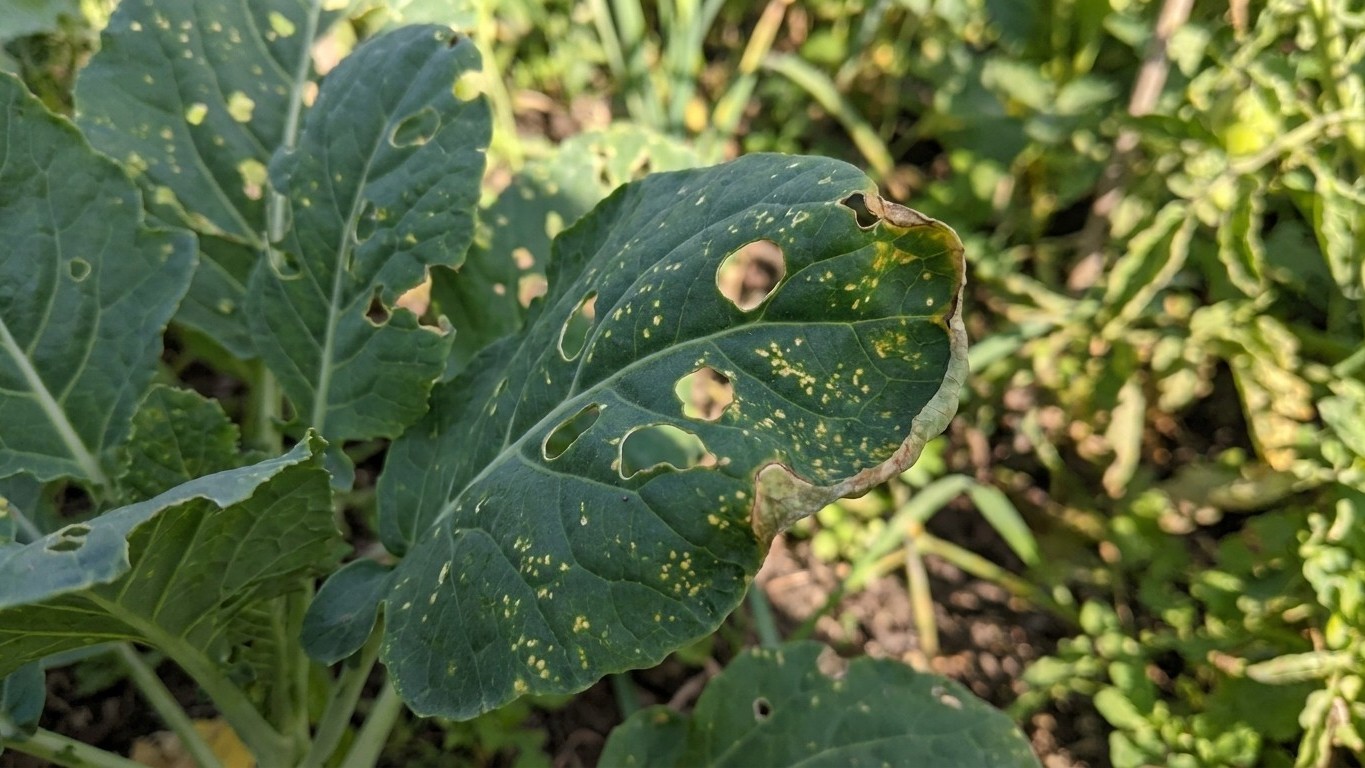
Striped cucumber beetle follows soon after true leaves appear, whether the squash was direct-seeded or set out as transplants once the frost risk had passed. The first sign is small, ragged holes in the cotyledons and young leaves, sometimes enough to skeletonize a seedling within days. Adults are small, yellow-and-black striped beetles easy to see if a gardener parts the leaves and looks.
Squash vine borer arrives later, once plants are Established and vining. The adult is a day-flying moth, often mistaken for a wasp, that lays eggs at the base of the stem. The first visible sign usually isn’t the moth or the egg. It’s a healthy-looking plant that suddenly wilts in the heat of the day even though the soil is moist, because larvae have already tunneled inside the stem and are feeding from the inside out.
Telling the damage apart from everything else
Squash vines wilt for reasons that have nothing to do with insects, and treating the wrong cause wastes a growing season that’s already short. The detail that decides it is where the damage sits: on the leaf surface, at the stem base, or below ground.
| Symptom | Likely cause | What tells them apart |
|---|---|---|
| Seeds fail to sprout, or seedlings collapse below the leaf | Seedcorn maggot, or simply cold/wet soil rot | Dig up a failed seed; maggot damage shows as a hollowed, tunneled seed, rot shows as mush with no tunnel |
| Ragged holes in cotyledons and young leaves | Striped cucumber beetle | Adults are visible on the plant, especially in morning; flea beetle damage looks similar but leaves tinier, pepper-shot holes |
| Sudden daytime wilting of an otherwise watered plant | Squash vine borer | Sawdust-like frass (excrement) piles up at the stem base where larvae have entered; drought wilt recovers by evening, borer wilt does not |
| Yellowing leaves, uneven fruit set, general poor vigor | Often nutrient deficiency or uneven watering, not a pest at all | No frass, no chew marks, no beetles present; check soil moisture and leaf pattern before assuming insects |
Bacterial wilt is another look-alike worth flagging, since striped cucumber beetle can transmit it while feeding. A plant that wilts vine by vine, with no frass and no visible stem tunnel, may be dealing with the bacterium rather than the beetle itself, and a cut stem that oozes a sticky, stringy sap when pinched is the sign extension offices use to separate the two. Guessing from a photo online isn’t as reliable as sending a sample or a clear photo to a local office that can look at the actual tissue.
What actually works here, and what is a waste of time
On a season bookended by a mean frost date in late May and another in early October, timing does more work than any single product ever could. The single biggest decision is when a physical barrier goes on, and when it has to come off. Floating row cover placed over seedlings right at planting keeps both striped cucumber beetle and the vine borer moth from ever reaching the stem or leaf surface. It has to come off once flowers open, though, because squash need pollinators to set fruit, and a cover left on too long trades one problem for an empty patch of blossoms.
For seedcorn maggot, the fix isn’t a barrier at all: it’s letting soil warm and dry a bit before seeding, since the maggot thrives in cold, waterlogged, high-organic ground. Waiting a stretch past the mean last frost date rather than rushing seed into cold soil does more than any treatment applied after the fact.
Watching stem bases for the first sign of frass, and slitting open an infested stem to remove a borer larva by hand while burying the wounded section in moist soil, is a workable rescue for squash vine borer if caught early, though it rarely saves a heavily infested plant. Crop rotation, moving cucurbits to a different bed each year, cuts down on beetle and borer populations that overwinter in old plant debris.
What doesn’t work: spraying anything without confirming which of the three pests is actually present, since the timing and target differ completely between a soil-dwelling maggot and a stem-boring larva. It also doesn’t help to treat squash for tree or shrub pests like winter moth or emerald ash borer, since none of that biology applies to a vegetable bed. A gardener’s own extension office is the one that knows what’s currently registered for use in the province, and that’s not something to guess at from a product label meant for a different country’s market.
Where to check this for your own county
The pest list here comes from the University of Maine Cooperative Extension, cited because it documents this region bordering New Brunswick in detail. The frost dates and hardiness figures on this page come from the Moncton station specifically, and a province is never one climate. A garden further north or at higher elevation than Moncton can run weeks behind these averages, which shifts every pest’s timing along with it.
For a New Brunswick-specific answer, the federal department’s site at agriculture.canada.ca is the current working link; the provincial department’s own site currently blocks automated verification, which is why the federal one is given here instead. From there, a county or regional agricultural office is the next stop, and it’s worth calling rather than emailing if a plant is actively wilting, since a phone conversation can narrow down the cause faster than a photo attachment.
Pest presence within a single province is never uniform. A garden on sandy, fast-draining soil near a river valley faces a different seedcorn maggot risk than one on heavy clay a few miles away, and cucumber beetle pressure can vary block to block depending on what was planted there the year before. What’s documented at the provincial or regional level is a starting point, not a diagnosis of what’s happening in one particular raised bed. The next step is local: a call to the nearest office, or a sample brought in, before assuming a bulletin written for the whole territory describes exactly what’s growing in a single backyard.