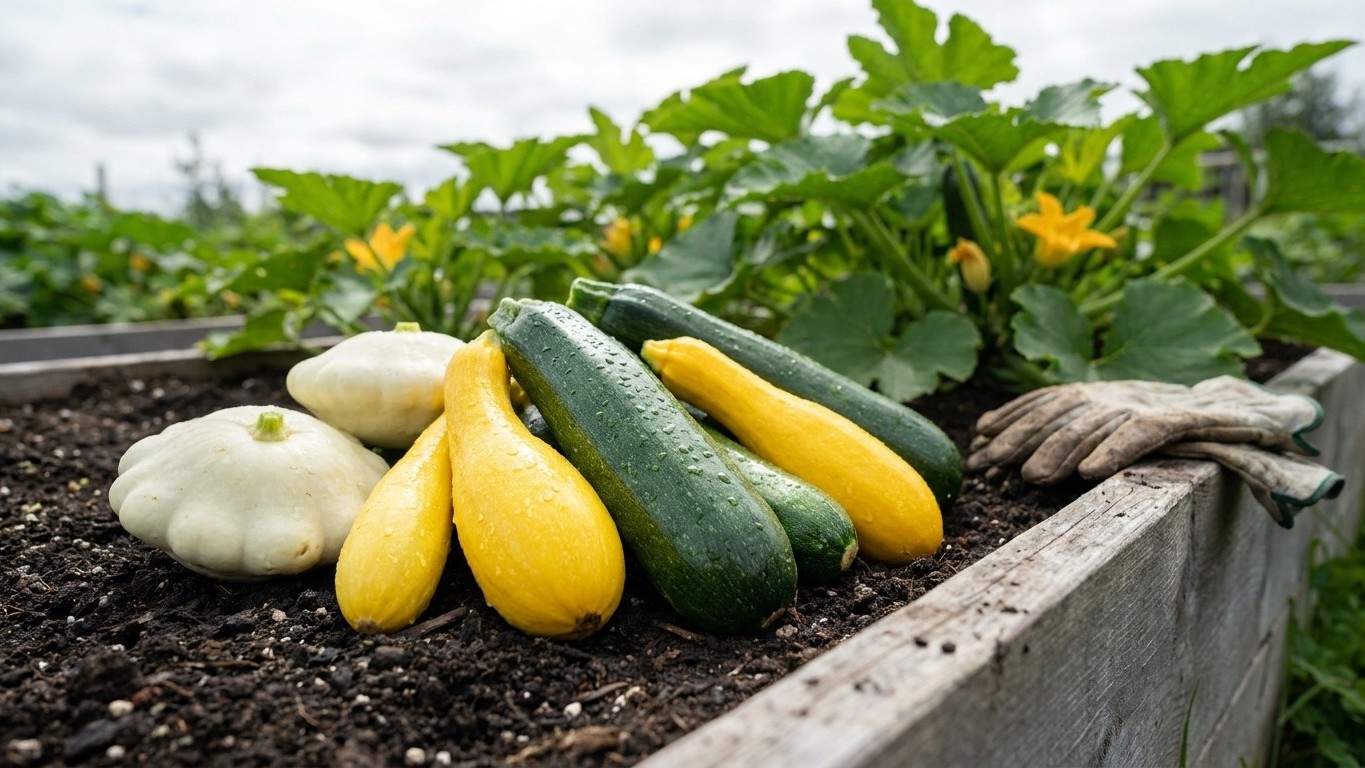

Bush zucchini and yellow crookneck bred to mature in 45 to 55 days are the safest bet in New Brunswick. Skip the long-vining heirloom types that need two extra weeks and a hotter summer than this province ever delivers.
The short answer for New Brunswick
Start with the two numbers that actually decide this: a mean last spring frost of May 23 and a mean first fall frost of October 2 at the Moncton reference station. That’s a 132-day window on paper. But a mean frost date isn’t a guarantee, it’s a coin flip. Half the years on record, frost lands after May 23. So the real growing season most gardeners can count on is shorter than 132 days, sometimes by two or three weeks.
That single fact rules out entire categories of summer squash before you even open a seed catalog. Anything listed at 65 to 70 days to maturity is gambling with a frost that could show up before the fruit does. Bush-type zucchini and yellow squash bred at 45 to 55 days give you a buffer on both ends, one that absorbs a late spring and still finishes weeks ahead of an early fall frost.
The second number that matters here is heat, or the near-total absence of it. Moncton averages 0.0 days a year above 90°F. That’s not a typo, it’s a climate. Summer squash doesn’t need tropical heat to fruit, but many popular varieties, especially the vining and heirloom types bred in warmer regions, were selected for gardens that get a run of hot, sunny days to push pollination and fruit set along quickly. Without that heat pulse, flowering can drag and fruit set can stall, which eats further into an already tight season.
Put those two facts together, short season and low heat load, and the decision by type becomes straightforward. Compact bush habits over sprawling vines, because bush plants put energy into fruit rather than foot after foot of stem. Fast-maturing hybrids over slow heirlooms, because every extra week of days-to-maturity is a week you may not have. And varieties bred or trialed for cooler, shorter-season climates over ones bred for the Gulf Coast or the Deep South, because those were never selected with a zero-90°F summer in mind.
This page doesn’t have county-by-county maturity trial data for New Brunswick specifically, so treat “fast-maturing bush type” as the category to shop by, rather than chasing a single brand name. That single filter does most of the work.
What will not work here
Long-vining summer squash, the tromboncino and trailing patty pan types that ramble six feet or more, are the clearest failure point in this province. They’re bred for gardens with a longer runway and often a warmer one. In a season that may deliver closer to 110 or 120 safe growing days once you account for how often frost arrives after its mean date, a vine that needs 70 days just to set its first fruit, then more time to size up, is racing a clock it usually loses.
Wet early summer, not a dry one
This is the detail that trips up gardeners who plan around generic “summer squash needs full sun and regular water” advice. New Brunswick’s summer rainfall runs about 10.5 inches across June, July and August, and it isn’t evenly spread: June averages 3.73 inches, July 3.63 inches, and only August drops to 3.18 inches. That means the front half of the growing season, exactly when young squash plants are most vulnerable to fungal disease, is also the wettest half.
Combine that early-summer moisture with zero days above 90°F, meaning slower drying, less evaporation, more lingering leaf wetness, and you get conditions that favor powdery and downy mildew. Varieties with dense, sprawling foliage and tight spacing trap humidity against the leaves and stems. That’s a recipe for mildew taking hold before the plant has even finished flowering, which is a bigger threat here than it would be in a drier, hotter climate where foliage dries out fast between rains.
The fix isn’t a different watering schedule, since the rain is already doing that work for you in June and July. It’s plant choice and spacing: open, upright bush habits that let air move through the canopy, given enough room between plants rather than crowded together for a bigger early harvest. A gardener who plants for a hot, dry Southern summer and irrigates on that schedule here will end up watering into an already damp root zone while the real problem, humid air around the leaves, goes unaddressed.
Slow-to-fruit heirlooms selected for flavor over speed, and any variety description that leans on words like “vigorous sprawling vines” or “needs a long hot summer,” are the two red flags worth watching for on a seed packet before it goes in a New Brunswick garden.
What changes across New Brunswick
The hardiness zone figure available for this page, 5a in the Canadian system, applies to the Moncton reference station, not to the whole province. That distinction matters more here than it might elsewhere, because the Canadian zone system is built from seven climate variables rather than the single minimum-temperature figure the USDA system uses. A province the size of New Brunswick, with coastal lowlands, the Saint John River valley, and higher inland and northern terrain, does not sit in one zone. It spans a range, and a summer squash timeline built around Moncton’s numbers will run early in a warmer coastal pocket and late in a colder inland or upland one.
What that means practically: a gardener working from this page’s frost dates and season length should treat them as a provincial midpoint, not a personal forecast. In a colder northern county or at higher elevation, the effective frost-free window is shorter than the 132 days worked out from Moncton’s means, which pushes the case for fast-maturing bush varieties even harder. In a milder coastal or southern pocket, that window opens a bit wider, and a slightly longer-season variety might finish in time where it wouldn’t further north.
There’s no way to resolve that gap from a provincial page, and it would be a mistake to try. This page cannot tell an individual reader which zone their own property falls into, since that depends on elevation, slope, proximity to the Bay of Fundy or the Gulf of St. Lawrence, and other local factors that a province-wide normal doesn’t capture. What it can do is point to where that answer actually lives: Natural Resources Canada’s Plant Hardiness Site, which maps zones by municipality using the same 1991-2020 normals framework. Checking that map for a specific town or county is the step that turns a provincial estimate into a usable local one, before committing to a variety’s stated days-to-maturity as if it were guaranteed.
Where to check this for your own county
This page works from provincial and reference-station normals: one frost pair, one hardiness zone, one rainfall total for the whole of New Brunswick. That’s useful for ruling categories in or out, but it isn’t a local planting calendar, and it was never meant to be one. A county-level or local extension recommendation, built from data closer to an actual garden, beats a provincial-scale estimate every time there’s a conflict between the two.
For New Brunswick, the provincial agriculture department’s own site currently refuses automated verification checks, so the reliable link to hand a reader is the federal one instead: Agriculture and Agri-Food Canada. It’s a better starting point than a broken or unverifiable provincial link, and it connects out to the regional and provincial resources that do carry local planting windows.
What’s worth hunting for once there: a planting calendar specific to a county or region within New Brunswick rather than the province as a whole, and any list of summer squash varieties that have actually been trialed locally, whether through a provincial extension program, a community garden network, or a seed library. Those trial lists matter more than a seed catalog’s stated days-to-maturity, because they reflect what has actually finished, and finished well, in that specific stretch of climate. A variety that performs on paper at 50 days in a warmer test plot may run closer to 58 or 60 days in a cooler microclimate three counties over, and a local trial list is the only source that would catch that difference.
Treat this page as the provincial-level starting filter: rule out long-season vines and heat-dependent heirlooms, favor fast bush types. Then let a county-level source narrow the list further before seed goes in the ground.
Checking this against your own garden
Every date and average on this page describes Moncton, not a specific backyard. The most reliable check a gardener has is the plant and the soil in front of them, and it beats a calendar date every time the two disagree.
Soil warmth by feel is the first signal. Summer squash seed sits and sulks in cold, wet soil rather than germinating, no matter what the calendar says about frost being past. Press a bare hand into the planting bed a couple of inches down. If it still feels cold and clammy rather than a comfortable, faintly warm dampness, the soil hasn’t caught up to the season yet, even if the mean frost date has technically passed.
The first flush of male flowers is the second signal, and it tells a different story: whether the plant has enough warmth and daylight behind it to move toward fruiting. Squash plants typically produce a run of male flowers before the female flowers, the ones with a tiny swollen bulge at the base, appear. A long gap between the first male flowers and the first females often points to a stretch of cool, cloudy weather slowing things down, which lines up with what the near-zero days above 90°F suggests about how this province’s summers behave.
The first true leaves, the ones that appear after the two rounded seed leaves and actually look like squash foliage, mark the point where the plant has shifted from surviving to growing. If they’re slow to show up or come in pale and stunted, that’s a more immediate and local read on soil temperature and fertility than any provincial normal could offer, and it’s worth acting on before assuming a variety choice was wrong.