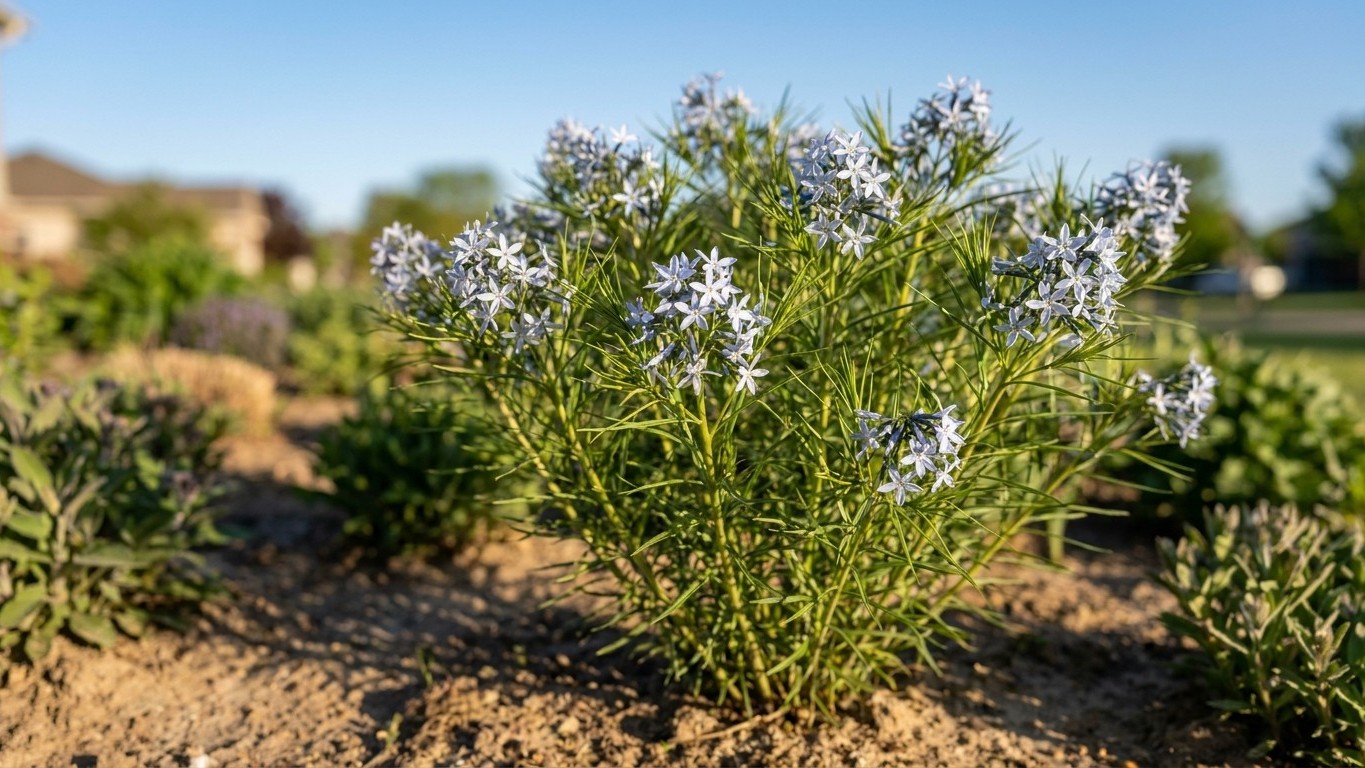

Amsonia hubrichtii, also sold as Arkansas Amsonia, Blue Star, Blue Star Amsonia, Hubricht’s Amsonia, or Threadleaf Blue Star, is an herbaceous perennial hardy in USDA zones 5a-8b. It dies back to the ground each winter and returns from the crown, blooms in spring, and asks for full sun to partial shade in soil that drains well. The details that decide whether it thrives, rather than merely survives, come down to drainage, spacing, and knowing when to divide it.
Where it will and will not survive

The USDA hardiness range for Amsonia hubrichtii is 5a-8b. That number matters most, because it tells you where the plant will not make it through winter at all, not just where it might be happy. Below 5a, the crown is likely to freeze out over winter regardless of mulch or siting. Above 8b, the plant runs into the opposite problem: not enough winter chill, and often summer heat and humidity stress it in ways the range doesn’t capture.
A hardiness range describes survival, not comfort. A plant rated to the warm edge of its range, zone 8b here, is not necessarily going to perform well there every year. It may survive most winters and still struggle through a hot, wet summer, or bloom less reliably than it would a couple zones cooler. The reverse holds too: a planting sitting right at zone 5a survival is at the mercy of an unusually harsh winter in a way one at zone 6 or 7 is not.
Check your own zone rather than guessing from memory or a neighbor’s garden. Zone boundaries shift block by block in hilly terrain and can vary by more than a full zone across a single county, especially near large bodies of water or at elevation. This site’s hardiness zone guide breaks that down by state and county, which is a more reliable way to place your yard on the map. Look up your zone there before deciding whether Amsonia hubrichtii is a fit, and treat the 5a-8b range as the filter it’s meant to be, because the growing conditions below come from a North Carolina source and its zone recommendations are specific to that state, not universal.
Light, soil and drainage
Amsonia hubrichtii tolerates a wider range of conditions than a lot of perennials, but the specifics matter for placement. Here’s how the tolerances break down, condition by condition:
| Condition | Tolerance |
|---|---|
| Light | Full sun (6+ hours direct) or partial shade (2-6 hours direct) |
| Soil texture | Clay, loam (silt), or sand |
| Drainage | Good drainage, moist, or occasionally dry |
That’s a plant with real flexibility on paper, but the drainage line deserves more attention than a single word in a table gives it. For a herbaceous perennial like this one, winter drainage decides survival far more often than cold temperatures do. A crown that sits in saturated, poorly drained soil through a wet, freezing winter is at serious risk of rotting out, even in a zone well within its hardiness range. The plant’s tolerance for “moist” soil applies during the growing season, when roots are active; it does not mean the crown can sit in standing water once the ground freezes and thaws.
There’s a simple check for this before you plant. Dig a hole roughly a foot deep in the spot you’re considering, fill it with water, and see how long it takes to drain. If the water is gone within a few hours, drainage is likely fine. If it’s still sitting there the next day, that spot holds water longer than this plant wants, especially over winter, and you’re better off amending the soil with coarser material, building a raised bed, or choosing a different location. Clay soils in particular are prone to holding winter moisture even when they seem fine in July, so test drainage going into fall, when the soil profile is closer to what it will be over the dormant months.
Matching light to your site
Full sun brings out the strongest flowering and the tightest, most upright habit. Partial shade is workable and won’t kill the plant, but expect a looser form and somewhat fewer flowers, since the plant tends to lean toward available light rather than holding its clumping shape tightly.
When it flowers and how long
Amsonia hubrichtii blooms in spring. That’s the season given by the source, and it’s worth treating it as exactly that, rather than pinning it to a specific month, since bloom timing shifts with latitude and elevation. A spring bloom in a warmer zone within the plant’s range will land earlier in the calendar than the same bloom in a cooler zone.
Once flowering wraps up, there isn’t a documented benefit to deadheading extending the display further, so the more useful move is cutting the spent flower stems back, which tidies the plant and redirects its energy into foliage rather than seed pod development. After flowering, the pods that were forming, described as attractive and narrow, beanlike, take over as the visual interest before the plant settles into its foliage phase for the rest of the growing season.
That foliage phase is most of the year, and it’s the part a lot of plant profiles skip past on their way to the next bloom season. Given the plant’s threadleaf-style common name and fine-textured habit, the foliage carries the display through summer as a soft, feathery mass, and then again in fall when deciduous perennials in this family are known for strong color before dieback. The clumping, erect habit holds its shape through these stages, which is part of why it works as a structural planting even when nothing is in bloom.
The flower’s role in attracting butterflies is specific to the bloom itself. Once flowering ends, that draw ends with it. Butterflies aren’t drawn to the foliage or seed pods, so if pollinator activity is a reason you’re planting this, plan for a spring window only.
Planting, and dividing it later
Getting Amsonia hubrichtii into the ground correctly sets up everything that follows, drainage included. Here’s the sequence:
- Plant in spring or fall, when temperatures are moderate and the plant isn’t stressed by summer heat.
- Space plants based on the mature spread, 12 inches to 3 feet, leaving room at the wider end if you want the clump to fill in without crowding neighbors.
- Set the crown at grade, level with the surrounding soil surface, not buried under an inch or two of soil or mulch, which invites rot.
- Water regularly through the first growing season while the root system establishes, then taper off once the plant is settled in.
- Mulch lightly around the base to conserve moisture and moderate soil temperature, keeping mulch pulled back from direct contact with the crown itself.
Unlike a shrub or tree that you plant once and largely leave alone, a herbaceous perennial like this one will eventually need dividing. The signs are more useful here than any fixed timeline, since growth rate and site conditions vary too much for a single interval to apply everywhere. Watch for a clump with a bare or sparse center while growth pushes out toward the edges, a noticeable drop in flower production compared to previous springs, or a footprint that’s simply outgrown the space you gave it.
When you see those signs, division follows a standard process:
- Dig up the entire clump in early spring or fall, lifting the root mass with as much soil intact as practical.
- Separate the clump into sections, each with a portion of healthy root and at least one growth point, using a sharp spade or knife where the clump doesn’t pull apart by hand.
- Discard the old, woody or hollow center if one has formed, keeping the vigorous outer sections.
- Replant the divisions at the same spacing guidance used originally, crown at grade, and water them in well to reestablish.
What it resists, and what it does not
Resistance in a plant profile means a tendency, not a guarantee. A plant listed as resisting deer is one deer tend to leave alone, not one that’s off-limits to them under all conditions, particularly when other food sources are scarce.
| Factor | What the source indicates |
|---|---|
| Deer | Resistant, meaning deer tend to avoid it, not that they never touch it |
| Wet soil / poor drainage | Not listed as a resistance; the plant tolerates moist soil in season but is vulnerable to standing water over winter |
That gap is worth sitting with. Deer resistance is a genuine point in this plant’s favor for yards dealing with browsing pressure, but wet, poorly draining winter soil is not something it’s noted to tolerate, which lines up with the drainage guidance covered earlier. A site that checks the deer box but fails the drainage test is still a risky choice for this plant.
Maintenance is rated low, which is a fair description but not the same as zero. Low maintenance here means the plant doesn’t need frequent feeding, staking, or pest management under typical conditions, and its slow growth rate keeps it from becoming an aggressive spreader. It still needs the seasonal cutback after flowering, occasional division once it shows the signs above, and attention to soil moisture, particularly in the first year.
Common questions
Is Amsonia hubrichtii native to the whole United States?
No. Where the source classifies it as a native plant, that refers to the southeastern United States specifically, not the entire country. Check your own region’s native plant resources if that distinction matters for your planting goals.
Does Amsonia hubrichtii spread aggressively?
Its growth rate is listed as slow, and its habit is clumping and erect rather than spreading by runners, so it tends to build a defined clump over time instead of colonizing surrounding beds.
Can it handle part shade, or does it need full sun?
It tolerates both full sun and partial shade. Full sun produces the tightest habit and strongest bloom; partial shade is workable but tends to loosen the form and reduce flowering somewhat.
What does the plant look like after it finishes flowering?
Once bloom ends, narrow, beanlike seed pods form and become the visual interest for a stretch, and the plant then settles into its foliage phase, which carries its fine, feathery texture through summer and into fall before it dies back for winter.