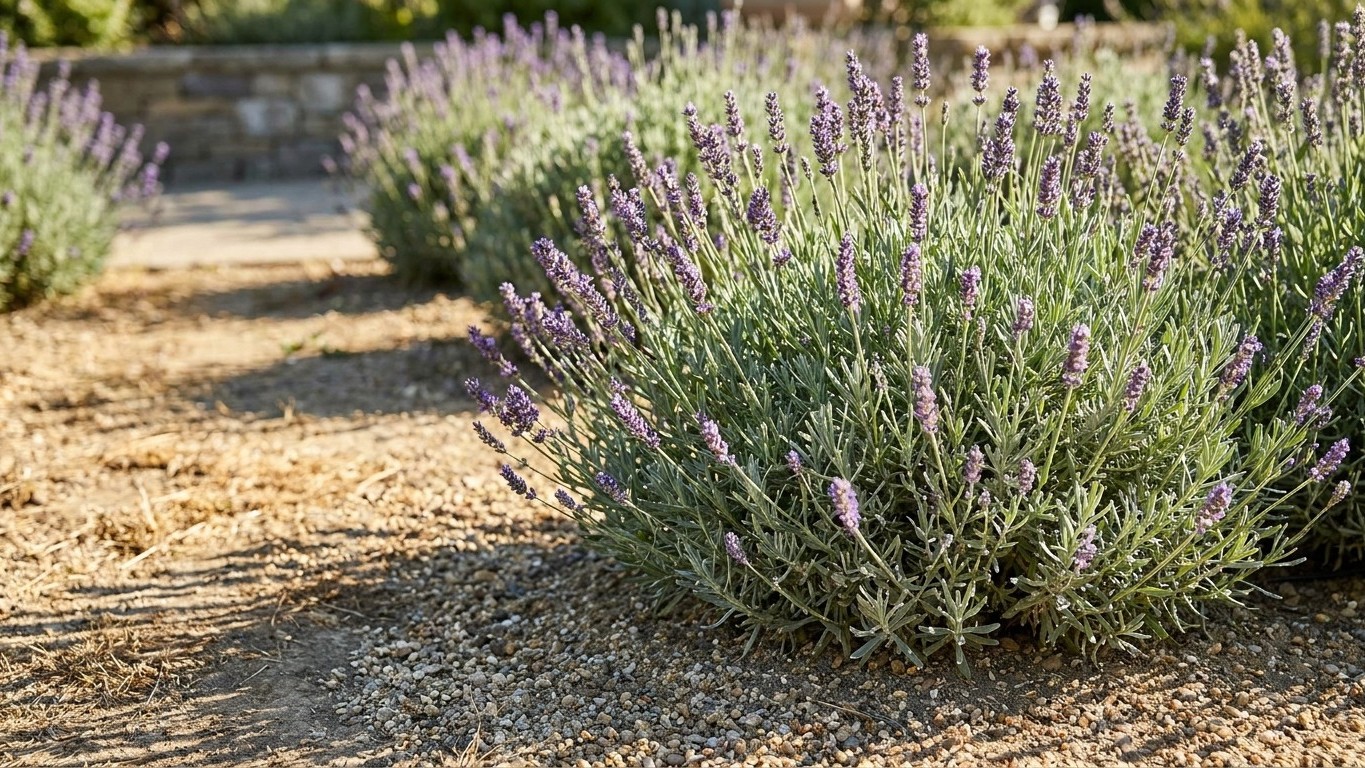

English lavender survives winter cold across USDA zones 5a through 9b, but that number alone won’t tell you whether a plant thrives in your yard. What actually decides its fate is drainage, not the thermometer. Give it full sun, lean soil and water that never pools around the crown, and it will hold its rounded, gray-green mound year-round. Get the drainage wrong, and zone rating becomes irrelevant.
Where it will and will not survive

The USDA hardiness range for Lavandula angustifolia is 5a-9b. That’s the working number, and the honest way to use it is backwards: it tells you where this plant will not survive, more than where it will flourish. Below the bottom of that range, winter cold routinely kills the plant outright, no matter how well the soil drains or how sheltered the spot. Above the top of it, the plant may survive the winter itself but struggles against a different problem: heat and humidity that this species didn’t evolve to handle.
A hardiness range describes survival, not comfort. A lavender planted at the warm edge of its range, zone 9b, is not necessarily happy there. It may live through most winters and still sulk through summer, stalling out or thinning in ways that have nothing to do with cold. Same story at the cold edge: a plant that limps through zone 5a winters isn’t performing the way it would at 6b or 7a, where the margin for error is wider.
Find your zone before you plant
None of this matters much until you know your own zone, and guessing is where most of the costly mistakes start. Rather than assume where your address falls, check a hardiness zone guide for your specific state, since zone boundaries shift by county and even by microclimate within a county. This site’s own hardiness zone guide breaks that down region by region, and it’s worth five minutes before you buy anything.
One more thing worth flagging: this plant’s growing data comes from the North Carolina Extension Gardener Plant Toolbox. The USDA hardiness range itself is a national standard and applies wherever you garden. But if you ever see regional planting advice tied to North Carolina specifically, Coastal, Piedmont, or Mountain guidance, treat that as local information for North Carolina gardeners, not a rule for your own yard. Your local extension office is the better source for anything that specific.
Light, soil and drainage
This is a plant that asks for very little, but it does have firm preferences. Here’s how the conditions break down, condition by condition.
| Condition | What the plant tolerates |
|---|---|
| Light | Full sun (6+ hours of direct sun), or partial shade (2-6 hours) |
| Soil texture | Loam (silt), sand, or shallow rocky soil |
| Soil pH | Neutral (6.0-8.0) to alkaline (above 8.0) |
| Drainage | Good drainage required |
| Space at maturity | 12 inches to 3 feet |
The space at maturity figure is the one people get wrong most often, and it’s the mistake that costs the most later. Lavender’s mature spread runs from a compact 12 inches up to 3 feet, a wide range that depends on growing conditions and how the individual plant is treated. Plant three or four of them a foot apart assuming they’ll stay small, and within a couple of seasons you’ve got a solid hedge of tangled stems fighting each other for light and airflow, which is exactly the crowded, damp microclimate that shortens a lavender’s life.
Why drainage matters more than cold
For a perennial like this one, winter drainage decides survival more often than winter cold does. A lavender rated hardy to zone 5a will still die in a spot where water sits over winter, because the combination of cold and saturated soil rots the crown and roots long before a dry cold snap would kill the same plant. This is the single most useful thing to know about growing lavender, and it’s the reason so many “hardy” plants fail in yards that are technically within their zone.
The soil texture and pH tolerances above are wide for a reason. This plant is built to handle sand and shallow rocky ground, alkaline pH included, precisely because those conditions drain fast. Loam works too, provided it isn’t compacted or amended in ways that hold water. Before planting, do the simple check: dig a hole about a foot deep, fill it with water, and see how long it takes to drain. If water is still standing after an hour or two, that spot needs raised beds, added grit, or a different location entirely, because no amount of sun exposure will compensate for wet feet in winter.
When it flowers and how long
Bloom time for this lavender falls in summer. That’s a season, not a fixed date, since actual timing shifts depending on latitude, elevation, and the particular weather that year. A garden at lower elevation or further south will typically see flower spikes open earlier in the season than one at higher elevation or further north, so use the summer window as a general expectation rather than a calendar entry.
Deadheading, cutting back, and the rest of the year
Removing spent flower spikes as they fade can extend the bloom display somewhat, encouraging the plant to put out a second flush rather than stopping once the first round is done. Once the main summer bloom period has clearly ended, a light cutback of the spent flower stems tidies the plant and helps prevent it from developing the woody, leggy look that untended lavender is prone to over time. A harder cutback into old wood is riskier and better reserved for reviving a plant that has clearly gotten leggy, rather than done as routine annual maintenance.
What often gets skipped on plant pages is what this shrub looks like the rest of the year, which is most of the year. Outside its summer bloom window, Lavandula angustifolia is a broadleaf evergreen with a rounded, mounding, multi-stemmed habit, holding its gray-green foliage through fall, winter and spring. It’s the structure and texture that carry the plant in a border for the majority of the calendar, not the flowers, which is worth remembering when deciding where to place it relative to other perennials that go fully dormant.
The flowers themselves attract butterflies and other pollinators, a property of the bloom itself. That means the pollinator traffic is tied directly to the flowering window: once the summer flush is over and the plant has been cut back, the pollinator activity drops off along with it, picking back up the following summer when new flower spikes open.
Planting, and dividing it later
Getting this plant established correctly matters more than most people assume, since a lavender planted too deep or overwatered in its first year rarely recovers well later.
- Plant in spring or early fall, giving roots time to settle before summer heat or winter cold arrives in full force.
- Space plants according to the mature size, 12 inches to 3 feet apart depending on variety and conditions, rather than how small the nursery pot looks today.
- Set the crown at grade, level with the surrounding soil surface, never buried, since a buried crown holds moisture against the stem base and invites rot.
- Water consistently through the first growing season while roots establish, then taper off, since an established plant tolerates drought far better than a new transplant does.
- Mulch lightly around the base without piling material against the crown itself, which would trap moisture in exactly the spot the plant can least afford it.
Signs it’s time to divide
This is where a herbaceous perennial habit shows through, even in a plant that’s technically classed as a shrub too. Watch for a bare or woody center with green growth only around the outer edges, a noticeably reduced flower count compared to previous years, or a clump that has simply outgrown the space allotted to it. Any one of those signs means it’s time to act, rather than waiting for a fixed number of years to pass, since growing conditions and individual plant vigor vary too much for a calendar-based rule to be reliable.
- Dig up the entire clump, taking care to lift as much of the root mass as possible.
- Separate it into sections, each with its own portion of roots and stems, discarding the dead or overly woody center.
- Replant the healthy divisions immediately at the same depth as before, crown at grade.
- Water the new divisions in well and keep the soil consistently moist while they reestablish, the same as with a fresh transplant.
What it resists, and what it does not
Resistance means a tendency, not immunity. A plant described as resistant to something is simply less likely to suffer from it than an average plant, not guaranteed to shrug it off entirely.
| Factor | Rating | What it actually means |
|---|---|---|
| Drought | Resistant | Applies to established plants; new transplants still need regular water |
| Dry soil | Resistant | Same caveat: tolerance builds as roots mature, not from day one |
| Wet soil | Not tolerant | Good drainage is a firm requirement, not a preference |
The two factors that matter most for a perennial like this are wet soil and deer, and this plant’s profile is telling on both counts. Wet soil isn’t on the resistance list at all, and that omission is the point: good drainage is listed as a flat requirement, and standing water over winter is the single most common way this plant dies. Deer resistance isn’t part of this plant’s documented profile either, so no claim should be made either way. If deer pressure is a concern in your area, treat that as an open question rather than an assumption in this plant’s favor.
Maintenance is rated low, which in practical hours means the plant doesn’t demand feeding, spraying, or constant attention, not that it demands nothing. Low maintenance still means an annual light cutback after flowering, occasional shaping to prevent legginess, and eventually dividing once the signs above show up. Budget for a few short sessions a year rather than none, and the plant will hold its rounded, evergreen structure for years.
Common questions
Is Lavandula angustifolia the same as English lavender?
Yes, English Lavender is one of the common names in regular use for this species, along with Common Lavender, Lavender, and Narrow-Leaved Lavender. None of these common names is the official one; the botanical name is used precisely because the common names overlap and vary by region.
Does this lavender need full sun, or will partial shade work?
Both are listed as acceptable. Full sun, at least six hours of direct light daily, is the stronger option for compact growth and flowering, but partial shade of two to six hours a day is also tolerated.
How long does the bloom period actually last?
The bloom time is documented as summer, without a specific month range, since actual timing shifts with latitude and elevation. Deadheading spent spikes can help extend the display within that summer window.
Is the fruit on this plant edible?
No indication of that either way should be assumed. The fruit is described only as non-ornamental nutlets, a description of what it looks like, not a statement about taste or edibility.