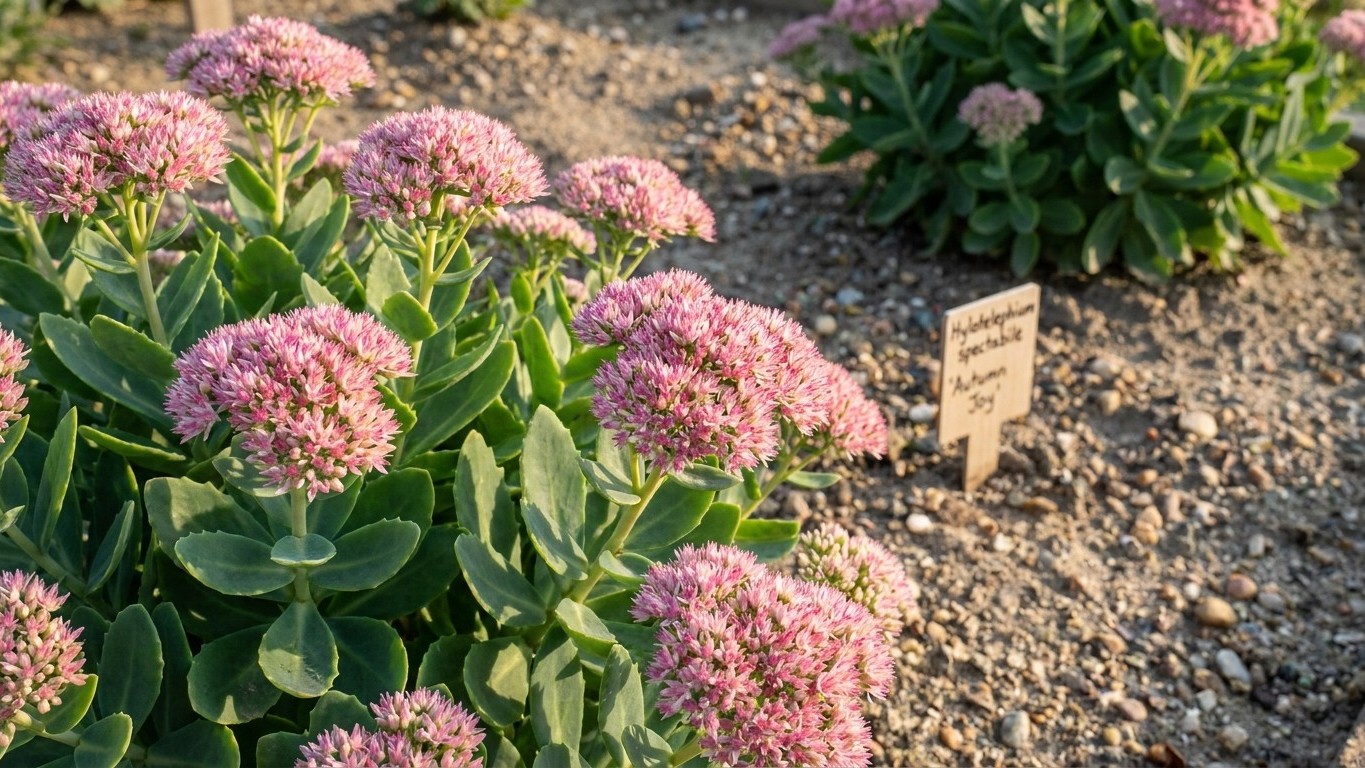

Hylotelephium spectabile, sold under names like Ice Plant, Showy Stonecrop, and Stonecrop, is a clump-forming succulent perennial hardy from USDA zone 4a to 9b. It tolerates full sun to partial shade, soils ranging from clay to sand, and drought once established, but it will not tolerate standing water over winter. The foliage dies back to the ground each fall, and rounded flower clusters open from summer into fall. Division becomes necessary once the center of the clump thins out, not on a fixed yearly schedule.
Where it will and will not survive

The USDA hardiness range for Hylotelephium spectabile is 4a-9b. Read backwards, this means the plant is not expected to survive winters colder than zone 4a, and it is not expected to hold up in the summer heat and humidity of zone 9b and beyond.
A hardiness range describes survival, not comfort. A specimen at the warm edge, in zone 9b, may live through winter and still struggle with a long, hot growing season. At the cold edge, surviving zone 4a winters isn’t the same as thriving there; a plant pushed to the limit often blooms later, grows smaller, or declines faster than one planted comfortably inside its range.
Zone numbers also aren’t something to guess at. USDA hardiness zones are drawn from average winter minimum temperatures, and they shift block by block in hilly terrain, near large bodies of water, and around urban heat pockets. Check your zone directly using this site’s hardiness zone guide, which breaks the country down by state and county.
One distinction matters here: the growing-conditions information comes from the North Carolina Extension Gardener Plant Toolbox, and the USDA hardiness range it cites is a national standard, applicable anywhere in the country. But that same source also publishes region-specific planting advice for North Carolina’s own coastal, piedmont, and mountain zones. That guidance is calibrated to North Carolina’s climate bands and doesn’t transfer to a reader gardening elsewhere, even in a matching zone. The zone figure travels; the regional commentary attached to it does not.
Inside the 4a-9b window, this stonecrop has wide latitude to work with, which is part of why it shows up so often in mixed perennial borders. Outside that window, in either direction, it’s not the right plant for the spot, no matter how good the soil or how sheltered the exposure.
Light, soil and drainage
The growing conditions reported for this species cover a wide band, which makes it forgiving in most ordinary garden soil. Here’s how the tolerances line up:
| Condition | Tolerance |
|---|---|
| Light | Full sun (6+ hours of direct sun) or partial shade (2-6 hours) |
| Soil texture | Clay, loam, sand, or shallow rocky soil |
| Soil pH | Acid, neutral, or alkaline |
| Drainage | Good drainage, or soil that occasionally runs dry |
Notice what’s absent: there’s no allowance for soil that stays wet. For a herbaceous perennial like this, winter drainage decides survival far more often than winter cold does. A plant rated hardy to zone 4a can still die in a zone 6 garden if its crown sits in saturated soil through a thaw-and-freeze cycle, because it’s the standing water, not the temperature, that rots the roots.
A drainage check anyone can run
Before planting, dig a hole about a foot deep and wide, fill it with water, and let it drain completely. Fill it again and time how long a second drain takes. Water gone within a few hours means good drainage; still standing after half a day means the spot holds water longer than this plant tolerates, and needs correcting through amendment, a raised bed, or a different location before planting. A quick squeeze test on the soil helps too: a tight, slick ball signals heavier, slower-draining clay, while soil that falls apart readily drains faster and suits this plant’s preferences.
When it flowers and how long
Bloom on Hylotelephium spectabile runs from summer into fall, a full-season display rather than a brief spring flush. The flower heads open as dense, rounded clusters that start out a pale, muted color and deepen as the season progresses, sitting atop upright succulent stems.
Deadheading isn’t the priority here that it is on many summer bloomers. Once the flower clusters fade in fall, the dried seed heads are worth leaving in place for winter interest, holding their shape through the cold months. The better approach is to skip cutting the plant back in fall and instead clear old stems in late winter or very early spring, just before new growth emerges from the crown.
Out of flower, which is most of the year, this is a mounding succulent with fleshy, gray-green foliage that forms a tidy clump before the flower stems rise. The whole plant is deciduous, dying back to the ground each fall and regrowing from the crown the following spring, so expect no winter greenery from the foliage itself, only from the standing seed heads.
The plant attracts butterflies, pollinators, and songbirds, but for different reasons on different schedules. Butterflies and pollinators come for the open flowers, and that traffic stops once the blooms fade in fall. Songbird interest shifts to the later stage instead, drawn to the seed heads left standing through winter, another reason to leave that cleanup for spring.
Planting, and dividing it later
Getting a new plant established is straightforward if a few basics are followed in order:
- Plant in spring after the threat of hard frost has passed, or in fall with enough time before the ground freezes for roots to settle in.
- Space plants according to their mature spread, which runs 12 inches to 3 feet depending on conditions, so clumps aren’t competing for light and airflow.
- Set the crown at grade, level with the surrounding soil surface, rather than burying it; a buried crown on a succulent perennial invites rot.
- Water regularly through the first growing season while roots establish, then taper off, since mature plants lean toward the drought-tolerant end of their range.
- Mulch lightly around the base to conserve moisture, keeping mulch pulled back from direct contact with the crown.
This clumping herbaceous perennial will eventually need dividing rather than simply growing larger in place forever. The signs are visual, not calendar-based: a bare or hollow center while growth continues only around the edge, a noticeable drop in flower count, or a clump that has outgrown its space and is crowding neighbors. Any one of those is the signal to divide, whether that happens in year three or year eight.
When it’s time, the process follows a simple sequence:
- Dig up the entire clump, lifting the root mass rather than slicing off a piece in place.
- Separate the crown into sections, making sure each division carries its own roots and at least a few growth buds.
- Discard the old, hollow center if one has formed, keeping only vigorous outer sections.
- Replant divisions promptly at the same depth as before, crown at grade, spaced per the mature spread noted above.
- Water the new divisions in well and keep soil consistently moist for the first few weeks while roots reestablish.
What it resists, and what it does not
Resistance, in a plant profile, describes a tendency rather than a guarantee. A plant listed as resisting a given pressure will usually shrug it off better than average, not that it’s immune under every condition.
For this species, the source tracks resistance to salt, drought, and rabbits as categories, though it doesn’t specify a level of resistance for any of the three:
| Factor | What’s known |
|---|---|
| Salt | Tracked as a resistance category; no specific level given for this plant |
| Drought | Tracked as a resistance category; no specific level given, and any drought tolerance would apply to established plants, not new transplants |
| Rabbits | Tracked as a resistance category; no specific level given for this plant |
Two gaps are worth flagging rather than filling with guesswork. Deer resistance isn’t part of this plant’s tracked data at all, so nothing should be assumed about deer browsing in a given yard. And wet soil isn’t a resistance here at all, it’s the opposite: the drainage requirements above make clear this plant needs good drainage or occasionally dry soil, with no tolerance for standing water, so that’s a vulnerability to plan around rather than a strength to rely on.
Maintenance is rated low, meaning this isn’t a plant that needs regular feeding, staking, or pest management through the growing season. But low maintenance still means some maintenance: a yearly cutback of old stems in late winter, occasional division once the signs above appear, and a watchful eye on drainage after heavy rain, particularly in the first year.
Common questions
Is “Ice Plant” the same plant as Showy Stonecrop?
The common names attached to this species include Ice Plant, Showy Stonecrop, and Stonecrop, but “Ice Plant” is also widely used for entirely different succulent genera, such as Delosperma and Carpobrotus. That’s a real ambiguity in common naming, and it’s a good reason to confirm the botanical name, Hylotelephium spectabile, before buying or trading a plant sold simply as “ice plant.”
Does this plant need deadheading to keep blooming?
No. The flowering display runs from summer into fall on its own, and rather than deadheading, the better practice is to leave spent flower heads standing through winter for visual interest. Cutting back is better saved for late winter or early spring, ahead of new growth.
How do I know if my clump needs dividing?
Look for a bare or hollow center, a noticeable decline in flower count compared to previous years, or a clump that has outgrown its allotted space. Any of those signs, not a fixed number of years, is the cue to divide.
Is it safe to eat?
The source notes that very young, tender stems and leaves may be eaten raw, and that same growth may be briefly cooked before flowering, with a bland flavor. That same source also classifies the plant as poisonous in its general listing, a contradiction worth treating as a reason for caution rather than resolving one way or the other.