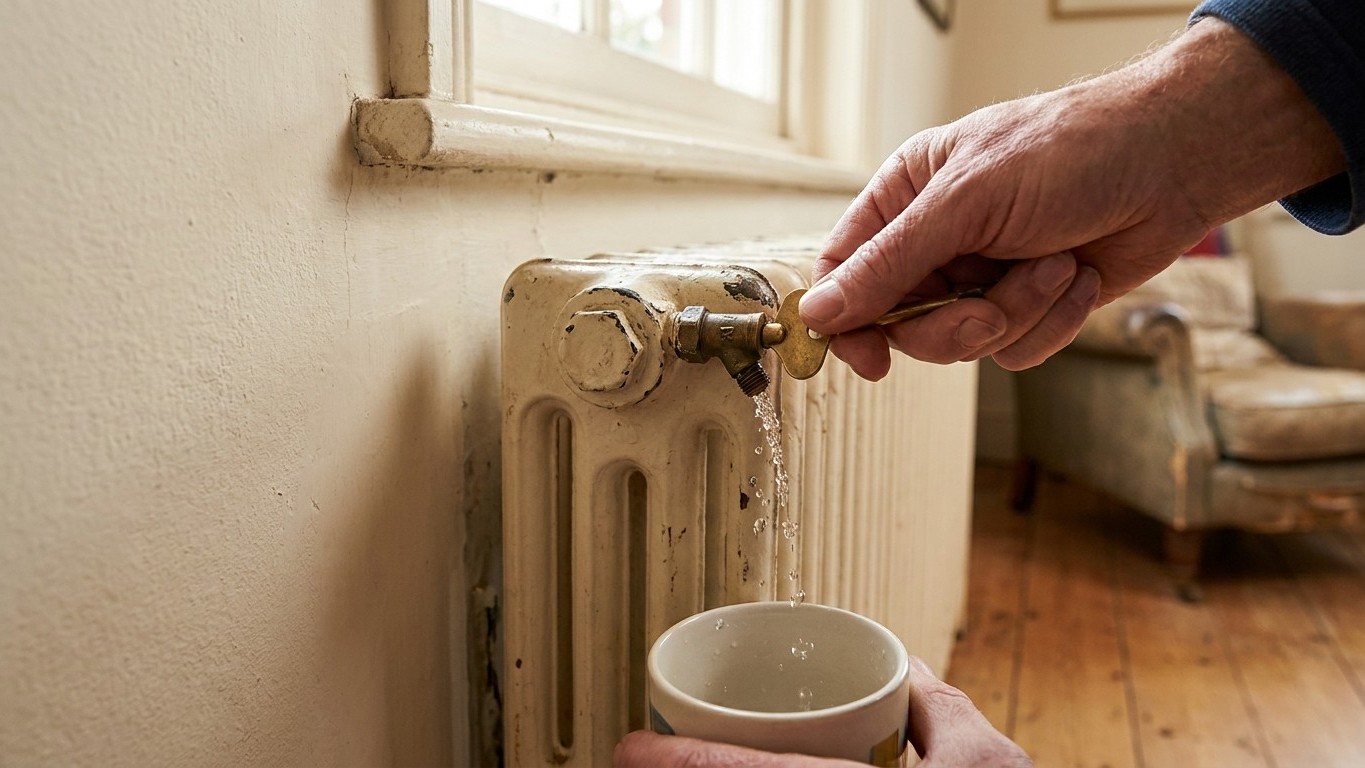

Bleed a hot-water radiator when the top stays cool while the bottom heats up. That mismatch means air is trapped inside, blocking water flow, and a few turns of the bleed valve usually clears it in minutes. Don’t try the same fix on a steam radiator’s air vent. Steam systems release air through a different kind of valve entirely, and forcing that valve open the way you’d bleed a hot-water radiator can cause more trouble than the cold spot you started with. Which system you have decides which answer applies to you.
How to Bleed a Radiator, and When Not To
The difference comes down to how each system moves heat. A hot-water (hydronic) radiator is part of a sealed loop: a boiler heats water, a pump pushes it through pipes, and it returns to be reheated. Air gets into that loop whenever the system is drained, refilled, or loses a little pressure over time. Because air is lighter than water, it rises and collects at the highest point it can reach, which is usually the top of a radiator. That pocket of air physically blocks hot water from filling the space, so the top of the radiator stays cold while the bottom, still full of water, stays warm. Opening the bleed valve at the top lets the trapped air escape so water can take its place. Once you see a steady stream of water instead of a hiss of air, the job is done.
Steam radiators work on an entirely different principle, and that’s where the “when not to” part matters. A steam system doesn’t rely on a pump pushing water around a loop. Instead, the boiler turns water into steam, and the steam itself pushes the air out of the pipes and radiators as it travels. Each radiator has an air vent, not a bleed valve, and that vent is designed to let trapped air escape automatically as steam arrives, then snap shut once it senses heat. There’s no manual “bleeding” step for a properly functioning steam radiator, because the system is built to purge its own air on every heating cycle. Opening or forcing a steam vent the way you’d bleed a hot-water radiator doesn’t clear anything useful. It’s more likely to flood the vent or damage a part that was never meant to be manually operated.
This distinction matters more in some states than others. In New York, for example, U.S. Energy Information Administration RECS 2020 state data shows 35% of homes heat with a steam or hot-water boiler, while 44% use a furnace and just 3% use a central heat pump. In a state like that, knowing which boiler type you have isn’t a minor detail. It’s the first fact you need before touching any valve.
How to tell, in your own house
Before you touch anything, work through these checks in order. Each one costs less than the next, and stopping partway still gets you real information.
- Feel the radiator top to bottom while the heat is running. Cold top, warm bottom points to trapped air. Cold everywhere usually means the valve feeding that radiator is closed or the circulation isn’t reaching it at all, which is a different problem.
- Check whether it’s one radiator or several. A single cold radiator usually means air trapped locally. Several radiators acting the same way across the house points to a system-wide issue, like a pump that needs attention or air that entered during a recent refill.
- Listen for gurgling or clanking in the pipes. That sound is often air moving through water as the system heats up, and it supports what your hand already told you.
- Confirm what kind of radiator you actually have. Look at the pipe connections: a hot-water radiator typically has two pipes running to it, while a steam radiator commonly has one. If you’re not sure, check the boiler nameplate or ask a technician the next time one is in the house, since this single fact determines whether the next step is safe.
- If it’s hot-water, locate the bleed valve, a small square or slotted fitting near the top corner, and open it briefly with a radiator key or screwdriver until water flows steadily, then close it.
- If it’s steam, stop here. There’s no bleed valve to open. A vent that hisses constantly, never closes, or lets water spit out instead of air is a sign the vent itself has failed and needs to be replaced, not manually adjusted.
Homeowner work ends at opening a hot-water bleed valve and closing it once water runs clear. If air keeps coming back within days, if the boiler’s pressure gauge keeps dropping, or if a steam vent is clearly malfunctioning, that points to a leak somewhere in the system, a failing expansion tank, or a pressure-reducing valve that isn’t holding. Those are jobs for a licensed heating contractor, because they involve pressurized equipment and parts that aren’t meant to be opened without training.
What it costs you to ignore it
Trapped air doesn’t stay quietly in one radiator. On a hot-water system, an air pocket blocks water from reaching part of the radiator’s surface, so that room runs cooler than the thermostat suggests it should. The boiler doesn’t know the difference between a room that’s genuinely losing heat and one that’s just not receiving hot water properly, so it keeps firing to chase a setpoint it can’t reach efficiently, running longer than it would with a clear system.
The pump also works harder pushing water against pockets of trapped air instead of a clean, continuous flow, which adds strain to a part that’s expensive to replace and inconvenient to be without in the middle of winter. Air trapped inside cast-iron radiators over long periods introduces oxygen into water that’s supposed to stay in a closed, oxygen-poor loop, and that oxygen contributes to internal corrosion over years of exposure, not overnight, but steadily.
On a steam system, ignoring a malfunctioning air vent means steam takes longer to reach the far end of the radiator, so heat becomes uneven across the room and the boiler cycles longer to compensate. None of this shows up as a dramatic failure right away. It shows up as a house that never quite feels even, a boiler that runs more than it should, and small mechanical wear that adds up long before anyone thinks to check a bleed valve.