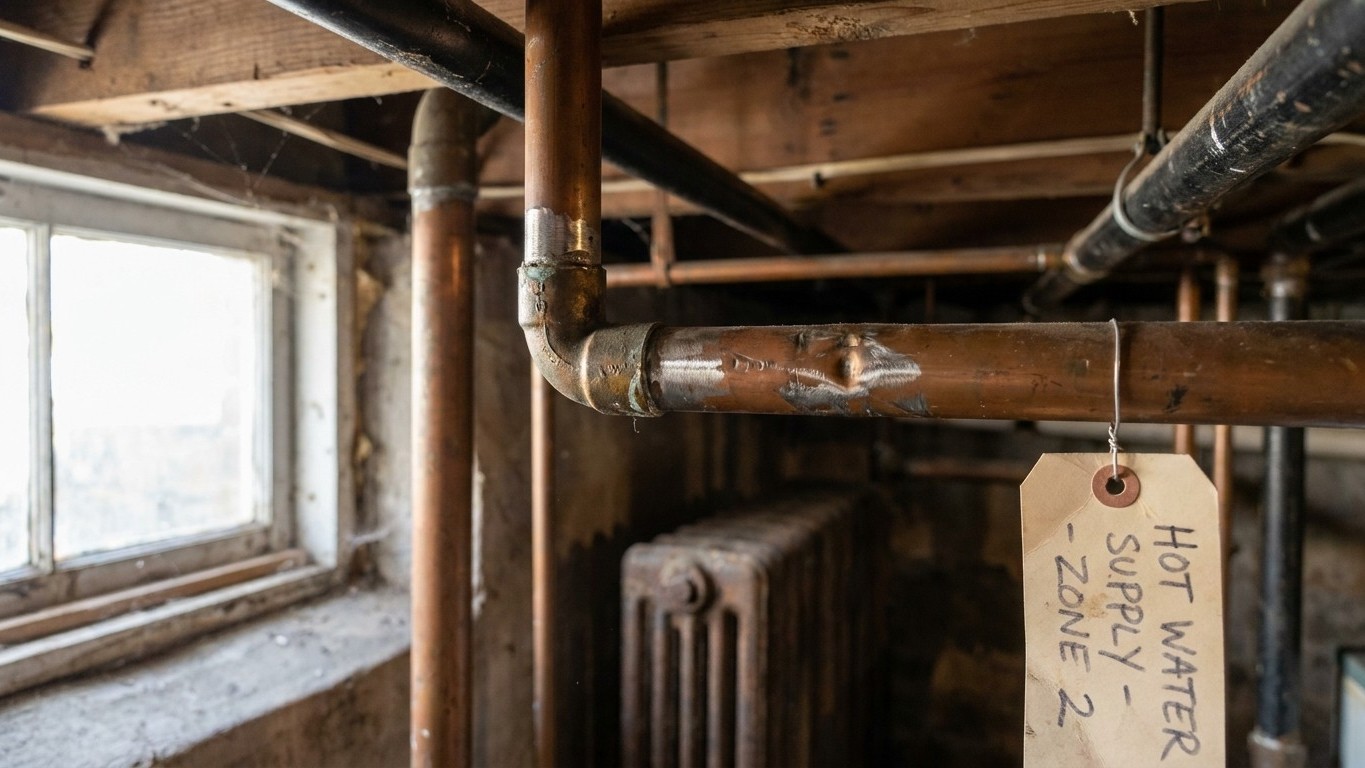

Banging and knocking pipes almost always mean water or steam moving where it shouldn’t, hitting a fitting, a trapped air pocket, or a sudden stop in flow. In heating systems, the fix depends entirely on whether you have steam or hot-water radiators, and figuring out which one you have is the first real diagnostic step.
Banging and Knocking Pipes
Two different mechanisms produce the same racket, and mixing them up wastes time. In a hot-water system, the noise usually comes from trapped air bubbling through the pipes as the pump pushes water around the loop, or from expanding metal pipes rubbing against joists as they heat up and cool down. In a steam system, the sound is more violent: cold condensate water sitting in a low spot gets hit by a fresh slug of steam, and the impact sends a bang through the whole radiator, sometimes loud enough to wake up a house.
Neither problem is really about the pipe itself. It’s about pitch, air, or water sitting where it shouldn’t. A steam pipe that isn’t sloped correctly back toward the boiler traps water at low points. A hot-water loop that was drained and refilled, say after a repair, often carries air pockets that haven’t found their way out yet. Pipes that were installed without enough clearance from framing will knock every single heating cycle because there’s nowhere for the metal to expand quietly.
Which of these you’re dealing with depends heavily on what kind of heating system is actually in the house, and that varies more by region and building age than most people expect. In New York State, for example, 35% of homes are heated with a steam or hot-water boiler, according to the U.S. Energy Information Administration’s 2020 Residential Energy Consumption Survey. That’s a higher share than the 44% running a standard furnace, and it means a large slice of homes in that state are running exactly the kind of radiator-based system where banging pipes are common. States with more furnace-heated homes and fewer boilers will see less of this particular complaint, because forced-air ductwork doesn’t carry water or steam.
The takeaway from that state-level split is a practical one: if your home was built before the 1950s and has radiators instead of vents blowing warm air, you’re statistically far more likely to be dealing with a steam or hot-water noise problem than a duct issue. Newer construction with central heat pumps, only 3% of New York homes according to the same survey, essentially never has this complaint, because there’s no water-filled piping running through the walls to the living space.
How to tell, in your own house
Work through this in order. Each step costs less than the one after it, and the first three will already tell you most of what a technician would ask on the phone.
- Note exactly when the noise happens. Banging the moment the boiler kicks on points to steam hitting cold condensate. A knock that happens gradually as the system warms up, and fades once everything reaches temperature, points to pipe expansion against framing. A random clunk with no clear pattern, especially tied to a faucet running elsewhere in the house, points to plain water hammer in the supply lines rather than the heating system at all.
- Check the radiators themselves for pitch. A steam radiator should tilt very slightly toward the pipe connection so condensate drains back out on its own. Slide a coin or a thin shim under the legs on the side opposite the valve if it’s sitting level or tilted the wrong way. This is free and takes five minutes.
- Bleed the radiators, but only on a hot-water system. Hot-water radiators typically have a small bleed valve; open it with a key or screwdriver until water (not air) comes out steadily. Steam radiators don’t get bled this way, so trying it on a steam system won’t help and can create a different leak.
- Look at exposed pipe runs in the basement or crawlspace. If a pipe is touching a joist or squeezed tight against framing, note where. That’s useful information even if you don’t fix it yourself.
- Check the main water pressure gauge if it’s a hot-water boiler. Most residential systems run in a narrow, specific range; a gauge reading well outside normal is worth reporting, not adjusting.
The boundary is specific: homeowners can shim a radiator, bleed a valve, and note where a pipe rubs against wood. What’s off-limits is anything involving the boiler’s internal pressure or water levels, the main steam vents, or repositioning pipe hangers on gas lines or pressurized supply lines. Those require draining, isolating, or reconnecting a system that can scald or flood a basement if it’s done wrong, and that’s licensed-technician territory, not a weekend project.
What it costs you to ignore it
A banging pipe rarely fixes itself, and left alone it tends to get worse rather than stay the same. On a steam system, trapped condensate that keeps getting hammered by fresh steam gradually loosens the joints and fittings it’s hitting, and over years that repeated mechanical shock is exactly the kind of stress that causes a fitting to eventually weep or fail at a seam.
There’s a comfort cost too, and it’s immediate rather than gradual. A radiator sitting on trapped air or misplaced condensate doesn’t heat evenly, so part of the radiator stays cool while the rest gets hot, and the room it’s supposed to warm takes longer to reach a comfortable temperature. That means the boiler runs longer to compensate, cycling more to make up for a radiator that isn’t doing its full share of the work.
Pipes that knock against framing because of thermal expansion are a slower problem, but not a harmless one. Each cycle rubs the same spot, and over enough winters that friction can wear through pipe insulation or, in older installations, thin the pipe wall itself at the contact point. None of this happens overnight. But a noise that’s dismissed for a few seasons in a row usually shows up later as a bigger repair, exactly at the point in January when a boiler failure is least convenient.