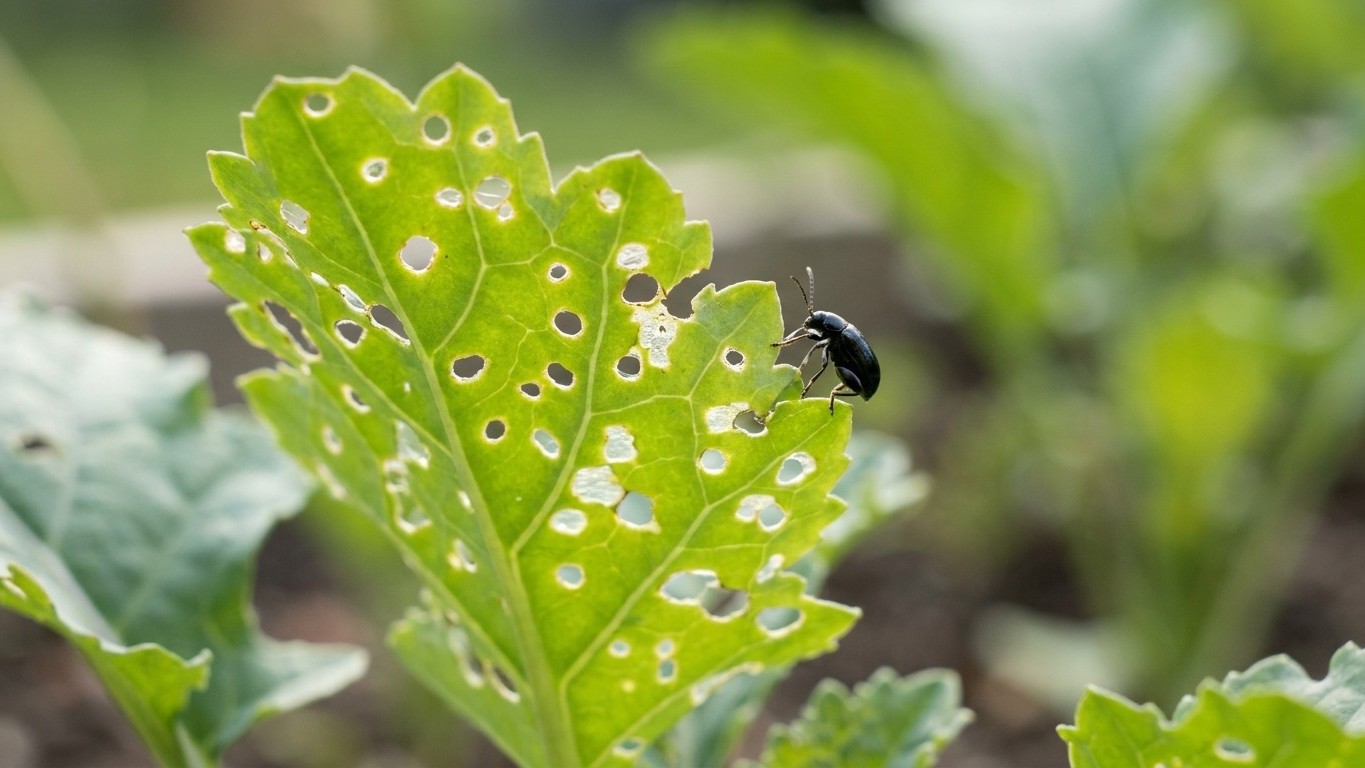

Flea beetles show up in Tennessee gardens as soon as the soil warms in early spring, usually within a week or two of the last frost, and they don’t leave until fall. They’re one of the first pests on the scene each year, chewing tiny shot-holes into seedling leaves before most other insects have even emerged. Row covers at planting and quick cleanup of garden debris are the two moves that matter most.
The weeks to watch

Flea beetles are active from the moment soil temperatures climb in spring through the first hard frost of fall, with no single peak week to circle on a calendar. The University of Tennessee Extension groups them among the “early-season pests,” alongside cutworms, thrips, and aphids, all of which arrive right after the soil-dwelling insects that attack seeds and roots at planting time. The state’s garden pest guide doesn’t publish a separate flight window for flea beetles specifically; it treats the whole growing season as one continuous pressure, with three to seven generations possible for many garden insects before the season ends.
First generation: overwintering adults
Adult flea beetles spend winter tucked into leaf litter, garden debris, and soil clods at the edge of cultivated ground. As soon as daytime soil temperatures rise in spring, they crawl out hungry and head straight for the nearest tender seedling. This is the wave that hits transplants and direct-seeded crops hardest, because young plants have no size to spare.
Later generations: summer through fall
Because the pest cycles through multiple generations in a single season, a garden that looks clean in May can have a fresh population by July. Later generations tend to spread out across whatever host crops are available, meaning damage doesn’t stop after one early flush. It rides along until frost shuts the season down.
Reading the calendar from your last frost

Flea beetles don’t check a calendar; they respond to soil warmth. That means an early spring pulls their emergence forward, and a cold, wet April pushes it back, regardless of what the date says. The last spring frost for Middle Tennessee falls between March 31 and April 12, based on NOAA’s 1991-2020 climate normals, and East Tennessee and the Cumberland Plateau typically run cooler and later than that window. Gardeners commonly notice the first shot-holed leaves within the first couple of weeks after setting out transplants, while the seedlings are still small and can’t outgrow the damage on their own.
- Start from your local last-frost range (March 31 to April 12 around Nashville, later in the mountains and on the Plateau).
- Count forward roughly two to three weeks past transplanting, the stretch when seedlings are most vulnerable and covers matter most.
That arithmetic gives a window, not a guaranteed date. A warm March can move everything earlier; a cold, wet April can hold it off. Treat the frost date as a normal to plan around, not a promise the pest will honor.
What it attacks, and what the damage looks like

Most gardeners spot the damage before they ever see the insect responsible. Leaves look peppered with tiny round or irregular holes, as if someone fired buckshot through them, and heavily hit seedlings can wilt or die outright before they’ve had a chance to establish. Adult beetles do that leaf damage above ground, but it’s the larval stage that causes the harder-to-see problem, tunneling into roots and tubers underground. That distinction matters for treatment: once larvae are feeding inside a root or stem, sprays and covers aimed at adult beetles on foliage won’t touch them.
- Eggplant
- Potatoes
- Tomatoes
- Radishes and other root crops
- Cabbage family crops (broccoli, cabbage, collards, kale)
- Spinach and other leafy greens
- Beans
- Corn seedlings
How Tennessee sits in this pest’s range

Flea beetles aren’t a regional curiosity; the University of Tennessee Extension’s garden pest guide covers them as a routine, statewide concern rather than a threat isolated to one corner of the state. That points to a widespread pest, where the real difference between parts of Tennessee is timing rather than presence. A garden outside Nashville, sitting in that March 31 to April 12 frost window, will typically see flea beetle activity begin earlier than a garden up on the Cumberland Plateau or in the higher elevations of East Tennessee, where spring arrives later and soil stays cooler longer. Gardeners in those cooler pockets aren’t spared the pest, they just get a later start to the same problem, and possibly one fewer generation squeezed into the season before fall frost shuts things down. Anyone gardening near the state’s edges, whether close to the Mississippi River bottomlands or up against the North Carolina line, should expect the same insect, just on a schedule shifted by local elevation and frost timing rather than by any real difference in whether it shows up at all.
What actually works against it

- Delay planting slightly, or size up transplants. Waiting until soil has warmed a bit, or setting out larger, sturdier transplants instead of direct-seeding, gives plants enough leaf area to tolerate early feeding without losing the whole seedling.
- Row covers, sealed at planting. A lightweight cover placed over the bed right after transplanting keeps adult beetles from reaching the leaves in the first place. It works only while it stays sealed at the edges, and it has to come off once flowering crops need pollinator access, which is also roughly when plants are large enough to shrug off some leaf damage.
- Hand-picking or shaking onto a tray. Flea beetles jump when disturbed, so a light tap over a container of soapy water can knock a good number off a small planting. This is realistic for a few raised beds, not a full row of potatoes.
- Clear garden debris and till in fall. Since adults overwinter in old plant litter and loose soil at the garden’s edge, removing that debris after harvest cuts down on how many beetles have a place to spend the winter close to next year’s crop.
- Rotate susceptible crops. Moving brassicas, nightshades, and root crops to a different bed each year means emerging adults don’t find a host waiting exactly where they overwintered.
None of these measures reach a larva already tunneling inside a root or stem; at that point the damage is set for the season, and rotation the following year matters more than anything applied now. Some gardeners also swear by sticky traps or diatomaceous earth dusted around seedlings; the results in home gardens are inconsistent, and the mechanism behind some of these home remedies isn’t well established, so treat them as a possible extra layer rather than a substitute for covers and timing.
Common questions
Do flea beetles kill mature plants, or just seedlings?
Mature plants can usually outgrow flea beetle feeding and survive fine with cosmetic leaf damage. Seedlings are the real risk, since a heavy flush of shot-holes on a plant with only a few true leaves can stunt or kill it outright before it ever establishes.
Can I still plant if I’ve had flea beetles before?
Yes. Rotating susceptible crops to a different part of the garden and covering new transplants at planting cuts the risk substantially, even in a bed that had trouble the year before.
Are flea beetles worse in a wet spring or a dry one?
The state’s garden pest guide doesn’t single out flea beetles for a rainfall pattern. What does shift things is soil temperature: a warm spring, wet or dry, brings them out sooner, since they’re timed to soil warmth rather than moisture.