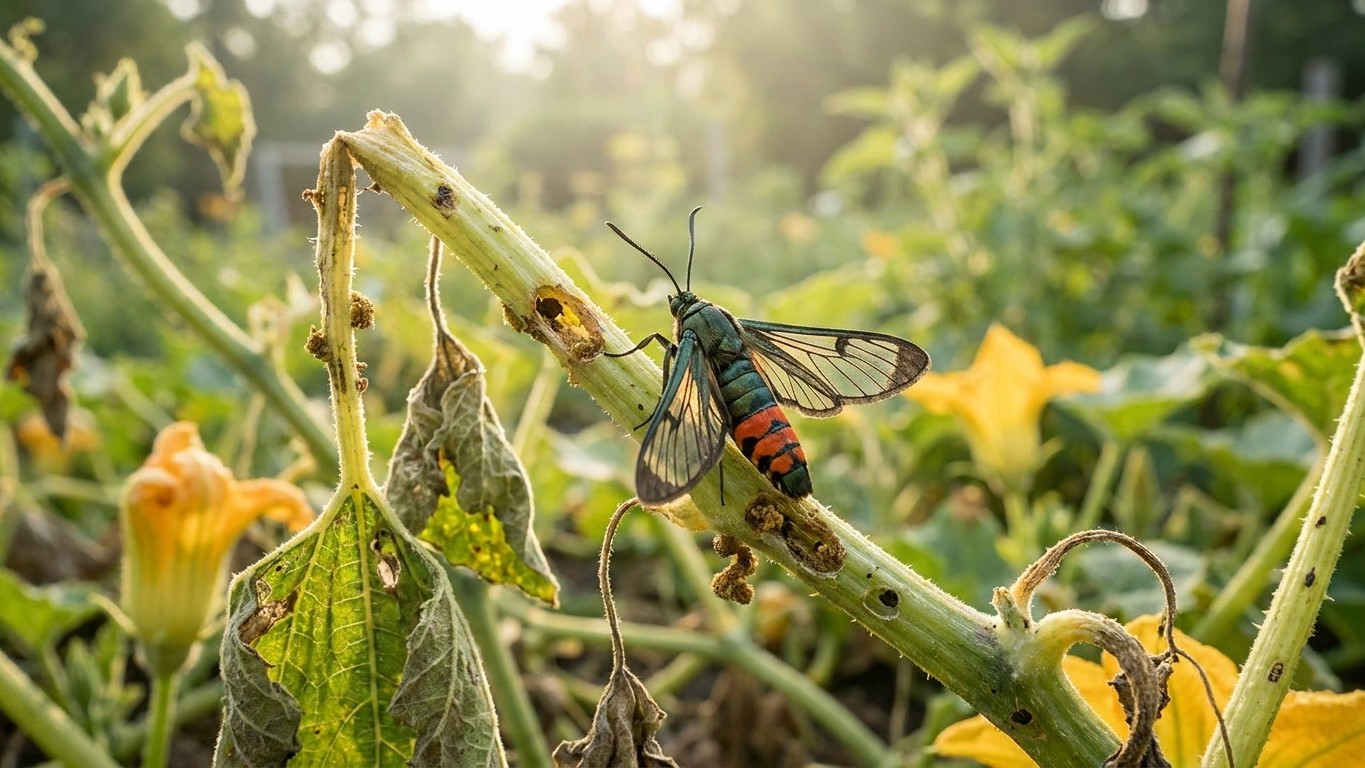

Squash vine borer shows up in Virginia gardens from late May through July, with adult moths active longest in the coastal plain and arriving latest in the mountains. There’s no single trigger date: soil warmth, not the calendar, decides when the moths fly and lay eggs, which is why the same garden can see damage in early June one year and mid-July the next.
The weeks to watch

Virginia’s cooperative extension network doesn’t publish a squash-vine-borer-specific emergence calendar the way it does for some tree pests or turf diseases. What’s published instead is the general biology of the insect, and that pattern holds well enough across the state to plan around.
Adult moths, which look more like a wasp than a typical moth, emerge from overwintering cocoons in the soil once ground temperatures climb into the range that triggers pupation, usually sometime between late May and July depending on how warm the spring has run. Most of Virginia sees a single generation per year. Egg-laying then continues over several weeks as moths keep emerging in staggered waves, which is why a single spray or single inspection rarely catches the whole problem.
One flight, a long window
Because there’s only one generation in most of the state, gardeners aren’t fighting repeated waves all summer the way they might with some other vine pests. The catch is that the single flight period stretches long enough, often six to eight weeks, that early-planted and late-planted squash in the same yard can both get hit, just at different points in the season.
Reading the calendar from your last frost

The one date most Virginia gardeners actually track is the last spring frost, and NOAA’s 30-year climate normals put that date at March 20 to April 3 for the coastal station at Virginia Beach (NAS Oceana). That’s a normal, not a promise, and it’s worth remembering this reading comes from the mild edge of the state. Gardens in the Blue Ridge and southwest Virginia run their last frost weeks later, which pushes every step below back on the calendar too.
- Squash typically goes into the ground one to two weeks after the last frost, once soil has warmed enough for the seed or transplant to take off. Using the coastal window, that lands somewhere in early to mid-April; mountain gardens should count from their own local frost date instead.
- First vine borer damage tends to appear roughly six to ten weeks after planting, once vines are established and stems have thickened enough to host a larva. That puts the earliest coastal risk in late May to June, sliding later for anyone who planted later or gardens further inland.
Row covers need to come off once female flowers start opening, since squash relies on pollinators, and that timing detail matters more than the exact calendar date: cover protection and pollination need are what actually decide the removal day, not a fixed number of weeks.
What it attacks, and what the damage looks like

The first sign most gardeners notice isn’t an insect at all. It’s a vine that was healthy yesterday and is wilting today, often just one runner while the rest of the plant looks fine. Look at the base of the wilted stem and you’ll usually find a small hole with a sawdust-like, greenish-yellow frass pushed out of it, the sign that something has been tunneling inside.
The damage is done by the larval stage, a cream-colored grub that bores into the stem and feeds inside it, cutting off water and nutrients to everything past the entry point. By the time the wilting is visible, the larva is already inside and protected from any surface treatment, which is why timing sprays or barriers before egg-laying matters so much more than reacting after symptoms appear.
Crops at risk in a Virginia garden:
- Summer squash and zucchini, generally the most heavily hit
- Pumpkins and winter squash such as butternut and acorn
- Ornamental and edible gourds
- Cucumbers and melons, less preferred but occasionally attacked when squash isn’t available
How Virginia sits in this pest’s range

Squash vine borer is established across nearly the entire eastern and central United States, which makes it one of those pests where presence isn’t really in question. What differs from one state, or one region within a state, to the next is timing, not whether the insect shows up at all.
The NOAA station data behind Virginia’s frost normals comes from Virginia Beach, on the coastal plain, so any timing math built from it reflects the mild end of the state’s climate. Gardens in the Blue Ridge and southwest Virginia sit at the cooler, later edge of that same statewide range: soil warms slower there in spring, the moth’s single flight period starts later, and the whole damage window shifts later into summer as a result. A gardener in Roanoke or the New River Valley is working from a genuinely different calendar than one in Norfolk or Virginia Beach, even though both are dealing with the same insect and the same single-generation biology.
What actually works against it

Once a larva is inside a stem, most treatments stop being useful. Everything on this list works better the earlier it’s applied, and the order below runs from least effort to most.
- Time the planting. Some gardeners delay planting summer squash by a few weeks past the usual window, aiming to have vines emerge after the peak egg-laying period has passed. It trades some harvest time for less exposure, and it works because it sidesteps the moth’s flight window rather than fighting it directly.
- Cover young plants. Lightweight row covers physically block moths from reaching stems to lay eggs. They have to come off once female flowers open, since squash needs pollinator access, and that’s exactly the point where protection ends.
- Check stems and hand-pick eggs. The moth lays small, flat, reddish-brown eggs individually at the base of stems. Checking the lower foot of each vine every few days during the flight window and scraping off eggs before they hatch prevents entry in the first place.
- Wrap the stem base. Wrapping the lower few inches of stem in foil, nylon stocking material, or similar barriers is a common home gardener practice meant to block the young larva from boring in. It’s widely used, but controlled trials on how well it actually stops entry are limited, so treat it as a supplement to the other steps rather than a guaranteed fix.
- Slit and bury if you catch it early. If wilting appears and frass is visible, some gardeners slit the stem lengthwise near the entry hole, remove the larva by hand, then mound moist soil over the wound to encourage the vine to root at that point. It only works if the vine hasn’t been girdled too badly to recover.
- Clear debris and rotate crops after harvest. Overwintering cocoons survive in the soil near where infested vines grew. Pulling and destroying vine debris at season’s end, then planting squash in a different bed the following year, reduces the local population available to emerge nearby next spring.
Common questions
Can a squash plant survive after vine borer damage?
Sometimes. If only one runner is affected and the main crown is still healthy, the plant can push out new growth from unaffected sections, especially if secondary rooting was encouraged along the vine. A plant with a girdled main stem near the crown usually doesn’t recover.
Do all squash varieties get hit equally?
No. Varieties with thinner, more tender stems, common in many zucchini and yellow summer squash types, tend to show more damage than thicker-stemmed winter squash like butternut, though none are immune.
Is it too late to plant squash if I missed the early window?
Not necessarily. Since the moth’s flight window is finite, a second planting timed to emerge after peak egg-laying has passed can sometimes outrun the pest entirely, particularly in the coastal plain where the growing season runs long enough to support a later crop.