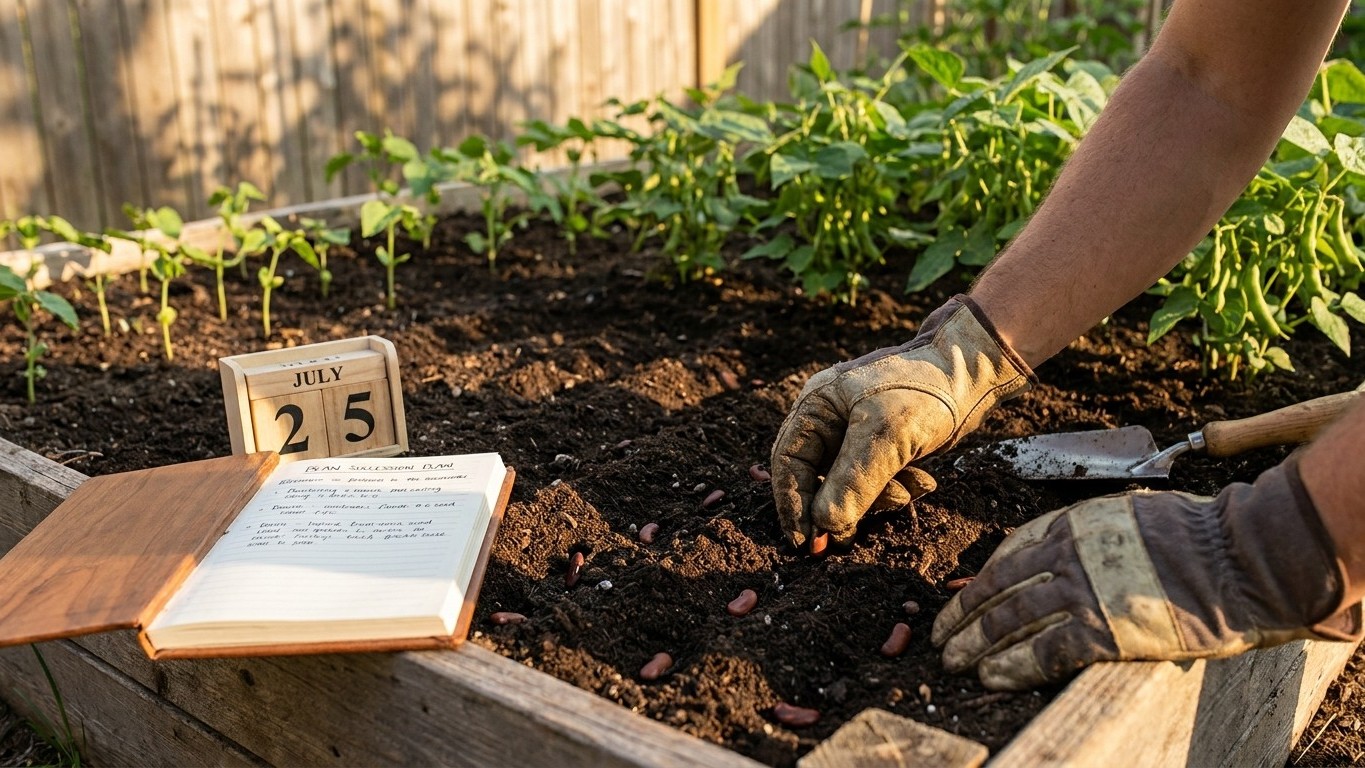

Bush beans and pole beans need opposite sowing strategies, and mixing them up is the most common way gardeners end up with an empty basket in August. Utah State University Extension ties the whole schedule to how long each type keeps producing pods, not to a date on the wall. The stopping point isn’t a month either. It’s a countdown you run yourself, using your own first fall frost date and the number of days a bean plant needs to reach harvest.
The short answer
Utah State University Extension recommends sowing bush beans every 14 to 21 days for continuous production throughout the growing season. That interval isn’t arbitrary. A single bush bean planting only bears pods for 2 to 3 weeks, so if you want a steady supply instead of one heavy flush followed by nothing, you need a new planting waiting in the wings before the current one stops producing.
Pole beans work on a different clock entirely. According to the same source, pole beans generally produce pods over a very long time period, so one or two plantings are all that’s necessary each year. Resowing pole beans every three weeks the way you would bush beans is redundant work: the vines are still cranking out pods from a planting made weeks earlier.
The stopping question has a specific, transposable answer. Utah State University Extension notes that bush beans require 50 to 60 days to mature depending on variety. That figure is the key to knowing when to quit, no matter where you garden. Count backward from your own first fall frost date: as long as 50 to 60 days remain before that frost, a new bush bean sowing still has time to reach harvest. Once the calendar tips below that window, a fresh planting is racing a clock it can’t win, and the pods either mature too late or get caught by cold before they’re worth picking.
This is why the source’s own cutoff, “until mid-July,” only applies to one state’s frost timing. Swap in your own first fall frost date and run the same 50-to-60-day math, and the rule travels with you regardless of zone.
What actually decides it
Two habits, two harvest windows
The bush-versus-pole distinction explains almost every piece of conflicting sowing advice you’ll come across. Bush plants are compact, mature fast, and burn through their production in 2 to 3 weeks, which is exactly why they need reinforcements every 14 to 21 days. Pole beans climb, take longer to get going, but then bear for 5 to 6 weeks straight, a window roughly double that of bush types. One planting of pole beans covers most of a season the way three or four staggered bush plantings would.
| Trait | Bush beans | Pole beans |
|---|---|---|
| Days to maturity | 50-60 days | Not specified by type; longer season overall |
| Bearing period | 2-3 weeks | 5-6 weeks |
| Plantings needed per season | Multiple, every 14-21 days | One or two |
The 50-to-60-day countdown
Every stopping decision comes back to that maturity window. Fewer than 50 days before frost, and even a fast bush variety is cutting it close. This is the piece of the Utah recommendation that travels beyond Utah: the calendar date changes by region, but the days-to-maturity figure doesn’t.
Why a warm-season crop still answers to a frost date
Beans are frost-tender and direct-sown only, never started indoors or transplanted, which is why the entire spring conversation is about waiting for warm soil before the first sowing goes in. That can make the fall side of the calculation feel contradictory: how does a crop that loves heat get shut down by a countdown to frost? The answer is that pod development itself isn’t the limiting factor, timing is. A bean plant sown with plenty of warm days ahead will finish its 50 to 60 days just fine. One sown too close to the season’s end runs out of warm days before it runs out of growing to do, and frost ends the attempt regardless of how well the plant was performing up to that point.
Dry beans add another layer to the same logic. Utah State University Extension notes that dry beans planted after a certain point generally will not mature in cooler areas, while the same planting will still produce mature seeds in warmer regions. That’s not a date problem, it’s a season-length problem. A region with a longer, warmer fall simply has more days available after any given sowing, so the same countdown lands in a different place depending on climate, not on the number on the calendar.
How to do it
- Direct-sow the first round of bush beans once your local frost danger has passed and soil has warmed. Beans go straight into the ground; there’s no starting them indoors or transplanting seedlings.
- Mark the sowing date, then plan the next bush bean planting 14 to 21 days later to keep new plants coming online before the current ones taper off.
- Before each new sowing, count how many days remain until your first fall frost. If 50 to 60 days or more remain, go ahead with another round.
- Once the countdown drops below that 50-to-60-day window, stop sowing bush beans for the season. A planting made at that point won’t reliably finish before frost.
- For pole beans, sow once early in the season, or add a second planting if you want overlapping harvests, since a single sowing already bears for 5 to 6 weeks.
- Skip added nitrogen fertilizer at every sowing. Beans fix their own nitrogen through root nodules, and extra nitrogen delays flowering and reduces pod set, the opposite of what you want from a plant you’re trying to keep productive.
- If you’re growing beans for dry seed rather than fresh pods, weigh your region’s season length rather than a fixed date: gardeners in cooler climates need more margin before frost for pods to dry down fully, while warmer regions with longer falls have room for later sowings.
What goes wrong
- Bush bean harvest drops off after a few weeks. This isn’t a failure, it’s the natural bearing window. Bush beans produce for 2 to 3 weeks by design; the fix is having the next 14-to-21-day sowing already in the ground before the current planting slows down.
- Pole beans get resown every few weeks out of habit. Since a single planting bears for 5 to 6 weeks, repeated sowings just crowd the trellis and waste seed. One or two plantings a season is the pattern the plant is built for.
- A late bush bean sowing never produces a real harvest. This happens when a planting goes in after fewer than 50 to 60 days remain before frost. The remedy is checking that countdown before every new sowing, not just going by habit or the previous week’s success.
- Dry beans come out immature or shriveled. This traces back to the same season-length issue rather than a growing mistake: in cooler regions, a sowing that would finish fine in a warmer climate simply runs out of warm days before the seed fully dries.
- Plants grow lush and green but set few pods. Extra nitrogen is almost always the cause. Because beans fix their own nitrogen, added fertilizer pushes leafy growth instead of flowers, and cutting it out is the fix, not adding more of anything.
Common questions
Can I use the same sowing schedule for bush and pole beans? No. Bush beans need a new planting every 14 to 21 days because each one bears for only 2 to 3 weeks. Pole beans bear for 5 to 6 weeks from a single planting, so one or two sowings usually cover the season.
What happens if I sow bush beans too close to frost? A planting made when fewer than 50 to 60 days remain before your first fall frost usually won’t mature in time. The plants may grow and flower, but pods run out of warm season before they’re ready.
Do beans need fertilizer to keep producing all season? No. Beans fix their own nitrogen through root nodules, and adding nitrogen fertilizer tends to delay flowering and reduce pod set rather than help it, which sets them apart from most other garden crops.
Can dry beans be grown on the same timeline everywhere? Not exactly. The same sowing that matures into dry seed in a warmer region with a long fall may fail to fully mature in a cooler region with a shorter one, since the limiting factor is available warm days after sowing, not a specific date.