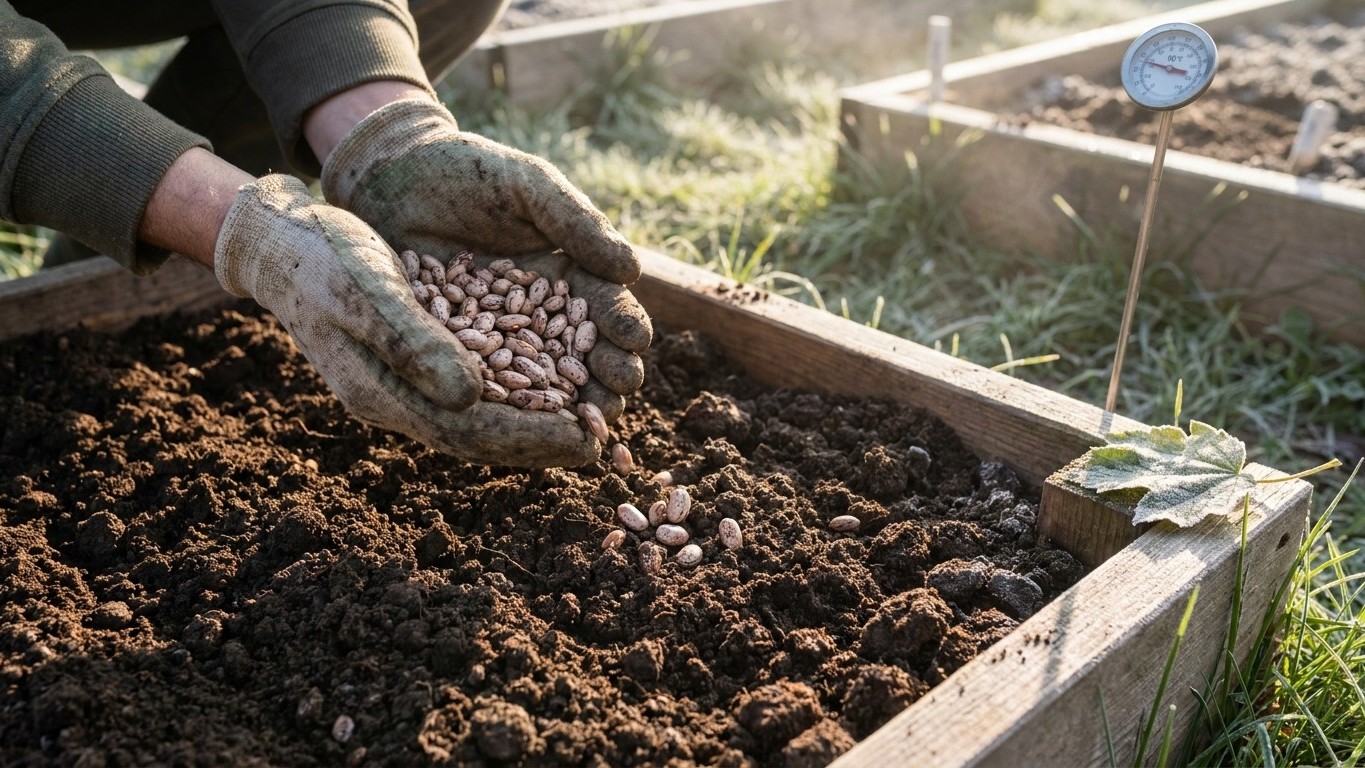

Beans get sown one week before your last spring frost date, not after it. That timing sounds backward for a warm-season crop that hates cold soil, but it works because the seed sits underground for well over a week before anything pokes through. The trick is in the gap between sowing day and emergence day, not in the calendar month. Get that gap right and beans come up right on schedule. Get it wrong and you’re fighting slow germination, a crusted-over seedbed, or seed that never had a chance.
The short answer
Utah State University Extension puts a number on this exact question in its guide Beans in the Garden: start planting beans one week before the last frost-free date for your area. That single line trips people up, because beans are unmistakably a warm-weather vegetable. Cold soil kills seed. A hard freeze on tender seedlings kills the plant. So how does a warm-season crop get planted before frost season has technically ended?
The answer is arithmetic, not a gamble. Bean seed germinates in 7 to 10 days once soil has warmed into the 65-85°F range. Count forward from a sowing date one week ahead of your last frost, and the seedlings break the surface roughly a week to ten days later, which lands right around, or just after, your actual frost date. The seed spends its most vulnerable stretch underground, not exposed as a tender green shoot. By the time it needs frost-free air, the frost-free air has arrived.
That one week of buffer is the whole strategy. It’s not a workaround, it’s built into how bean seed develops below the soil line. Sow much earlier than that week, into soil still sitting below 60°F, and germination drops sharply no matter what the air does later in the month. Sow later than necessary, and you’ve simply given up days of growing time, since the plant was never in real danger to begin with once soil temperatures hold above that 60°F mark.
Row covers and plastic mulch change the math. Utah State University Extension notes that with plastic mulch and row covers in place, beans can go in 2 to 3 weeks before the last frost date, because the covering warms the soil artificially, doing the job the sun alone can’t do that early in the season. Without that protection, the one-week rule stands. Pushing sowing earlier without adding mulch or covers just reintroduces the cold-soil problem the one-week rule exists to sidestep in the first place.
What actually decides it
Soil temperature calls the shots, not the calendar frost date
The apparent contradiction, a warm-season crop going into the ground before winter has officially ended, dissolves once you separate two different thresholds. Beans need soil and air temperatures above 60°F for best germination and plant growth. The last frost date measures air temperature at the surface on a given night, nothing more. Soil several inches down warms and cools on its own slower schedule, often already sitting above 60°F while the air can still dip to freezing after dark. The one-week-before rule assumes that in most gardens, soil crosses that 60°F line right around the same window the last frost typically falls, give or take.
The germination clock buys the safety margin
Seed doesn’t experience frost the way a leaf does. Underground, a bean seed is insulated from the worst of an overnight cold snap, and it stays there for the entire 7-to-10-day germination window before anything green appears above the soil line. That week-plus of underground time is exactly the buffer the one-week-before rule is built on. Sow a week ahead of frost, wait out the germination clock, and the seedling emerges into air that’s already cleared the frost threshold. Shorten that gap, sowing too close to or After the Frost date, and you haven’t broken anything, you’ve just left growing days on the table for no benefit, since the seed was never racing the frost to begin with.
Put those two mechanisms together and the seeming contradiction in the title stops being a contradiction. A warm-season crop planted before the frost date isn’t defying its own nature. It’s using soil as insulation while the calendar catches up.
How to do it
- Mark your last frost date, then count back one week. That’s your target sowing day for an open, uncovered bed.
- Check soil temperature before committing seed to the ground. If soil is still reading below 60°F, hold off regardless of what the one-week countdown says. Cold soil is the one variable that overrides the schedule.
- Sow seed 1 inch deep. Space seeds 2 to 3 inches apart within the row.
- Set rows 18 to 24 inches apart. No thinning is necessary afterward, even if the stand comes up thicker than expected.
- Budget seed by row length. Plan on roughly 3 to 4 ounces of seed for every 100 feet of row. Leftover seed can be stored and planted the following year.
- Skip the nitrogen fertilizer. Beans fix their own nitrogen through their root system, and added nitrogen delays flowering and reduces pod set instead of helping the plant along.
- For a second or third sowing later in the season, work backward from your first fall frost instead of forward from spring. Bush-type beans need 50 to 60 days to mature, so keep sowing as long as 50 to 60 days remain before your first fall frost is expected. Once that window closes, hold off until the following spring.
- If you’re using plastic mulch or a floating row cover, move the whole schedule up. Those tools let you sow 2 to 3 weeks before the last frost date instead of just one, since they raise soil temperature ahead of the season.
What goes wrong
- Seed rots in the ground or never sprouts at all. The cause is almost always soil temperature. If you plant when soils are below 60°F, germination is greatly reduced, and no amount of patience fixes seed that’s already failed underground. The fix is upstream: check soil temperature before sowing rather than relying on the calendar alone, and hold off until it clears 60°F.
- Seedlings can’t push through the surface even though the seed itself was fine. This shows up more in heavy clay soils, where the surface can crust over after sowing, sealing seedlings in before they emerge. Keeping the seedbed from drying into a hard cap after sowing gives seedlings a better chance of breaking through.
- Nothing comes up at all, from an otherwise well-timed sowing in warm soil. Older seed or poorly stored seed may simply not germinate, regardless of timing or soil temperature. Since leftover seed can be stored and used the next year, the safeguard is proper storage in the first place, not troubleshooting after a failed sowing.
- Plants look lush and green but set few pods. This is usually a fertilizer problem in reverse. Beans fix their own nitrogen, and extra nitrogen fertilizer delays flowering and reduces pod set. The fix is to stop fertilizing beans the way you might tomatoes or squash, since more nitrogen here works against you.
- Bush beans quit producing after a few weeks while a pole variety nearby keeps going strong. That’s not a problem to fix, it’s a difference in plant type. Bush beans mature in 50 to 60 days with a bearing period of 2 to 3 weeks, while pole beans bear over a longer 5 to 6 week stretch. Expecting bush beans to behave like pole beans is the actual mistake here, not the plant.
| Plant type | Days to maturity | Bearing period |
|---|---|---|
| Bush beans | 50-60 days | 2-3 weeks |
| Pole beans | Not specified by source | 5-6 weeks |
Common questions
Can I sow beans early to get a head start on the season?
Not usefully. Soil below 60°F greatly reduces germination regardless of how eager you are to plant. The one-week-before-frost rule already accounts for the soil warming schedule most gardens follow; sowing weeks earlier without plastic mulch or a row cover just increases the odds of rotted seed.
Do beans need fertilizer to produce a good harvest?
No. Beans fix their own nitrogen, and Utah State University Extension is explicit that added nitrogen fertilizer delays flowering and reduces pod set. That puts beans in a different category from most other garden vegetables, where regular feeding is standard advice.
How much seed do I actually need for a home garden row?
Plan on about 3 to 4 ounces of seed for every 100 feet of row. Any seed left over stores fine and can be planted again the following year.
Can I keep sowing beans all summer long?
Only as long as there’s enough season left. Since bush beans need 50 to 60 days to mature, keep sowing as long as 50 to 60 days remain before your first fall frost. Once that count drops below 50 days, a new sowing won’t have time to mature before frost ends the season.