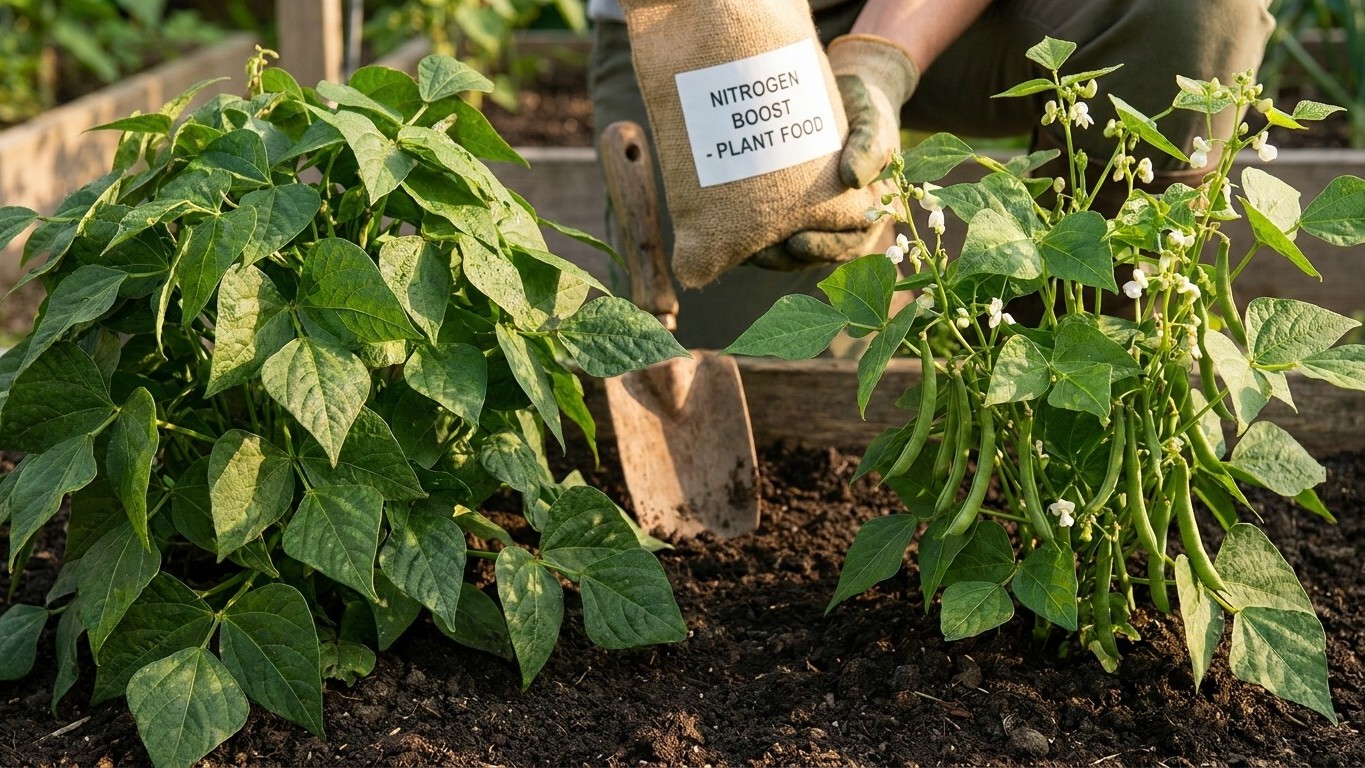

Beans pull nitrogen straight out of the air through bacteria living on their roots, so an all-purpose fertilizer and compost applied at planting is already more than the plant needs. Utah State University Extension is direct about it: extra nitrogen stimulates leaf growth, delays flowering, and reduces pod set. Feed a bean plant like you feed your tomatoes, and you’ll get a bush of leaves with nothing to show for it.
The short answer
Skip the fertilizer. That’s the whole answer, and it comes straight from Utah State University Extension’s guide to growing beans: “Beans do not require additional fertilizer if an all-purpose fertilizer and compost was applied at planting.” Beans have what the Extension calls a low fertilizer requirement, and the reason is built into the plant itself. Soil bacteria attached to bean roots fix nitrogen directly from the air, which means the crop manufactures its own supply of the one nutrient most feeding programs are built around.
This puts beans in a strange spot compared to nearly everything else in a home garden. Corn, squash, tomatoes, peppers, most leafy greens: they all want a nitrogen boost through the season. Beans don’t. Push more nitrogen at them and the plant spends its energy building foliage instead of setting pods. You end up with a lush, green, disappointing row.
Timing is the other piece readers usually get wrong, because beans go straight into the ground as seed rather than as transplants. There’s no seed tray, no hardening-off period, no indoor head start. Utah State University Extension puts the planting window at one week before your area’s last frost-free date. Don’t count that as a date on a calendar. Count it against your own frost date. Beans need soil and air temperatures above 60°F for good germination and growth, and seeds take 7 to 10 days to emerge once soil has warmed to 65-85°F. Sow one week ahead of frost, add that emergence window, and the seedlings break ground after the frost risk has already passed. That’s the entire trick, and it only works if you know your own last frost date rather than someone else’s calendar page.
Gardeners using plastic mulch and row covers get more room to move. Those tools warm the soil faster, so the source allows planting 2-3 weeks before the last frost date instead of just one. Either way, the crop goes into the ground as seed, not as a start, and it feeds itself once it’s up.
What actually decides it
Two things seem to fight each other in the Extension’s own guidance: beans are a warm-season crop, yet the recommended planting date sits before the last frost. Untangling that contradiction is really the whole game.
The germination-emergence gap
Seed in the ground isn’t the same as a plant exposed to frost. A bean seed sown a week before your last frost date sits underground, absorbing warmth, for the 7 to 10 days it needs to emerge. Soil that has warmed to 65-85°F drives that germination clock. By the time the seedling actually pushes through the surface, the calendar has moved past the frost date and the tender growth above ground never meets the cold air that would kill it. The seed does the waiting; the gardener doesn’t have to.
The self-fertilizing root system
The second mechanism explains why beans break the standard feeding rule. Nitrogen-fixing bacteria colonize the roots and convert atmospheric nitrogen into a form the plant can use. That’s an internal nitrogen factory most other vegetables don’t have. Compost and an all-purpose fertilizer at planting cover the rest of what the plant needs (phosphorus, potassium, trace minerals) and topping that off with more nitrogen mid-season doesn’t add yield. It subtracts from it, by feeding leaf growth at the expense of flowers and pods.
Bush versus pole: two harvest windows, two plans
Plant type decides how long a single sowing keeps producing. Bush beans bear for just 2-3 weeks and mature in 50-60 days, which is why the Extension recommends repeat sowings every 14-21 days for continuous production. Pole beans behave the opposite way: they bear over 5-6 weeks, so “one or two plantings are necessary each year” rather than a running succession. Planning a bean patch means picking one of these two production models, not blending them.
How to do it
- Wait for soil, not just air, to warm. Soil and air temperatures need to sit above 60°F before you sow. Below that, the Extension notes, germination is greatly reduced.
- Sow one week before your last frost date (or 2-3 weeks before it if you’re using plastic mulch and row covers). Count from your own local frost date, not a generic calendar month.
- Plant seeds 1 inch deep, spacing them 2-3 inches apart in rows 18-24 inches wide. Thinning isn’t necessary even if the stand comes up thick.
- Budget your seed. About 3-4 ounces of seed covers 100 feet of row, and leftover seed stores fine for use the following year.
- Choose bush or pole based on how you want to harvest. Bush varieties mature in 50-60 days and bear over 2-3 weeks; pole varieties bear over 5-6 weeks from one or two sowings. Trellis pole beans since they climb naturally and yield more when supported, and support makes harvest easier too.
- Keep re-sowing bush beans every 14-21 days for a continuous supply, but only while 50 to 60 days still remain before your first fall frost. Once the days-to-maturity window no longer fits before frost, stop sowing bush beans for the season.
- Watch dry bean timing differently. Dry beans sown late in the season won’t mature into dry seed in cooler, shorter-season areas, though they’ll still produce mature seed where the growing season runs longer. Treat that as a question about how many warm days remain, not a fixed date.
- Skip added nitrogen. An all-purpose fertilizer and compost at planting is enough; the plant fixes its own nitrogen afterward.
- Water consistently through flowering and pod sizing, since that’s when drought stress does the most damage, but avoid overwatering, which promotes root rot and slows growth.
What goes wrong
- Seeds don’t come up. Cold soil is the usual cause. Anything below 60°F sharply reduces germination. Heavy clay soils can also crust over and block emergence, and old or poorly stored seed simply won’t sprout regardless of temperature. Test soil temperature before sowing, and don’t plant seed that’s been sitting around for several seasons in a damp shed.
- Flowers drop, and the pods that do form turn stringy. These are two symptoms of the same underlying stress. Hot weather above 95°F combined with dry conditions makes plants abort their flowers, and that same stress builds fiber inside the pods, making them tough and stringy. The fix for both is the same: keep soil moist and use organic mulch during flowering to buffer the plant from heat and drought. One exception worth keeping in mind: some heirloom varieties are naturally stringy by breeding, sometimes called “string beans,” and that’s a trait, not a failure.
- Plants grow lush and green but set few pods. This is the fertilizer trap. Adding nitrogen beyond the compost and all-purpose fertilizer applied at planting pushes leaf growth, delays flowering, and reduces pod set. The remedy is to stop feeding, not to feed more.
- Roots rot and growth stalls. Overwatering keeps soil too wet, which favors root rot diseases. Cool, wet spring conditions also encourage damping off in young seedlings. Let soil drain and avoid watering on a fixed schedule regardless of actual soil moisture.
- Weeds crowd out young plants. Regular cultivation while plants are small keeps weeds down, but dig carefully to avoid damaging shallow bean roots. Closer row spacing and dense growth also help by shading out weed competition once the canopy fills in.
- Pests show up mid-season. Mexican bean beetle leaves yellow egg clusters under leaves, though large, flowering plants can tolerate some feeding pressure without real yield loss. Leafhoppers are mobile and genuinely hard to control. Cutworms and army worms often hide under organic mulch during the day, so check under mulch layers if you spot chewed stems.
Common questions
Do beans need fertilizer at all during the season?
No. Utah State University Extension states beans don’t need additional fertilizer beyond what’s applied at planting, because soil bacteria on the roots fix nitrogen from the air. Extra nitrogen mid-season delays flowering and reduces pod set.
How do I know when to stop sowing bush beans for the season?
Count backward from your first fall frost date. Bush beans need 50-60 days to mature, so keep sowing only while that many days still remain before frost arrives in your area.
Why are my bean pods stringy?
Stringiness usually signals heat or water stress, since fibers form inside pods under those conditions. Keeping soil consistently moist during flowering and pod sizing prevents it. The exception is certain heirloom varieties bred to be naturally stringy, which isn’t a growing problem at all.
Should I plant beans before or after my last frost date?
Sow one week before your last frost-free date (2-3 weeks before it if using plastic mulch and row covers). Since emergence takes 7-10 days in warm soil, the seedlings break ground after the frost risk has passed even though the seed went in before it.