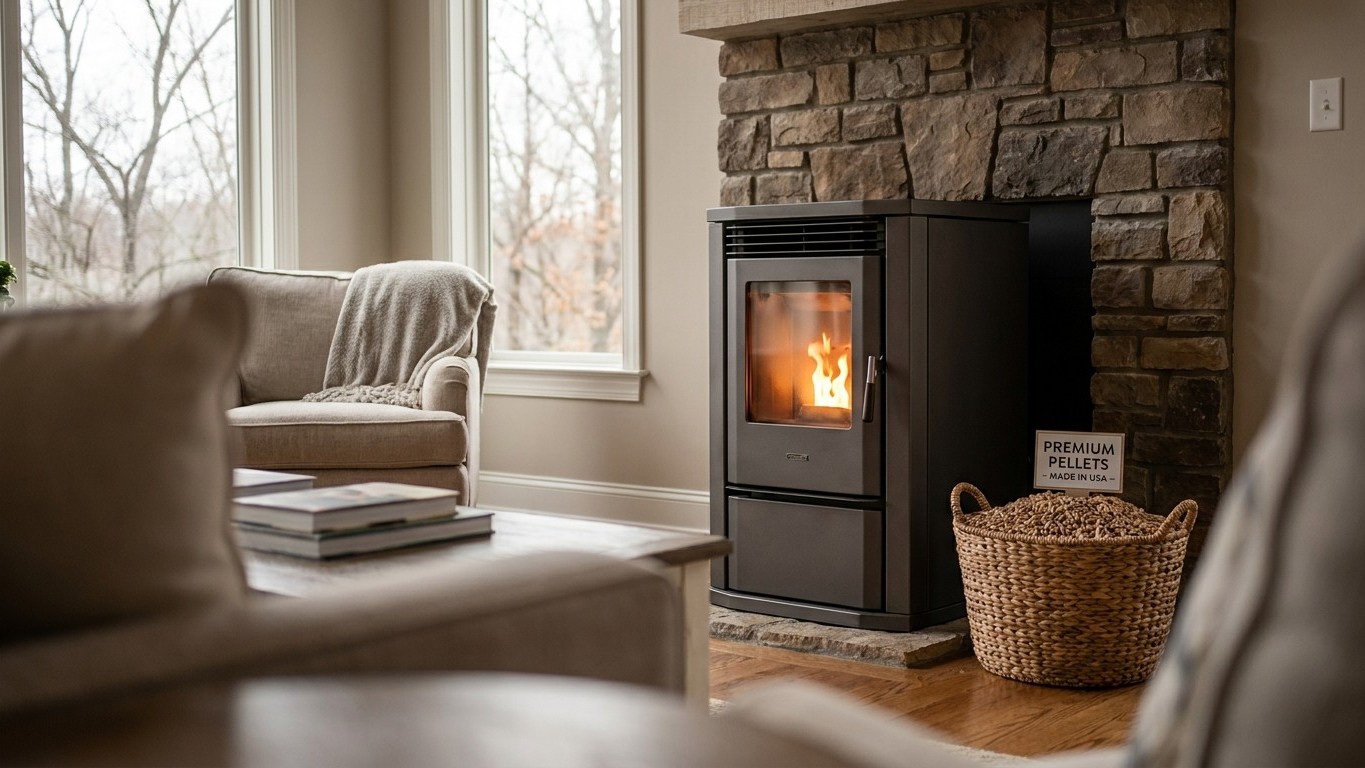

A pellet stove in Arkansas is best planned as supplemental heat rather than a full replacement for a furnace. The state’s winters are moderate by national standards, but they still stretch across seven months on the calendar, so the question isn’t whether the stove works here. It’s how many tons that stretch actually takes, and what happens when the power blinks during the one hard cold snap of the season.
How hard the winter works here

The number that matters is 3,165 heating degree days a year, measured at Little Rock AP Adams Field, the National Weather Service reference station for central Arkansas. Heating degree days tally, for every day of the year, how far the average temperature fell below 65°F, and they add up in direct proportion to fuel burned. A house that needs twice the degree days of another needs roughly twice the pellets to stay warm, all else equal.
At 3,165, Little Rock sits well below the national average of roughly 4,500, and far short of the totals recorded across New England or the northern Great Plains, where furnaces and stoves alike run at a much harder pace all winter. That gap is exactly why a pellet stove here tends to function as comfort and zone heat, warming the room where people actually sit, rather than as the sole system keeping a whole house above freezing. For a small, tight, well-insulated home it can still carry most of the load. For anything larger or drafty, it’s a supplement to a furnace or heat pump.
A long, mild season, not a short brutal one
The depth of the cold and the length of the season are two different things, and Arkansas illustrates the difference well. Heating demand starts in October, the first month the normal mean temperature drops below that 65°F baseline, and it doesn’t fully clear until May. That’s a seven-month window. January carries the heaviest load, averaging 754 degree days on its own, more than twice the total for November or March. December runs close behind at 684. The season is long even though no single month is punishing.
One caution matters for anyone reading this outside central Arkansas: a station is not a state. The Ozark and Ouachita highlands in the north and west run noticeably colder than Little Rock, while the Delta and southern counties trend milder. Anyone near the state’s northern edge should treat 3,165 as a floor, not a ceiling, for their own degree-day count.
How many tons a winter takes here
No agency or dealer publishes a tons-per-winter figure for Arkansas, and treating one as gospel would be misleading anyway. Two houses on the same street can burn twice as much fuel as each other depending on how tight the building envelope is and how the stove gets used. What’s useful instead is the arithmetic that lets a household build its own estimate.
A standard bag of wood pellets weighs 40 pounds. Fifty bags make a ton. From there, consumption tracks the heat the house actually loses, which is exactly what the degree-day figure above measures: more degree days, more fuel, in rough proportion. A home near the Little Rock reference station burning steadily through a normal October-to-May season will use noticeably less fuel than an identical home a few counties north in the highlands, simply because the colder site racks up more degree days over the same months.
Three variables move the total more than anything else:
- How well the house holds heat, meaning insulation, air sealing, window quality, and how open the floor plan is around the stove
- Whether the stove is the only heat source or a supplement running alongside a furnace or heat pump on the coldest days
- The setting it runs at, since a stove held at a low simmer to take the chill off a room burns a fraction of what one run wide open all day does
The honest method, and the one worth trusting over any published estimate, is to count the bags used in the first winter and treat that number as the household’s own baseline going forward. One measured season on a specific house beats every generic figure, because it already accounts for that house’s insulation, layout, and habits. For the national math behind bag counts and burn rates, see how many pellets a winter takes.
Buying and storing them in this climate
Timing matters more than most buyers expect. Heating demand in central Arkansas starts building in October, so the smart window to buy is before that month, not during it. Once a cold snap hits in November or December, regional demand spikes, shelves at local dealers and hardware chains empty fast, and pellets bought in a hurry midwinter tend to cost more than the same tons bought in late summer when suppliers are trying to move inventory ahead of the season.
Storage is the part a territorial climate actually changes. Wood pellets are compressed sawdust held together purely by the natural lignin released under heat and pressure during manufacturing, with no added glue. That makes them strong when dry and fragile when wet. Arkansas summers run humid, and a garage or shed that sweats condensation on its slab in July and August is a real threat to a pallet of pellets sitting there. Damp pellets swell, lose their shape, and crumble into sawdust and fines that clog a stove’s auger and burn poorly even after they dry back out.
Anyone buying ahead of the October start needs a dry, elevated storage spot, off a concrete floor that can sweat, and ideally away from a bare dirt-floor shed. Keep bags on pallets or shelving rather than stacked directly on a slab. When comparing sources, compare price per ton, since that’s the only figure that lines up across bag sizes and package deals. For a full breakdown of what separates a well-made pellet from one that jams a stove, see the national guides on pellet storage and pellet quality and grades.
What a winter outage means here
A pellet stove is not a wood stove, and the difference shows up the moment the power goes out. Feeding pellets from the hopper into the firebox and pushing warm air into the room both depend on an electric auger and blower built into the appliance. Cut the power and the stove stops working within minutes, regardless of how much fuel sits in the hopper.
Cross that against the degree-day figure and the stakes become clear. In a state averaging 3,165 heating degree days, most outages land during a mild stretch and mean nothing worse than a cold evening without the stove running. But Arkansas winters also bring occasional ice storms that knock out power across whole counties for days at a time, usually during the same January stretch that carries the heaviest heating load of the year. That’s the scenario where losing the stove’s electric supply actually matters, because it coincides with the coldest days on the calendar.
What a household falls back on during that kind of outage depends on what else is installed. Statewide, 60% of homes report a furnace as their main heating equipment, and 19% run a central heat pump; natural gas fuels 43% of homes and electricity another 46%, with propane at 4%. A gas furnace with a standing pilot can sometimes keep running on battery backup for its blower, while an all-electric heat pump goes down along with everything else on the circuit. Boiler and oil heat aren’t meaningfully present in the state’s survey data, so neither is a realistic fallback here. For sizing a generator or battery to bridge that gap, check the wattage listed on the stove’s own rating plate rather than guessing, and see the national guide to pellet stoves and power outages for how to plan around it.