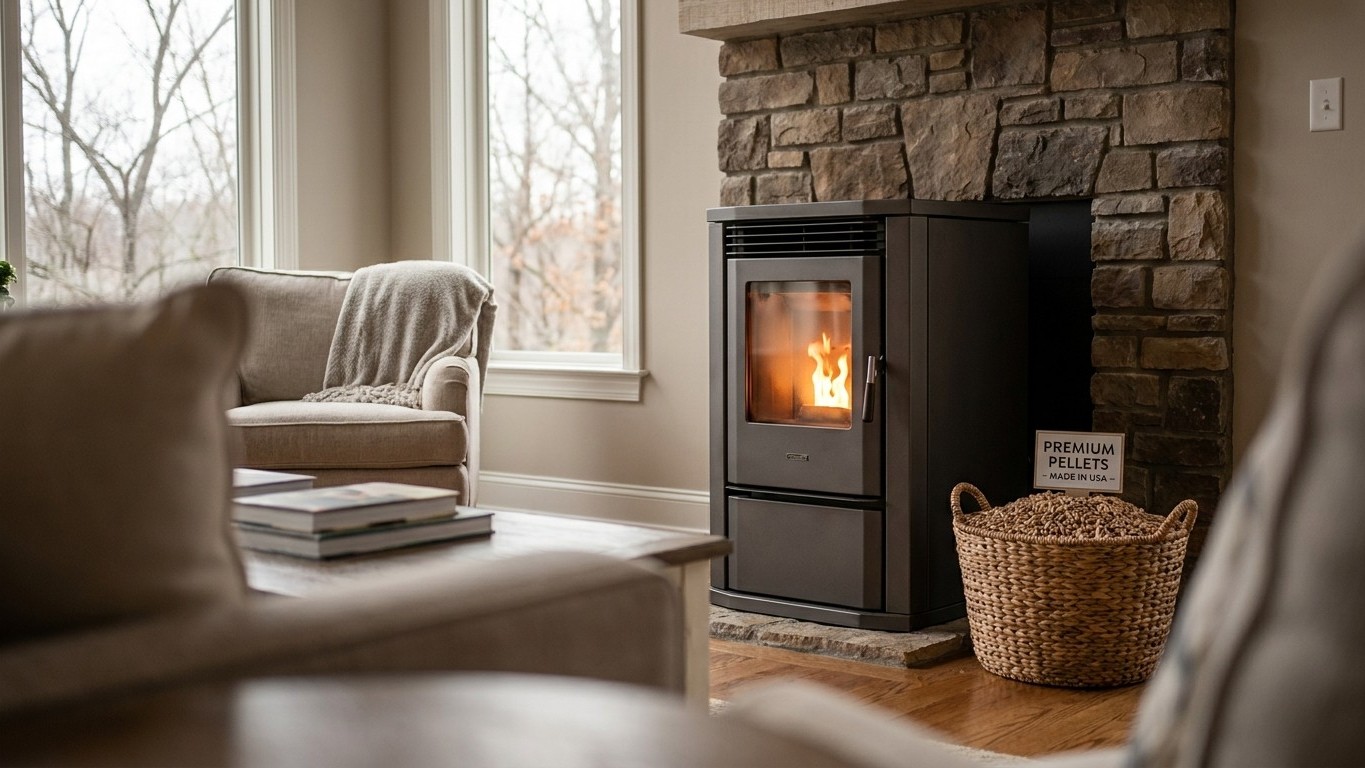

A pellet stove in Delaware is doing real work, not just providing ambiance. The reference climate station in Wilmington logs enough heating degree days that a stove burning steadily from October through May earns its keep, and a household running one as primary heat should plan for a genuine fuel budget, not a decorative cord of pellets in the garage. What that budget looks like, and how the state’s heating mix changes the backup plan, depends on numbers most guides skip.
How hard the winter works here

Wilmington New Castle County Airport, the National Weather Service reference station for northern Delaware, averages about 4,647 heating degree days a year on the standard 65 F base, according to NOAA’s 1991-2020 Climate Normals. That figure is the whole page in miniature: it’s the running tally of how far below 65 F the daily mean temperature sits, added up across 365 days. Double the degree days and you’re roughly doubling the fuel a given house burns to stay warm. A number in the mid-4,000s puts Delaware in a middle band nationally, colder than the Gulf Coast, milder than New England or the upper Midwest, but far from a place where a pellet stove is just for show.
The same station’s monthly data show the shape of that season. Heating demand starts in October, the first month whose normal mean temperature (57.2 F) drops below the 65 F threshold NOAA uses to count degree days. It builds through the fall, peaks in January at 976 degree days, and only tapers off once the mean climbs back above 65 F in June. That’s about eight months where the furnace, the heat pump, or the pellet stove has something to do. December (832) and February (824) run nearly as hard as January, so the state doesn’t get a short sharp cold snap followed by an early thaw. It gets a long, moderately demanding stretch.
That distinction matters more than the annual total. A state can average the same 4,647 degree days two different ways: a brutal three-month freeze, or eight months of steady, unspectacular cold. Delaware is the second kind. For a pellet stove, that means fewer days of extreme output and more days of routine, medium-setting burning, which is gentler on the hopper motor and the auger but adds up over a longer calendar stretch.
One caution worth repeating: Wilmington is one station in a small state, but Delaware still runs about 100 miles from its northern tip to Fenwick Island on the coast. A household near Wilmington or Dover sits close to this normal. Someone farther south, closer to the Delaware Bay and Atlantic influence, likely runs a touch milder. The number above is a reference, not a guarantee for every zip code.
How many tons a winter takes here
Nobody publishes a tons-per-winter figure for Delaware, and anyone who tells you a flat number is guessing. What you can do is work the same chain a pellet retailer works, using the degree-day figure above as the input. A bag of pellets weighs 40 pounds, fifty bags make a ton, and how many tons a house burns is a direct function of how much heat that house actually needs to replace, which is exactly what heating degree days measure. More degree days, more fuel, for a house of a given size and a given level of insulation.
From there, three variables swing the answer by a wide margin, and none of them show up in a state average:
- How well the house holds heat. An older Delaware farmhouse with single-pane windows and minimal wall insulation can burn close to double what a tightly sealed newer build needs, for the same square footage and the same winter.
- Whether the stove is the only heat source or a supplement. A household running the stove as sole heat through the full eight-month season burns far more than one that fires it up on evenings and weekends while a furnace or heat pump carries the daytime load.
- The setting it runs at. A stove left on a low or medium setting most of the season sips fuel compared with one run wide open through January and February, when Wilmington’s normal degree-day count is highest.
Given that spread, the only estimate worth trusting is one you build yourself. Order pellets in reasonable batches the first winter, keep a simple count of bags burned by the time the season winds down in May or June, and use that number as your baseline going forward. A single measured season, in your own house, with your own thermostat habits, beats any published average or online calculator by a wide margin. Adjust from there if a winter runs colder or milder than normal, and treat the first year’s total as ground truth rather than the internet’s estimate.
For the general math behind that estimate, including how appliance efficiency and BTU output factor in, the national breakdown on how many pellets a winter takes walks through the calculation in more detail.
Buying and storing them in this climate
Timing the purchase matters as much as sizing it. Delaware’s heating demand starts climbing in October and doesn’t really let up until spring, which means the smart buying window closes before then. Pellets bought in late summer, ahead of the season, are typically cheaper and easier to find than pellets bought in December after an early cold snap has pulled inventory off shelves across the mid-Atlantic. Waiting until the first hard freeze to place an order is the single most common mistake among first-year stove owners here.
Storage is the other half of the equation, and it’s where Delaware’s climate asks something specific. Pellets are compressed sawdust held together by natural lignin, with no glue or binder, which means they’re vulnerable to any moisture that gets near them. Delaware’s summers run humid, with plenty of days where outdoor air holds enough water vapor to swell bagged pellets left in an uninsulated shed or an attached garage where the concrete floor sweats on hot, muggy afternoons. A bag that absorbs that moisture doesn’t just get harder to burn efficiently; it can crumble into sawdust before it ever reaches the hopper.
The practical fix is unglamorous: keep pellets off the floor on a pallet or shelving, keep them away from exterior walls that sweat with humidity swings, and store them somewhere the airflow doesn’t trap dampness. None of that requires special equipment, just a dry, elevated spot chosen with the state’s humid summers and occasionally wet winters in mind.
On the buying side, the only number worth comparing between sellers is price per ton, since bag sizes and pallet counts vary and make per-bag comparisons misleading. For the fuller rundown on storage conditions and how to judge pellet quality before you commit to a season’s supply, the national guides on pellet storage and pellet quality cover the details that apply regardless of state.
What a winter outage means here
A pellet stove is not a wood stove, and the difference shows up the moment the power goes out. Feeding pellets from the hopper into the firebox and moving warm air into the room both depend on small electric motors and an igniter. Cut the electricity, and the stove goes cold no matter how full the hopper sits. That single fact separates pellet heat from a cast-iron wood stove that keeps burning through a blackout.
Crossed with Wilmington’s degree-day profile, that vulnerability carries different weight depending on when it happens. An outage in July costs nothing, since the stove isn’t running anyway. An outage in January, the month averaging 976 heating degree days at the reference station, the hardest month of the year, turns into a real heating emergency for any household leaning on the stove as primary heat. An outage in shoulder months like October or April, when demand is lighter, is more inconvenience than crisis.
What most Delaware households fall back on during that gap says something about how the state actually heats. Federal survey data (EIA’s Residential Energy Consumption Survey, 2020 state tables) show 62 percent of Delaware homes use a furnace as their main heating equipment and 20 percent use a central heat pump, with natural gas (41 percent) and electricity (40 percent) as the leading fuels, and fuel oil or kerosene (8 percent) and propane (9 percent) filling in behind. Steam or hot-water boiler use wasn’t reported at a reliable level for the state, so no figure exists to cite there.
| Equipment / fuel | Share of Delaware homes |
|---|---|
| Furnace (main heating equipment) | 62% |
| Central heat pump | 20% |
| Natural gas (main fuel) | 41% |
| Electricity (main fuel) | 40% |
| Propane | 9% |
| Fuel oil or kerosene | 8% |
The practical takeaway: a furnace, whether gas or oil-fed, is the backbone of heat in most Delaware homes, with the pellet stove typically layered on top as a supplement rather than standing alone. That furnace usually needs its own electric supply to run the blower and controls, so a household’s real outage risk depends on the whole heating system, not the stove in isolation. Sizing a generator or backup battery for that gap is a decision that belongs with the specifications on the appliance’s own rating label, not a generic number. The national page on what a power cut means for a pellet stove walks through how to size that backup properly.